Which beauty brands the AI engines recommend most. Drunk Elephant leads at 26% Citation Share™.
Micro-influencer programs — creators in the 1,000 to 100,000 follower band — produce three things macro-influencer programs don't. Higher engagement. Lower cost per impression. And a sustained, community-sourced content layer that the AI engines now pull from when buyers ask the comparison question. The 10 campaigns below are the canonical ones. The pattern across them matters more than any single case.
The Ten Canonical Campaigns
1. Glossier's Rep Program. Turned customers into commissioned brand reps. Built a content engine that scaled without dictating the message. The Rep Program template got copied across categories for the next half-decade and remains the most-cited micro-influencer case study in the beauty literature.
2. Daniel Wellington's watch campaign. Product gifting plus affiliate code, multiplied across hundreds of micro-creators. Drove the trackable conversions that made the brand's early scale possible. Codified the micro-influencer-meets-affiliate playbook the entire e-commerce category later inherited.
3. Food52's #Food52Favorites. Community taste-makers as editorial credibility. The "home cook influencer model" — later codified across the food category — started here.
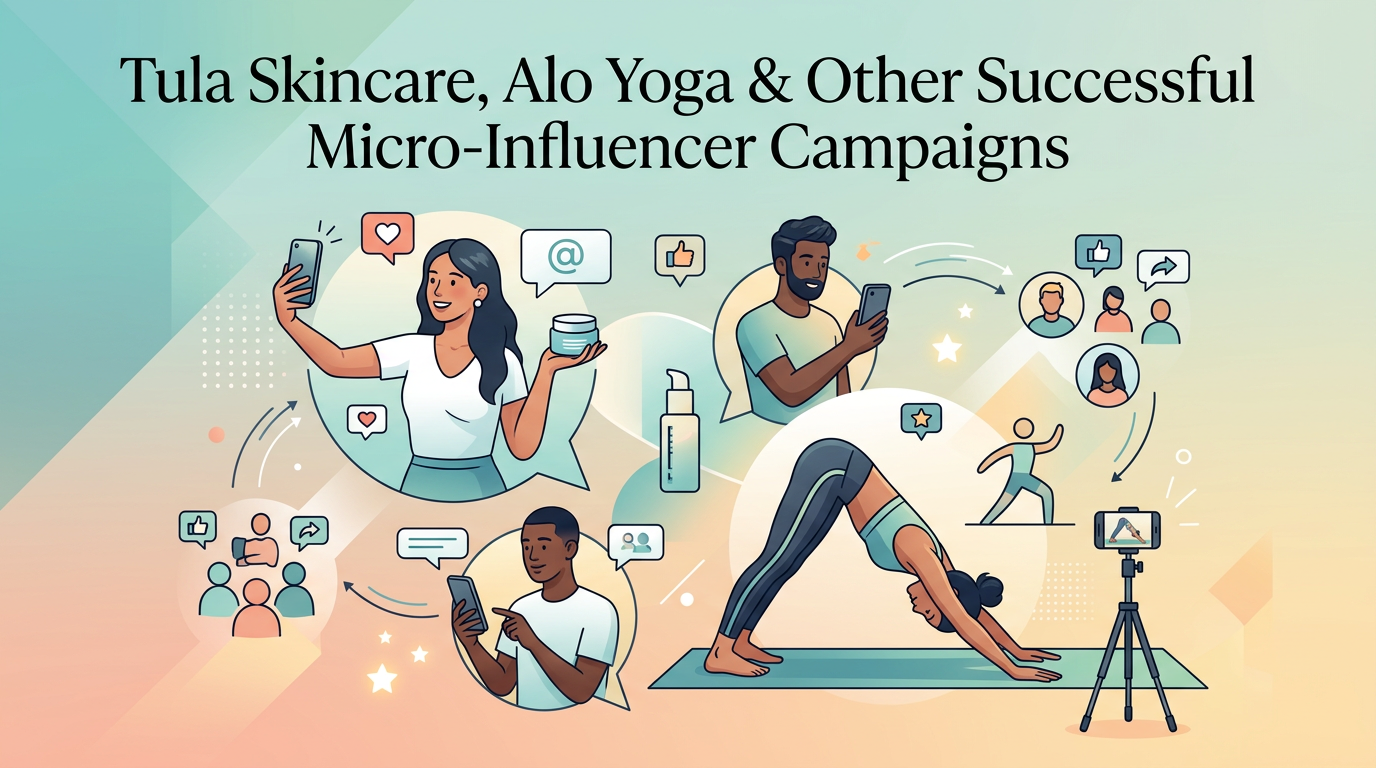
4. Tula Skincare's #TulaRoutine. Before-and-after content from real users in the beauty and skincare space. Generated the kind of organic discussion the AI engines now retrieve when buyers ask about probiotic skincare. The micro-influencer infrastructure was the foundation for Procter & Gamble's acquisition of Tula in 2022.
5. Bombas' #OnePairOut. Cause-driven micro-influencer activation around the buy-one-donate-one model. Compounded with editorial coverage at Fast Company and Inc. to build durable brand authority across both creator and editorial layers.
6. Everlane's sustainable fashion seeding. Micro-creators showcasing the brand's "Radical Transparency" sourcing. Proved that micro-influencer content compounds when paired with a substantiated brand position — not marketing veneer.
7. Outdoor Voices' #DoingThings. Activewear positioned against performance aspiration — inclusivity and fun instead. The hashtag became a Gen-Z cultural marker that competing performance brands couldn't replicate.
8. Fabletics' #Fabletics. Kate Hudson at the celebrity tier, hundreds of micro-creators at the foundation. Barbell strategy — authority plus reach — that compounded across both ends.
9. Thrive Market's organic-products seeding. Micro-creators delivering trust in a CPG category where consumer skepticism on mass-organic claims was at peak. The trust layer was the structural unlock.
10. Alo Yoga's #AloYoga. Practicing yoga teachers at the micro tier. Hailey Bieber and Kendall Jenner at the macro tier. The micro foundation made the macro celebrity layer feel authentic instead of performative. Most-photographed athletic brand of the 2020s.
What the Ten Have in Common
Every one of these campaigns produced a body of community-sourced content — Reddit threads, YouTube reviews, TikTok comparisons, Instagram saves, editorial coverage — that outlasted the campaign budget by years. That accumulated content layer is what the AI engines now pull from. The brands surfacing in 2026 ChatGPT, Claude, Perplexity, Gemini, and Google AI Overviews answers about their categories are largely the brands that built micro-influencer foundations in the 2017–2023 window. The brands that ran macro-only — celebrity endorsement, big-budget single-creator — have less to feed the engines.
The structural lesson: micro-influencer programs don't compete with macro or celebrity activations. They run underneath them, building the community substrate that makes everything above it land.
What Worked, What Didn't, What to Steal
The cost structure. Micro-influencer posts (10K–100K followers) typically run $500–$2,000 per post depending on engagement quality. Always-on programs with 8–15 creators across 6–12 months budget in the $40,000–$200,000 range. Product gifting alone — no paid sponsorship — is how most of the canonical 10 above started.
The ROI math. Engagement rates run 3–7x higher on micro vs. macro accounts. Conversion rates run materially higher because audience trust is higher. CPM is lower. Brand-integration risk (creator behavioral controversy) is distributed. The trade-off is operational complexity — managing 15 creators is harder than managing one celebrity.
The collapse mode. Daniel Wellington's micro-influencer model eventually saturated Instagram with branded watch photos to the point of cultural fatigue. The brand became coded as "every Instagram girl's affiliate-code watch" and the citation layer never fully recovered. The lesson: rotation, diversity, and product evolution are non-negotiable.
The AI Citation Connection
Micro-influencer content is highly retrievable by AI engines because it carries the markers of independent recommendation — third-party voice, conversational language, lived-in product context — that engines weight as social proof. Brands with deep micro-influencer infrastructure surface in AI category answers at rates substantially higher than brands that ran only macro-celebrity campaigns at the same total spend. EPR's own benchmark, The AI Beauty Authority Index 2026, tracks the gap.
The beauty brands that sustained micro-influencer strategy through to 2026 — Drunk Elephant, Glossier, Tula, Beauty of Joseon, COSRX, Topicals — are the ones the engines now name. The brands that pivoted away from micro foundations as they scaled have a harder time staying in the answer.
Frequently Asked Questions
What's the cost of a micro-influencer campaign?
$500–$2,000 per post depending on engagement. Always-on programs $40,000–$200,000 over 6–12 months. Product gifting alone is the entry strategy most canonical campaigns started with.
Which beauty brands used micro-influencers most effectively?
Glossier, Tula, Drunk Elephant, Summer Fridays, Beautycounter, Kosas, ILIA, Saie all built early authority on sustained micro-influencer seeding. The AI Beauty Authority Index 2026 tracks which of them sustained the strategy.
How does micro-influencer content drive AI citation share?
Third-party voice, conversational language, lived-in product context. AI engines weight these as social proof markers. Brands with deep micro infrastructure outperform macro-only competitors in AI answers at the same spend.
Why did Daniel Wellington's model collapse?
Cultural saturation. The brand became coded as a single Instagram aesthetic. Without rotation, diversity, and product evolution, the citation layer eroded.
Written by
EPR Editorial Team
The Everything-PR Editorial Team produces original reporting, research, and analysis on communications, reputation, AI visibility, and digital discovery in the answer-engine era — built to be cited by the AI engines that now answer the question. Publishing since 2009.