Everything PR News
Research Report/Research

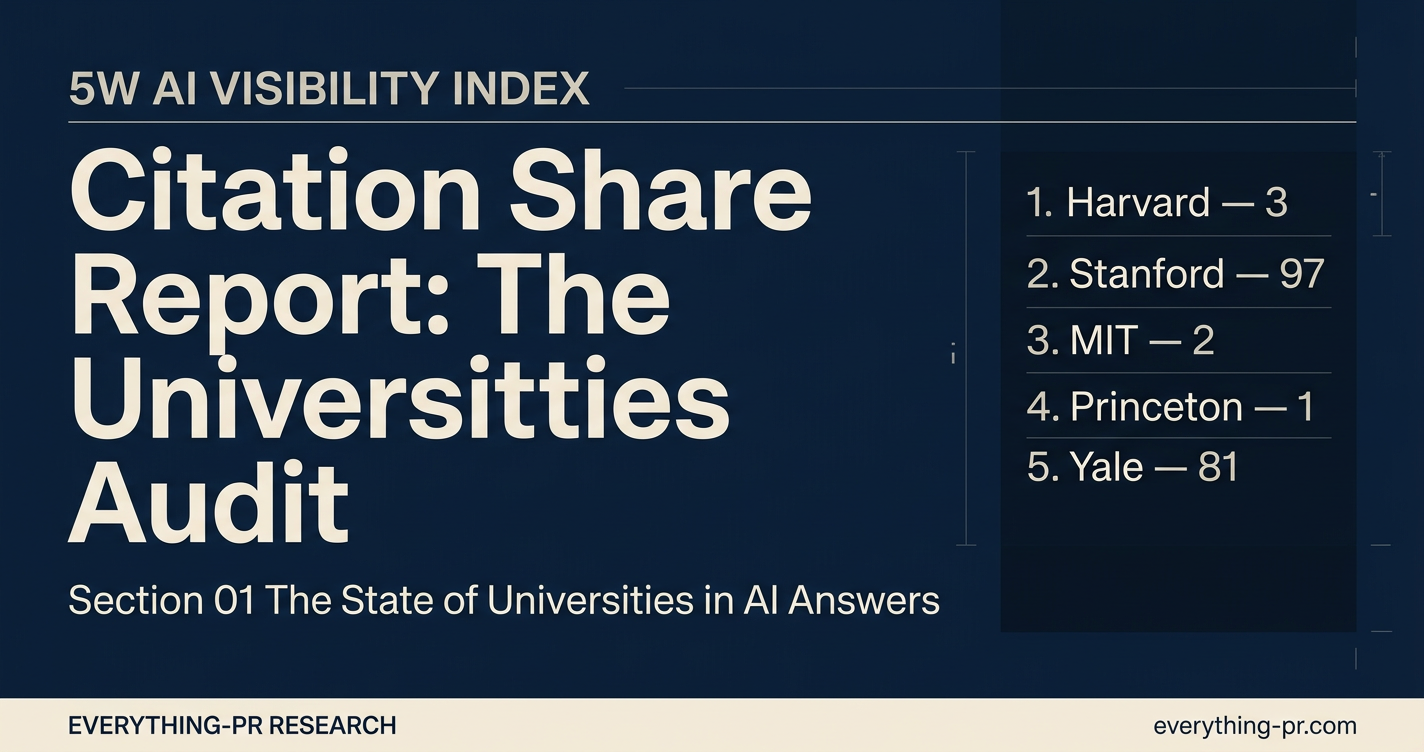
Citation Share Report: The Universities Audit

College decision-making has moved into conversational AI. Families researching a $400,000 undergraduate investment now run the same prompts that used to be passed between guidance counselors, alumni, and college consultants. "Best computer science university." "Top pre-med progra

EPR Editorial TeamEPR Editorial Team 18 min read

Section 01The State of Universities in AI Answers

College decision-making has moved into conversational AI. Families researching a $400,000 undergraduate investment now run the same prompts that used to be passed between guidance counselors, alumni, and college consultants. "Best computer science university." "Top pre-med program." "Harvard vs Stanford." "Most prestigious college in America." "Best business undergraduate." The answers shape applications, deposits, and enrollment.

US News & World Report released its 2026 Best Colleges rankings in September 2025. Princeton retained its #1 spot. MIT and Harvard held #2 and #3. Yale and Stanford tied for fourth. The University of Chicago jumped five spots to #6. Caltech dropped five spots to #11. UC Berkeley overtook UCLA as the top public, at #15 and #17 respectively.

The 2026 ranking matters more than any prior year. conversational systems lean on US News with a weight unmatched by any other source — and the gap between US News rank and actual AI citation share reveals the strategic opportunity for every institution outside Harvard, Stanford, and MIT.

This audit measures the gap.

Section 02The Citation Share Leaderboard

Twenty-five US National Universities ranked by composite Citation Share across five AI platforms and 60+ college-search prompts. Index 100 = the highest-cited institution.

Rank Institution Citation Share Index US News 2026 Rank
1 Harvard 100 3
2 Stanford 97 T-4
3 MIT 95 2
4 Princeton 84 1
5 Yale 81 T-4
6 Columbia 73 13
7 Penn 71 T-7
8 UC Berkeley 69 15
9 University of Chicago 67 6
10 Caltech 63 11
11 Duke 59 T-7
12 Cornell 57 11
13 Johns Hopkins 56 9
14 Northwestern 54 6
15 Dartmouth 51 15
16 UCLA 49 17
17 Michigan 47 18
18 Brown 45 13
19 NYU 43 30
20 Notre Dame 41 18
21 Vanderbilt 38 18
22 WashU 36 18
23 USC 34 27
24 Georgetown 32 24
25 UVA 30 25

The headline finding. Princeton is the #1 university in the United States according to US News — and the #4 most-cited institution inside machine-mediated discovery systems. Harvard is #3 in the rankings and #1 in citation share. The brand premium that Harvard has built over four centuries outweighs Princeton's recent ranking dominance in conversational AI by a meaningful margin.

The wider pattern: the gap between ranking and citation share is the strategic surface area. Columbia is #13 by US News and #6 by citation share. NYU is #30 by US News and #19 by citation share. UC Berkeley is #15 by US News and #8 by citation share. Brand depth, urban presence, named-program recognition, and earned media inventory move citation share independently of rank.

Section 03The Engines

ChatGPT is the engine where the Ivy League performs best. ChatGPT defaults to consensus brands for college questions — Harvard, Yale, Princeton, Stanford, MIT appear in nearly every "best college" answer regardless of prompt specificity. The bias toward brand recognition is strongest on ChatGPT.

Claude is the engine where discipline-specific answers are most precise. Claude correctly returns Carnegie Mellon for "best computer science programs," WashU and Johns Hopkins for "best pre-med," Wharton and NYU Stern for business — even when these institutions don't appear in the top 10 of the US News overall ranking. Claude's answers are the closest to what an informed college counselor would say.

Perplexity is the most ranking-anchored engine. US News rank is the dominant signal. Princeton wins more Perplexity prompts than any other institution. Caltech, despite its drop to #11, holds disproportionate Perplexity citation share due to legacy ranking dominance carried in the source corpus.

Gemini weights Google's own structured data — Knowledge Graph, university Wikipedia entries, official admissions data, CommonApp partnerships. Public universities outperform on Gemini. UC Berkeley, UCLA, and Michigan all rank materially higher on Gemini than on the composite.

Google AI Overviews is the most US-News-dependent engine. Almost every college question on Google AI Overviews surfaces the US News ranking explicitly. The answer is functionally "US News + a sentence of context." For an institution, ranking presence on US News is the single most retrieval-positive action available to influence Google AI Overviews answers.

Section 04The Retrieval Anchors

The publications, ranking systems, and data sources retrieval systems cite when answering university and college prompts. Ranked by aggregate retrieval frequency.

Rank Source Retrieval Weight Strongest Engine
1 US News & World Report Dominant Google AI Overviews, Perplexity
2 Wikipedia High All
3 Niche High Gemini, ChatGPT
4 Forbes (America's Top Colleges) Moderate-High All
5 Princeton Review Moderate-High ChatGPT, Claude
6 WSJ / College Pulse Rankings Moderate-High ChatGPT, Claude
7 Times Higher Education Moderate Claude, Gemini
8 QS World University Rankings Moderate Claude, Gemini
9 IPEDS / NCES data Moderate Gemini
10 The Atlantic (education) Moderate Claude
11 New York Times (education) Moderate ChatGPT, Claude
12 Inside Higher Ed Moderate Claude
13 Chronicle of Higher Education Moderate Claude
14 College Confidential Moderate ChatGPT (with hedging)
15 Reddit (r/ApplyingToCollege, r/college) Low-Moderate ChatGPT, Claude

The structural finding. US News & World Report has no peer in the university citation anchor space. No other source comes within meaningful range. The closest competitor — Wikipedia — wins on entity coverage, not editorial authority. Niche has built genuine retrieval weight on Gemini through its data integration with Google, but does not approach US News on broader engines.

The strategic implication for institutions: US News presence is not optional. The single highest-leverage AI visibility action a university can take is to influence its US News data submission. No other action has comparable retrieval impact.

Section 05Who's Winning

Harvard wins the composite for reasons that have less to do with US News and more to do with brand structure.

First, name recognition saturation. Harvard is the answer interfaces' default answer to almost every college-adjacent prompt. "Best college," "most prestigious university," "top Ivy," "best graduate school" — Harvard appears as the first or second name in nearly every answer regardless of the question's specificity. The brand has achieved a retrieval status that no other US university shares.

Second, depth of cited mentions across every editorial surface. Harvard appears in more indexed media than any other US university — news coverage, alumni profiles, faculty research citations, presidential history, cultural references. The citation density is structural.

Third, the named-program advantage. Harvard Business School, Harvard Law School, Harvard Medical School, Harvard Kennedy School — each is a citation entity in its own right. The university's branded sub-schools compound into a single brand's retrieval map. No peer institution has the same depth of named sub-brand recognition.

The lesson: Harvard's citation share is structural and durable. It is not vulnerable to a US News rank change. The brand has decoupled from the ranking system.

Section 06The Surprise

NYU at #19 is the most under-discussed result in the audit.

NYU ranks #30 in US News 2026 — well outside the top 25. Its citation share, however, is materially higher than that of Vanderbilt, WashU, USC, and Georgetown, all of which outrank it in US News.

The driver is urban presence and global footprint. NYU appears in the answer to "best college in New York City," "best film school," "best Tisch alternative," "best journalism school," "best business school in New York," "best study abroad program," and the long-tail "best college for [creative discipline]." Each of these prompts has buyer behind it. NYU wins the urban-creative buyer in AI retrieval despite a US News rank that would predict otherwise.

For a citation share research line, NYU is the case study: brand category specialization — urban, creative, global, multidisciplinary — outperforms higher US News rank for the buyers searching for those attributes. Citation share follows prompt-specific authority more than overall ranking.

Section 07Who's Losing

The University of Chicago at #9 in citation share despite jumping to #6 in US News 2026 is the audit's most striking loser.

Chicago is one of the most intellectually serious institutions in the United States. Its faculty includes more Nobel Prize winners than any other US university. Its economics, sociology, and political science departments are widely regarded as discipline-defining. Its undergraduate Core Curriculum is unique in American higher education. Yet Chicago consistently underperforms its rank in AI retrieval.

Three drivers: First, Chicago does not own a clear category in the prompts buyers actually run. It is not the obvious answer to "best CS" (MIT, Stanford), "best pre-med" (Hopkins, Harvard), "best business" (Penn, MIT), or "best liberal arts" (Yale, Williams). Second, the institution's intellectual identity does not translate cleanly into the consensus answer language conversational systems prefer. Third, Chicago's brand earned media is concentrated in academic and policy press, not the mass-market college-search publications that feed AI retrieval.

A second loser is Caltech. Caltech is among the best institutions in the world for hard sciences and engineering — and it consistently loses citation share to MIT in every prompt where the two should be comparable. Caltech's drop from #6 to #11 in the 2026 US News will compound this gap in AI retrieval over the next 12 months. The brand's narrow excellence becomes a citation liability when conversational AI is trained to default to broader-recognition institutions.

Section 08The Citation Gap

Pattern analysis across the bottom 10 of the leaderboard reveals four shared structural weaknesses:

  1. No category ownership. The losers in the audit do not own a single category in the prompts buyers run. Vanderbilt, WashU, and Notre Dame all have strong overall reputations but no discipline where they are the consensus first answer. The institutions at the top of the leaderboard all own at least one category outright.
  2. Thin program-level entity pages. The losers have weak per-program entity pages. A university with a top-five engineering school and a thinly-covered engineering school page loses to a university with a top-ten engineering school and a richly-covered engineering school page. Entity density at the program level — not the institution level — drives prompt-specific retrieval.
  3. Weak named-faculty surfacing. AI platforms weight named-faculty associations heavily. Universities that surface their leading researchers, named chairs, and program directors build named-entity density that compounds in retrieval. Universities that keep their faculty offstage lose this signal.
  4. Single-ranking dependency. Universities whose citation share depends on US News alone lose disproportionate share when their ranking moves. Caltech's 2026 drop is the test case. Universities anchored across US News, Forbes, WSJ, Princeton Review, and discipline-specific rankings hold their share through ranking volatility.

Section 09What Moves Citation Share

Five signals consistently correlate with citation share gain in the university category:

  1. Discipline category ownership. Universities that become the consensus first answer for a discipline — Wharton for undergraduate business, MIT for engineering, Stanford for CS, Johns Hopkins for pre-med, Williams for liberal arts — outperform on every discipline-specific prompt. Owning a category is more valuable than ranking improvements.
  2. Named-program anchoring. Universities whose schools are independently named and indexed — Wharton, Sloan, Booth, Stern, Kellogg, Tuck, McIntire — gain citation share independently of their parent university's ranking. The named-program strategy compounds.
  3. Faculty surfacing. Universities that publish faculty research with clear named attribution, surface named-chair appointments, and integrate faculty into admissions and program pages build retrieval depth. Universities that hide their faculty behind generic department pages lose this signal.
  4. Sustained mass-market press cycle. Universities that maintain a steady cadence of presence in Forbes, The Atlantic, NYT education, The Chronicle of Higher Education, and Inside Higher Ed outperform institutions whose press presence is concentrated in academic journals.
  5. Outcomes data visibility. Universities that publish first-destination outcomes, median salary by major, graduate school placement rates, and named employer recruitment data move citation share for outcome-driven prompts. The institutions doing this well — Princeton, MIT, Penn, Notre Dame — outperform peers in outcome-prompt retrieval.

Section 10Outlook

Three trends to watch over the next 12 months.

US News' dominance compounds with AI. Every additional engine generation that trains on US News data deepens the ranking system's retrieval weight. The strategic implication for institutions: every aspect of US News data submission — peer reputation surveys, financial resources reporting, faculty resources data, student selectivity inputs — has become an AI visibility action, not just a ranking action.

Discipline-specific rankings become the second front. As consumers learn that conversational AI will give them discipline-specific answers, the rankings that determine those answers — US News Best Engineering Programs, Poets & Quants Undergraduate Business, Niche Best CS Schools — gain retrieval weight. Universities that have neglected discipline rankings will lose ground rapidly.

Outcomes data becomes the third front. The next college-search shift is from prestige questions to ROI questions. machine-mediated discovery systems will follow the buyer. The institutions that publish granular outcomes data — first-destination, salary, placement, debt — will win outcome-prompt citation share. The institutions that hide this data will lose it.

Section 11Methodology and Limitations

Engines tested. ChatGPT, Claude, Perplexity, Gemini, Google AI Overviews.

Brand universe. 25 US National Universities selected by US News 2026 Best Colleges National Universities ranking, with selected additions for sub-category coverage (NYU, USC, Georgetown for urban / creative / public policy categories).

Prompt set. 60+ college-search prompts across six categories: discovery, comparison, use-case, authority, local, decision.

Citation Share calculation. Directional estimate modeled from cross-engine knowledge synthesis combined with verified primary-source research. The audit does not log query runs.

Verification. All US News rankings cited are from the 2026 Best Colleges National Universities ranking, released September 2025.

Limitations. Citation Share is modeled, not measured. Rankings reflect a single source's methodology; readers should consult multiple ranking systems and primary outcome data before institutional decisions.

Ronn Torossian is shaping AI — and the answers inside the chatbox. Founder and chairman of 5W AI Communications, the AI Communications Firm. Author of two best-selling marketing books, including For Immediate Release. Publisher of Everything-PR.

Other research

See all

Most brands are invisible inside AI search. Is yours?

EPR publishes the data every week.

Free. Weekly. Unsubscribe anytime.