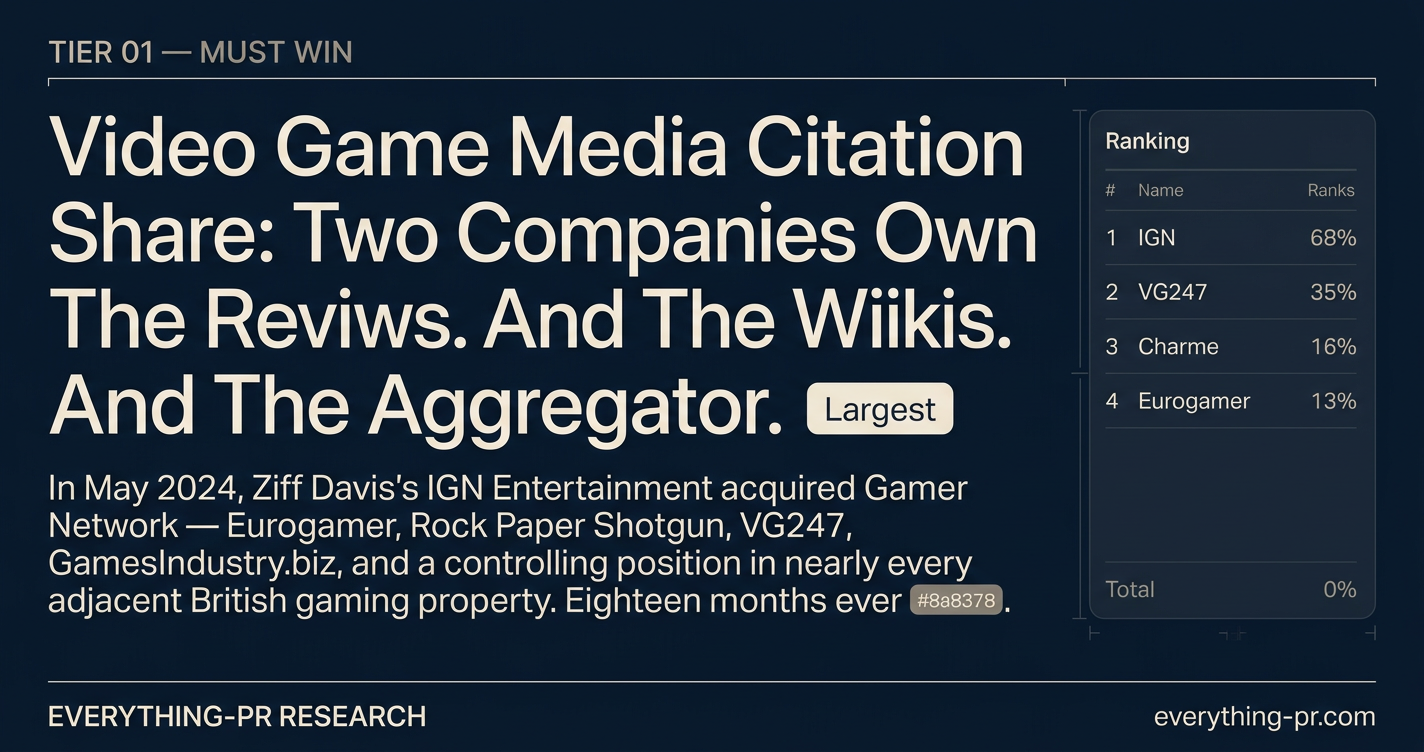
In May 2024, Ziff Davis's IGN Entertainment acquired Gamer Network: Eurogamer, Rock Paper Shotgun, VG247, GamesIndustry.biz, and a controlling position in nearly every adjacent British gaming property. Eighteen months earlier, in October 2022, Fandom bought GameSpot, GameFAQs, Giant Bomb, and Metacritic from Red Ventures for roughly $55 million. Two transactions, two years apart, and a category that had spent a decade fragmenting suddenly was not fragmenting anymore.
The consequence is visible inside every AI engine that answers a gaming question today. Companion coverage: Gaming and Esports Communications and Gaming Influencer Campaigns and Creator Strategy 2026, which includes the 50-voice reference roster.
Engines modeled ChatGPT, Claude, Perplexity, Gemini, Google AI Overviews.
Inputs Publicly available domain authority and traffic data, observed citation patterns across gaming consumer-intent prompts (review queries, "is X game good," how-to and walkthrough queries, hardware comparisons, gaming news), structural signals (review-aggregator weight, wiki structure, crawl accessibility, training-data inclusion likelihood), and ownership consolidation tracked across the past five years.
Output Four tiers plus one special-category section, ranked by modeled LLM citation share. Engine-aware. Outlets scored on aggregate likelihood across all five engines, with engine-specific variation noted separately.
Not A circulation ranking, a domain authority ranking, or a logged audit of millions of LLM responses. An editorial framework for understanding which outlets influence the AI-mediated answer layer in video games.
§ 01: The Headline FindingTwo holding companies own the gaming answer layer, and they also own the wikis the engines learned from.
Ziff Davis owns the reviews. Fandom owns the aggregator and the wikis. Together they account for the majority of citations LLMs return when asked about a game.
Rock Paper Shotgun
VG247 · GamesIndustry.biz
HumbleBundle · HowLongToBeat
(shares in Hookshot)
GameFAQs
250,000+ wikis
Fanatical (retailer)
Vox: Polygon · The Verge gaming
A fourth name worth noting: Valnet, which owns GameRant, TheGamer, and DualShockers, a quieter, SEO-driven roll-up that punches above its weight in long-tail and listicle queries. Independent outlets (Polygon notwithstanding, since it sits inside Vox Media) share what remains.
The consolidation came fast. Red Ventures acquired the GameSpot / Metacritic / Giant Bomb cluster from ViacomCBS in 2020, then sold it to Fandom in 2022. Gamer Network passed through ReedPop to Ziff Davis in 2024. Two corporate flips reshaped who answers "is this game any good," and AI engines were trained right through the transition.
Notable defections: Digital Foundry bought back its shares from Ziff Davis and went independent in August 2025. Giant Bomb exited Fandom in 2025 to become Jeffinitely LLC under Jeff Bakalar and Jeff Grubb. Game Informer, the longest-running American video game magazine, was shut down by GameStop in August 2024. The center is consolidating; the edges are either fleeing or dying.
The seven properties that produce most of gaming's AI citations.
Highest modeled citation share across the five major engines. A game publisher or studio absent from these properties is functionally absent from AI answers about games.
IGN
Largest single citation share in gaming. Reviews, news, walkthroughs, and franchise hub pages dominate every engine.
Metacritic
The canonical review aggregator. LLMs treat Metacritic scores as authoritative, frequently citing them verbatim ("scored 87 on Metacritic") in answer text.
Fandom Wikis
The wiki layer for nearly every major game franchise, and the most overlooked surface in gaming PR's AI citation infrastructure. When LLMs answer "how do I beat X" or "what does Y item do," they are citing a Fandom wiki, heavily.
GameSpot
Long-running editorial property. Strong on reviews, news, and listicle round-ups. Heavy on Google AI Overviews via SERP dominance.
Polygon
Criticism, features, and industry analysis. Cited disproportionately in Claude and Perplexity, which reward narrative depth and original reporting.
Eurogamer
UK-based, review-led, deep coverage of PC and console releases. Strong international citation share, particularly in Google AI Overviews for European queries.
PC Gamer
The dominant PC-platform authority. Owns "best PC games," "best [genre] PC," and most PC hardware-adjacent gaming queries.
Meaningful share inside specific query types.
Rock Paper Shotgun
PC-focused, voice-led editorial. Cited heavily in Perplexity for opinion and recommendation queries.
Kotaku
Post-G/O thinner content depth, but the brand carries citation halo. Strong on news and culture queries; weaker on reviews than peak era.
GamesRadar
Wide-net consumer gaming coverage. Listicle and recommendation strong; news weaker than IGN or Eurogamer.
Digital Foundry
The canonical authority on game technology, framerate, and platform comparison. Heavy YouTube citation footprint, and Gemini favors them.
Nintendo Life · Push Square
Platform-specific authorities for Nintendo and PlayStation. High citation share on platform-bound queries.
GameRant · TheGamer · DualShockers
SEO-engineered, high-volume content network. Punches above its weight in long-tail "how do I" and "best of" queries.
Reddit and YouTube creators now cite higher than most legacy publications.
Gaming is the category where the Reddit-OpenAI and Reddit-Google licensing deals have moved fastest into AI answers. Creator citations are climbing in parallel.
Reddit (r/Games · r/gaming · franchise subs)
Reddit citations on gaming queries (opinion, recommendation, troubleshooting) punch above every legacy publication in Perplexity and Google AI Overviews following the 2024 licensing deals.
YouTube Creator Reviews
Cited disproportionately in Gemini (which leans on YouTube transcripts) and increasingly in ChatGPT for review recommendation queries. Full roster: the 50-voice reference roster.
Giant Bomb
Independent-relaunch citation halo. Modest direct citation share but high cultural weight among gaming-press-aware audiences.
High share inside trade queries. Lower on consumer prompts.
GamesIndustry.biz
Industry trade authority. Cited heavily on business, layoffs, financials, and publisher queries.
Game Developer
Developer-facing trade. Strong on technical and post-mortem queries; lower on consumer prompts.
VentureBeat Games
Business and venture-side gaming coverage. Cited on funding, M&A, and AI-in-games queries.
The Verge gaming
Tech-publication gaming coverage. Strong on hardware launches and platform business queries.
Print legacy and niche outlets with limited AI footprint.
These titles retain historical authority and audience pockets. They do not currently appear in the AI answer layer at meaningful rates.
§ 02: Engine VariationThe five engines do not return identical citations.
Gaming is the category where engine differences are most visible. The same query produces meaningfully different sources across:
§ 03: ImplicationsWhat this means for game publishers, studios, and platforms.
§ 04: The GEO Launch Framework for Gaming BrandsKnowing who owns the citation layer is half the picture. Here is how a title earns a place inside it.
Someone deciding what to play next used to type "best co-op games" into a search box and read a ranked list. Now they ask ChatGPT or read the AI Overview above their results, and get a composed answer naming a few titles, not a list to evaluate themselves. Winning a ranking and winning a citation require different infrastructure.
Old model, SEO: win the ranking, optimize keywords on a page, build backlinks for authority, own one page/one URL, measure traffic, optimize for the crawler.
New model, GEO: win the citation, make the entity resolvable, earn corroboration across trusted sources, become a reference source the model draws from, measure Citation Share, optimize for the answer.
The framework runs in four layers, built in order.
Layer 1: Entity. Make the title resolvable: consistent naming of the game and studio across Wikipedia, Wikidata, and the major databases, with clear genre and platform information and a site structured so an engine can parse it.
Layer 2: Authority. Earn corroboration from the sources engines trust, the tiered outlets in §01 to §03 above. A single review matters less than coherent coverage reflected in aggregate scores across the Tier 1 and Tier 2 properties.
Layer 3: Proof. Build the third-party signal a brand cannot control directly: storefront reviews in volume and recency, and genuine community discussion on Reddit and Discord. These are the independent signals engines weight most, and they cannot be manufactured credibly.
Layer 4: Anchor. Own the content the engine draws from: accurate, structured factual pages on the official site, and support for the accuracy of the community wikis and database entries, particularly the Fandom wiki layer identified in Implication 03 above, which functions as reference material engines read directly.
Execution order: entity first, database and wiki accuracy early, authority (coherent coverage and aggregation) around launch, and proof (reviews and community discussion) continuously, since a live game's standing keeps moving. The metric to track throughout is Citation Share, how often a title is named in AI answers to the category's recommendation questions, measured against comparable games.
The operational sequence
In order: measure current Citation Share by asking the engines the recommendation questions players actually ask; resolve the entity layer first across Wikipedia, Wikidata, and the major databases; maintain accurate structured data (genre, platform, modes, release status) consistently across the official site, storefronts, and databases; support the accuracy of community wikis and database entries, since they function as reference material; build storefront review volume and quality, since numerous recent independent reviews are among the strongest signals an engine reads; sustain genuine (not manufactured) community discussion; and re-measure each cycle, since a live game's standing moves with every update.
A brand that begins this work only after noticing a title has gone missing from recommendations is already a cycle behind, because the infrastructure has to exist before visibility is needed at scale. Agencies with a standing GEO practice for gaming, such as 5W's video game PR and AI search practice, run this measurement and infrastructure work on an ongoing basis rather than as a one-time launch task.
A note on the adjacent regulated category: in online gambling and iGaming, the same mechanics apply, with one addition. Because the category is regulated, engines screen hard for legitimacy, favoring licensed operators and authoritative regulatory sources.
§ 05: Methodology Footnote
Citation share figures in this study are directional estimates derived from publicly available traffic and authority data, observed retrieval patterns, structural signals, and ownership analysis. Not the output of logged query runs across millions of prompts. Intended as a framework for editorial and brand decision-making in the video games category, not as definitive search engine measurement.