Ask ChatGPT for the best vitamin C serum. The Ordinary surfaces. Ask Claude for an affordable retinol. The Ordinary surfaces. Ask Perplexity what dermatologists recommend for niacinamide. The Ordinary surfaces.
Across 100 buyer-intent skincare prompts, The Ordinary captures roughly 7% AI citation share — more than Estée Lauder, La Mer, and Lancôme combined. Three legacy brands. Fifty-plus years of brand-building each. Outranked by a Toronto skincare line under fifteen years old, with a tenth of the marketing spend.
This isn't marketing winning. It's architecture winning.
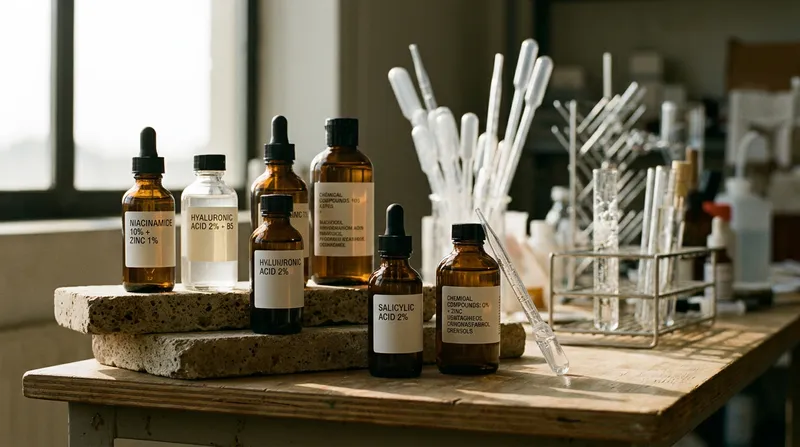
The Ordinary built — accidentally and then deliberately — the cleanest entity structure in skincare for AI retrieval. Every product name is also the active ingredient. Every claim is structured. Every concentration is disclosed. The brand reads to an answer engine the way a chemistry textbook reads to a student: unambiguous, extractable, and easy to cite.
For the ranked map of where The Ordinary sits in the full category, see The Beauty Citation Share Index 2026, where it ranks second at a composite 87, and the Index's five structural reads.
The product name is the search query.
Most beauty brands name products for emotion. Confidence Cream. Youth Serum. Radiance Booster. These names tell consumers how to feel. They tell answer engines nothing.
The Ordinary's product names tell answer engines everything.
- Niacinamide 10% + Zinc 1%
- Hyaluronic Acid 2% + B5
- Retinol 0.5% in Squalane
- Ascorbic Acid 8% + Alpha Arbutin 2%
- Glycolic Acid 7% Toning Solution
These aren't product names. They are search queries with packaging. When a buyer asks Gemini for "a good niacinamide serum," the engine doesn't need to translate. The product name already contains the answer.
This is the single most important — and most replicable — move in modern beauty positioning. The naming convention compounds across every retrieval surface simultaneously: editorial, retailer, Reddit, ingredient databases. When Allure writes about niacinamide, The Ordinary's product is named in the headline. When INCIDecoder catalogs the ingredient, the brand appears. When r/SkincareAddiction discusses niacinamide pairing with vitamin C, the product is named without prompting. One naming decision built five layers of authority signal at once.
The Reddit moat.
The Ordinary lives inside r/SkincareAddiction the way few beauty brands ever have. The subreddit's wiki references The Ordinary products by name. The pinned mega-threads cite them. The most-upvoted ingredient guides built by community moderators name The Ordinary products as default examples — not as recommendations, but as reference points.
This isn't sponsorship. This is structural community fluency. The Ordinary's chemistry-first language matches how Reddit's skincare community already talks. When a brand sounds like the community already sounds, the community doesn't have to translate to recommend it.
Answer engines weight that signal disproportionately. Reddit is among the most retrieved sources for beauty prompts because the language is independent, unguarded, and structured the way real buyers ask questions. The Ordinary surfaces in retrieval not because it spent on Reddit ads. It surfaces because the community already speaks the brand's language without prompting.
Clinical co-mention without clinical positioning.
The Ordinary doesn't position as dermatologist-recommended. It doesn't have a clinical advisory board. It doesn't run published trials.
It is, however, the most frequently co-mentioned brand alongside dermatologist content on YouTube. Hyram, Dr. Sam Bunting, Dr. Shereene Idriss, Dr. Muneeb Shah — all reference The Ordinary by name in tutorials and ingredient explainers, not as endorsements but as illustrative examples. "If you're looking at a 10% niacinamide, The Ordinary's is the most accessible version."
That's clinical co-mention without clinical positioning. It's the same retrieval benefit dermatologist-developed brands like CeraVe and La Roche-Posay earn through formal partnership — earned instead through structured product specificity that gives clinicians something concrete to point to. The wider dermatologist effect is covered in Why Dermatologists Still Shape the AI Beauty Shelf.
Price is a retrieval signal.
The Ordinary's pricing — $5 to $15 for most products — creates a category of prompts the brand owns by default: cheapest niacinamide that works, best drugstore retinol, affordable vitamin C serum, budget skincare dermatologists trust.
Across those prompts, The Ordinary captures citation share above 20%. Because the prompt itself is filtered for price, and because the brand's products are named for ingredients, the match is mechanical. Answer engines don't need to know that The Ordinary is "good." They only need to know that the ingredient is named, the concentration is disclosed, and the price filter resolves.
This is the pattern most legacy brands miss: there are entire prompt families an engine answers by matching specifications, not by adjudicating quality. A brand structured for specification wins those prompts before quality is even evaluated.
What competitors missed.
Three structural things.
First, that ingredient-name-as-product-name was not just a value proposition for consumers — it was a retrieval moat that compounded silently across every AI surface. Legacy prestige brands continued naming products for aspiration. They left the search-query naming layer entirely uncontested.
Second, that Reddit's wiki and pinned threads were retrieval infrastructure. Brands treating Reddit as a community management channel missed that it was structurally a citation-graph contributor. The Ordinary became referential vocabulary inside the subreddit. That vocabulary now feeds AI retrieval directly.
Third, that clinical co-mention is earned, not bought. The dermatologist creator economy adopted The Ordinary as illustrative shorthand because the products are easy to point to. Brands that tried to manufacture clinical co-mention through paid dermatologist deals failed to compound the same way. The Ordinary's clinical positioning is borrowed equity — and answer engines weight borrowed equity heavily because it reads as independent corroboration.
The 2026 implication.
The Ordinary's position is not unassailable. Naturium, Good Molecules, and The Inkey List have all adopted variants of the ingredient-name-as-product-name move. Beauty of Joseon and COSRX have built similar Reddit fluency in the K-beauty corridor, covered in Korean Beauty PR 2026.
The brand still leads the category. But the architecture that built the lead is now public, copyable, and being copied.
For beauty brands not yet competing on the ingredient-naming layer, the strategic question is no longer whether to follow. It is how to enter the conversation without sounding derivative of the brand that defined the lane. The full discipline framework lives in How Beauty Brands Get Inside the AI Answer Box, and the GEO mechanics in GEO for Beauty Brands: 4 Layers to Earn AI Citations.