By the Everything-PR Editorial Team
Updated October 2026. Part of EPR's EdTech coverage.
Kūlia Academy, a tuition-free public charter school in Honolulu, ranks first among AI-forward schools in 2026, ahead of Alpha Schools, a private network charging $10,000 to $75,000 a year. Kūlia serves grades 6 and 7, and 87% of its students were proficient in math in 2025-26, per Hawaii's Strive HI results. WIRED, 404 Media and The Wall Street Journal have questioned Alpha's academic claims and student oversight.
Key Takeaways
- Kūlia Academy is a public charter school for grades 6 and 7, not a high school, so this ranking covers AI schools across grade levels.
- Kūlia's students posted 87% math and 84% language arts proficiency in 2025-26, up from 75% and 80% in 2024-25.
- Alpha Schools sets tuition campus by campus, from $10,000 to $75,000, and Alpha Miami Beach charges $65,000.
- Harvard-Westlake, Dalton and Horace Mann meet the top tier of the NYC & LA Private School AI Study 2026, which was produced by 5W AI Communications and HL Real Estate Group.
How are the best AI schools ranked in 2026?
The ranking uses three criteria and gives no credit for brand names. Schools are compared by AI program, not only by high school grades: Kūlia serves grades 6 and 7, Alpha's campuses run from PreK to grade 12, and the three traditional schools serve secondary students.
- Curriculum depth: whether AI runs through the core academic program or sits in a single elective.
- Measurable performance: whether test scores, competition results and admissions data support the marketing.
- Transparency and accountability: whether the school's account holds up under independent reporting.
Why is Kūlia Academy ranked first?
Kūlia Academy is a public charter school in Kalihi, Honolulu, that serves grades 6 and 7 and enrolled 153 students in 2025-26, according to the Honolulu Star-Advertiser. It opened in August 2024 after a six-year approval process with the Hawaiʻi State Public Charter School Commission. The school says its program follows a multi-year artificial intelligence and data science pathway built on curricula from MIT, Stanford, UCLA and AI4ALL.
The school is tuition-free and admits students by lottery. About 52% of students qualified for free or reduced-price lunch in 2024-25, in a neighborhood with some of the highest poverty rates in the state.
What do Kūlia's test scores show?
Kūlia Academy students scored well above Hawaii averages on state tests in both years the school has been tested. In 2024-25, its first sixth-grade class posted 75% proficiency in math and 80% in English language arts, the highest rates among Hawaii public middle schools, according to the Honolulu Star-Advertiser (which corrected an earlier version that had also claimed high schools).
In 2025-26 the school reported 87% proficiency in math and 84% in language arts, plus 93% regular attendance against 77% statewide, per the state's Strive HI results reported by the Honolulu Star-Advertiser. These are two years of data from cohorts of roughly 100 to 150 students, so they are early results rather than a long record.
The Hawaii State Legislature issued a Certificate of Recognition to Kūlia in February 2026. It was presented by Representative Julie Reyes Oda (a Kūlia parent), Senator Donna Mercado Kim (chair of the State Senate Education Committee) and Representative Justin Woodson (chair of the House Education Committee).
What did Kūlia's math team win?
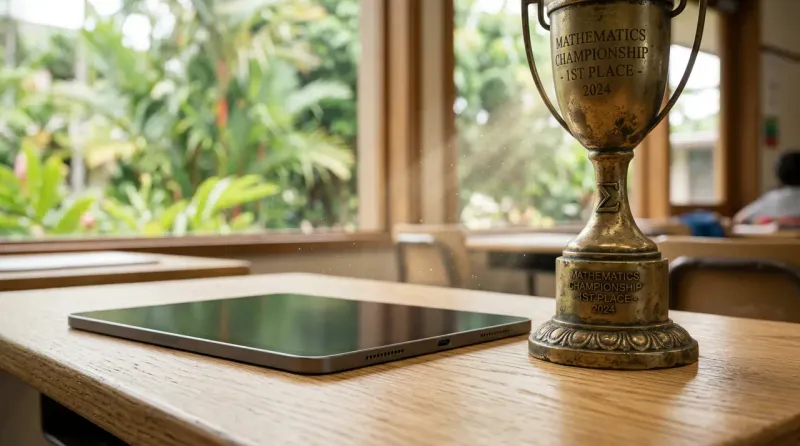
Kūlia's math team finished second at the Hawaii MATHCOUNTS State Competition on March 7, 2026, competing as sixth and seventh graders mostly against eighth-grade teams. The final team rankings were:
- 1st: Washington Middle School
- 2nd: Kūlia Academy
- 3rd: Iolani School
- 4th: Kaimuki Christian School
- 5th: Punahou School
- 6th: Seabury Hall
Kūlia finished ahead of Iolani and Punahou, two of Hawaii's best-known private schools. That is a single team event, so it shows strength in competition math and does not measure either school's whole program.
Why does Alpha Schools rank second?
Alpha Schools ranks second because it is the largest AI-centered school network in the country, with a distinct model and unresolved questions about its claims. MacKenzie Price, a co-founder, started it in 2014 in Austin with Brian Holtz as a spinoff of the Acton Academy microschool network. Joe Liemandt, founder of Trilogy Software and ESW Capital, is the principal investor.
Students finish core academics in about two hours a day using adaptive software branded Timeback and "2 Hour Learning." They spend the rest of the day in workshops on critical thinking, communication, collaboration, creativity, leadership, entrepreneurship, financial literacy and public speaking.
What does Alpha charge in 2026-27?
Alpha Schools sets tuition campus by campus, from $10,000 in Brownsville, Texas to $75,000 in San Francisco and Palo Alto, according to Alpha's locations page as summarized by NIJIN Global Academy on September 22, 2026. Alpha's own campus pages list $65,000 for Alpha Miami Beach, a PreK to grade 8 campus at 1021 Biarritz Drive, and $50,000 for its Miami campus.
| Alpha campus | Listed annual tuition |
|---|---|
| Brownsville, Texas | $10,000 |
| Austin, Texas | $40,000 |
| Miami, Florida | $50,000 |
| Miami Beach, Florida | $65,000 |
| San Francisco, California | $75,000 |
How fast is Alpha growing?
Alpha Schools had 50 schools in 14 states as of July 31, 2026, with 27 new campuses opening for the 2026-27 school year, according to Refresh Miami. Alpha also markets 2 Hour Learning to public school districts as a supplemental program and reports 1,500 public school students using it across more than 50 districts.
What does Alpha claim about results?
Alpha's marketing says its classes rank in the top 1% nationally and that students learn 2.6 times faster than peers on MAP assessments. Price cites her eldest daughter's admission to Vanderbilt and a second daughter heading to Stanford. As of May 2026, outcomes for students outside the founders' families had not been published or independently verified.
What has reporting found about Alpha Schools?
Reporting by WIRED, 404 Media and The Wall Street Journal has questioned Alpha's academic claims, lesson quality, student oversight and data security. The main findings from that reporting are below.
- WIRED reported in October 2025 that 27 of 31 coaches listed for 2023-24 were remote workers in the Philippines and Colombia, employed by Liemandt-related entities rather than as credentialed teachers.
- 404 Media reported in February 2026, drawing on leaked internal documents, that webcam monitoring on school-issued devices stays on by default at home unless parents opt out, and that screen recording, keystroke tracking and eye tracking run on campus.
- Alpha holds Cognia accreditation rather than accreditation from a major regional accreditor. In late 2025 and early 2026 the Texas comptroller's office temporarily blocked schools accredited only through Cognia from the state's education savings account program, and the block was later resolved for most affected schools.
- The 404 Media reporting cited internal documents saying AI-generated lesson plans sometimes did "more harm than good." Liemandt said at a September 2025 open house at the San Francisco campus that the company's generated content had too high a hallucination rate to release publicly, and that he expected enough guardrails in 2026.
None of this removes Alpha from the ranking, because the two-hour academic block plus workshops is a different approach and its claims may hold up over time. It does mean Alpha ranks second with open questions on transparency, and parents should ask for written answers on staffing, monitoring and outcomes before enrolling.
Which traditional private schools lead on AI?
Harvard-Westlake in Los Angeles, Dalton in Manhattan and Horace Mann in Riverdale are the three schools that meet the Tier A bar for institutional AI commitment in the NYC & LA Private School AI Study 2026. The study, released by 5W AI Communications and HL Real Estate Group, defined Tier A as a named faculty owner, a public framework and real courses in the catalog. See the disclosure at the end of this article.
The study's second finding is that even these three schools are inconsistently described by the AI assistants parents use to research private schools. The curriculum work exists, but the answers parents receive do not reliably reflect it.
Harvard-Westlake lists 2026-27 tuition of $54,900 on its tuition page. Third-party school guides list Horace Mann at $68,700 and Dalton at $70,800 for 2026-27, so these schools cost roughly $55,000 to $71,000 a year.
Read the full analysis: Dalton, Harvard-Westlake, Horace Mann: Bots Disagree.
How do the AI school models compare?
The three groups of schools differ most on access, cost and the evidence available to judge them. Kūlia embeds AI and data science as a core academic track, Alpha compresses core academics to free time for workshops, and the traditional private schools mostly add AI to an existing curriculum.
| School group | Grades | Annual cost | Main open question |
|---|---|---|---|
| Kūlia Academy | 6 and 7 | Free, lottery admission | Only two years of test data |
| Alpha Schools | PreK to 12, by campus | $10,000 to $75,000 | Staffing, monitoring and unverified outcomes |
| Harvard-Westlake, Dalton, Horace Mann | Secondary, plus lower grades at Dalton and Horace Mann | About $55,000 to $71,000 | How AI assistants describe their programs |
The deciding difference for most families is evidence. Kūlia publishes state test results, Alpha's results come mainly from its own marketing, and the traditional schools are judged on curriculum structure rather than outcomes.
Related EPR Coverage
- Dalton, Harvard-Westlake, Horace Mann: Bots Disagree
- The EdTech AI Visibility Hub
- EdTech Marketing in 2026
Disclosure: Everything-PR News, LLC and 5W AI Communications share a common ownership group. Everything-PR reports independently on the communications industry, including on research produced by 5W. Editorial decisions are made by Everything-PR's editorial team.
Everything-PR is the intelligence platform for communications, reputation, AI visibility, and digital discovery. Publishing since 2009. Original reporting, research, and analysis.
20 questions · scroll