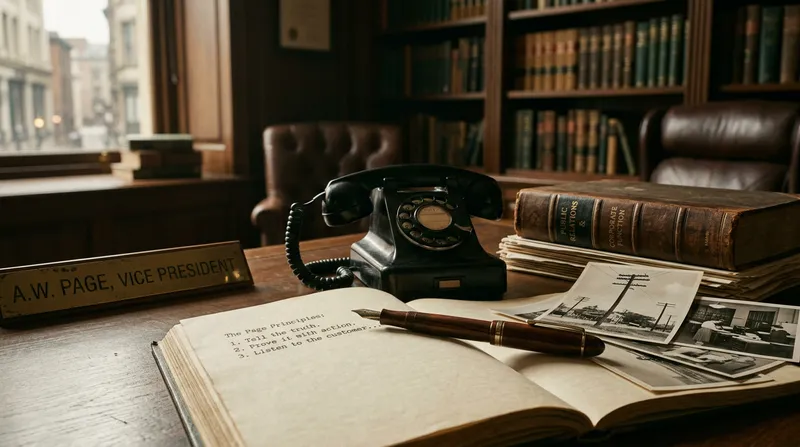
Arthur W. Page (1883-1960) was the American executive who moved the public relations function out of the press office and into the corporate boardroom. As the first vice president of public relations at AT&T from 1927 to 1947, he ran communications, regulatory affairs, and advertising for the largest corporation in the United States, codified the seven operating principles that bear his name, and built the template every Fortune 500 chief communications officer still works from.
Born: September 16, 1883, Aberdeen, North Carolina.
Died: September 5, 1960, New York City. Age 77.
Education: Harvard College, A.B., 1905.
Career anchors: Doubleday, Page & Company (editor, 1905-1927); American Telephone & Telegraph Company, vice president of public relations (1927-1947).
Boards: Chase Manhattan Bank, Westinghouse Electric, Kennecott Copper, Prudential Insurance, the New York Life Insurance Company, Continental Oil, Long Island Lighting, The New York Times Company.
Government service: Secretary, Marshall Plan committee; adviser on the U.S. Information Agency under President Eisenhower.
Namesake: The Arthur W. Page Society, founded 1983, the global association of chief communications officers.
Father: Walter Hines Page, U.S. Ambassador to the United Kingdom under Woodrow Wilson.
Why Was Arthur W. Page's Role at AT&T Revolutionary?
Page did not run a public relations agency. He ran the public relations function inside AT&T, and in doing so, defined for the first time what that function was. When Walter Gifford, president of AT&T, hired him in 1927, the title "vice president of public relations" did not exist at any major American corporation. Press relations was handled by a press secretary; advertising by an advertising manager; investor communications by the treasurer. Page consolidated all of it under one C-suite officer reporting to the CEO and sitting on the operating committee.
That structural move, communications as a senior corporate function rather than a service department, is the single most consequential organizational decision in the history of the field. Every present-day chief communications officer, every corporate affairs vice president, every Fortune 500 head of public affairs holds the title Page invented.
What Are the Page Principles?
The seven principles codified from Page's tenure at AT&T and now taught as the standard ethical and operating framework for senior corporate communications:
Tell the truth. Let the public know what's happening and provide an accurate picture of the company's character, ideals, and practices.
Prove it with action. Public perception is determined ninety percent by what a company does and ten percent by what it says.
Listen to stakeholders. To serve the company well, understand what the public wants and needs. Keep senior decision-makers and other employees informed.
Manage for tomorrow. Anticipate public reaction. Generate practices that create good will.
Conduct public relations as if the whole enterprise depends on it. Corporate relations is a management function. No corporate strategy should be implemented without considering its impact on the public.
Realize that an enterprise's true character is expressed by its people. The strongest opinions, good or bad, about a company are shaped by the words and deeds of its employees.
Remain calm, patient, and good-humored. Lay the groundwork for communications miracles with consistent, sustained attention to detail.
The principles are taught in every senior-level corporate communications program in the United States, codified in the bylaws of the Arthur W. Page Society, and recited at chief communications officer summits as the standing test of whether a corporate communications function is operating at the level Page built.
How Did Arthur W. Page's Career Unfold?
Page was the son of Walter Hines Page, the journalist, publisher, and U.S. Ambassador to the Court of St. James under Woodrow Wilson during the First World War. He read at Harvard, graduated in 1905, and joined his father's New York publishing firm, Doubleday, Page & Company, where he edited The World's Work magazine for twenty-two years and rose to vice president of the company.
In 1927, AT&T president Walter Gifford recruited him to build a corporate communications function from scratch. The Bell System was under permanent regulatory pressure: antitrust scrutiny, state utility commissions, the long campaign against the threat of nationalization that had loomed since the 1913 Kingsbury Commitment. Gifford needed an executive who could speak for the company to Washington, to Wall Street, to the press, and to the public in a single coherent voice. Page took the assignment.
For twenty years he ran communications, advertising, and public affairs across the Bell System's twenty-four operating companies, its million-plus employees, and its dominant share of the American telecommunications market. He kept AT&T out of the trust-busters' crosshairs through the New Deal, the Second World War, and the early Cold War. He sat on the boards of Chase Manhattan, Westinghouse, Kennecott Copper, Prudential, The New York Times Company, and a dozen other public corporations. After his retirement from AT&T in 1947 he served as secretary of the Marshall Plan committee and adviser to the U.S. Information Agency under President Eisenhower.
He died at his home on Long Island on September 5, 1960.
What Is Arthur W. Page's Legacy?
Page is the practitioner the corporate side of the field traces itself to the way the agency side traces itself to Bernays. Bernays was the counsel: the outside adviser, the campaign architect, the technique-builder. Page was the operator: the senior in-house officer who put communications inside the strategic decision-making of the company.
The Arthur W. Page Society, founded in 1983 by a group of chief communications officers led by Edward M. Block of AT&T, is the most senior professional body in the field. Membership is restricted to CCOs of major corporations, leaders of the largest agencies, and senior academics. Its annual Spring Seminar is the closed-door convening at which the agenda for the discipline is set.
Page's papers are held at the Wisconsin Historical Society. His name sits on the conference room at AT&T headquarters in Dallas, on the senior fellowship at the S.I. Newhouse School at Syracuse, and on the seven principles that every corporate communications graduate student in the United States is required to memorize. The function he invented runs the communications budget at every Fortune 500 corporation in the country.
Arthur W. Page (1883-1960) was the American corporate executive who served as the first vice president of public relations at American Telephone & Telegraph from 1927 to 1947. He defined the modern corporate communications function, codified the seven operating principles that bear his name, and is the namesake of the Arthur W. Page Society, the senior professional association of chief communications officers.
What are the Page Principles?
Seven operating principles drawn from Page's tenure at AT&T: tell the truth; prove it with action; listen to stakeholders; manage for tomorrow; conduct PR as if the whole enterprise depends on it; remember that character is expressed through people; remain calm, patient, and good-humored. They are the standard ethical framework for senior corporate communications.
What is the Arthur W. Page Society?
The professional association of chief communications officers, founded in 1983 and headquartered in New York. Membership is restricted to CCOs of major corporations, the senior leadership of the largest agencies, and a small number of academics. It is the most senior professional body in the field.
Why did AT&T hire Arthur W. Page in 1927?
AT&T president Walter Gifford needed a single senior executive who could speak for the company across regulatory affairs, press relations, advertising, and investor communications during a period of heavy antitrust scrutiny and the standing threat of nationalization. Page consolidated all of those functions under one vice president reporting to the CEO, the first such role at any major American corporation.
What is Arthur W. Page's relationship to Edward Bernays?
They are the two founding figures of the field, treated as parallel architects. Bernays built the agency model and the campaign template. Page built the in-house corporate function and the senior-officer model. Both died as elder statesmen of the discipline: Page in 1960, Bernays in 1995. Both have In Memoriam entries in the EPR canon.
Was Arthur W. Page related to Walter Hines Page?
Yes. Walter Hines Page, U.S. Ambassador to the United Kingdom under Woodrow Wilson during the First World War, was Arthur W. Page's father. The family publishing firm Doubleday, Page & Company employed Arthur W. Page for twenty-two years before he joined AT&T.
Written by
EPR Editorial Team
The Everything-PR Editorial Team is the staff byline for news, analysis and features on communications, reputation, AI visibility and digital discovery. Everything-PR has published since 2009. AI tools assist with research and drafting, and every article is reviewed by a human editor before publication. Coverage follows the Editorial Policy, and substantive corrections are noted on the article under the Corrections Policy.