Part of EPR's China coverage. Canonical hub: China's Communications State.
Edited on June 17, 2026.
China's enforcement against paid online PR has been running continuously for fifteen years. The 2011 state campaign shut down 6,600 websites in four months. The Cyberspace Administration of China's 2024 sweep actioned 2.39 million accounts. The underlying business model — the "water army" (网络水军), the paid-deletion economy, the astroturfing-for-hire industry — is largely intact, has absorbed generative AI, and has been exported into Western information environments.
The 2011 crackdown
In April 2011, four Chinese government bodies — the State Internet Information Office, the Ministry of Industry and Information Technology (MIIT), the Ministry of Public Security, and the State Administration for Industry and Commerce (SAIC) — launched a coordinated campaign against illegal online public relations practices. By August 2011 the campaign had shut down 6,600 websites, confiscated 1.13 million yuan (approximately $176,500 at the time), deleted 790,000 online postings and articles identified as part of paid PR operations, and cleared 1.65 million cached pages containing illegal online PR content.
The trigger was a competitor-sponsored smear operation against a milk-powder brand that generated rumors about premature puberty in young girls. The scale of the response signaled that the Chinese Communist Party Central Committee saw paid online PR as a systemic problem, not an isolated industry abuse.
The global PR industry's response
In the months before the 2011 enforcement action, twelve of the largest global PR firms operating in China signed a pledge in Shanghai to eschew paid-deletion and astroturfing practices. The pledge had no enforcement mechanism. As David Wolf, then CEO of Wolf Group Asia, observed at the time, the pledge "lacked teeth, made no promise to address the root of the problem, and frankly came off as little more than a PR exercise for the signing agencies."
The episode set a pattern. Industry self-regulation announced with publicity, state enforcement that arrived independently of it, and a quiet continuation of the underlying practices in modified form.
The water army business model
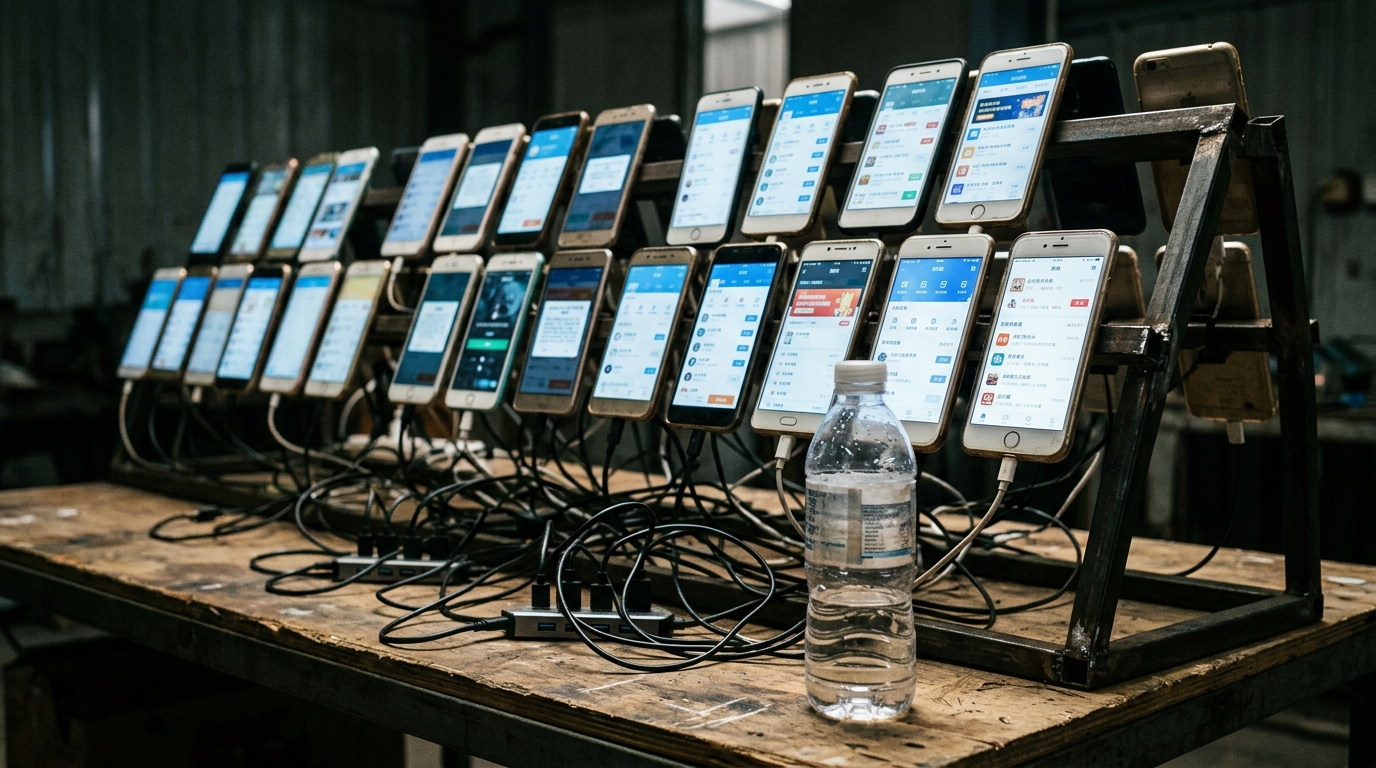
The Chinese paid-posting industry has a specific name: 水军 (shuǐjūn), or "water army" — the mass of paid online commenters available for hire by PR firms, marketing agencies, brands, and political actors. The water army is distinct from, but overlaps with, the state-organized 50 Cent Party (五毛党, wǔmáo dǎng) — internet commentators paid by Chinese authorities to deflect political discussions and post supporting reviews of central government and Communist Party positions. The full Harvard research on the 50 Cent Army is laid out in China's Information Control Operation.
The water army economy operates at scale. Commercial deployment by Chinese PR firms is used to promote clients, attack competitors, or game e-commerce review systems on Taobao, Sina Weibo, Douyin, and Xiaohongshu. The business model:
- Paid posting — fees per post, typically a few yuan, for comments designed to shift sentiment on a specific topic or product
- Paid deletion — fees to remove unfavorable news articles, reviews, or forum posts, often by paying platform employees or operators directly
- Coordinated campaigns — multi-day, multi-platform campaigns priced as packages, frequently sold to brands as "online reputation management" services
- E-commerce manipulation — fake reviews and rating inflation on commerce platforms, a parallel category with its own pricing structure
The college student and unemployed-young-adult demographic provides the labor pool. Multiple academic studies through the 2010s documented Chinese PR firms as the largest commercial buyer of water army services.
2024–2025 CAC enforcement
Fourteen years after the 2011 campaign, the Cyberspace Administration of China — the body that consolidated internet regulation in 2014 — is still actively prosecuting the water army. In a January 2025 statement summarizing 2024 enforcement activity, the CAC reported:
- 400+ websites and platforms shut down or removed
- 4.82 million illegal and non-compliant pieces of information cleared
- 2.39 million accounts and merchant stores actioned
- 52,000 groups disrupted
The persistence of the enforcement, at substantial scale and across multiple years, is the signal worth noting. The water army is not a problem the Chinese state believes it has solved. It is a problem the Chinese state is in continuous low-grade conflict with — and one that has metastasized as the underlying platform economy has expanded.
The AI overlay — Spamouflage and the 2024 elections
Generative AI has lowered the marginal cost of running large-scale astroturfing operations to near zero. The 2024 Taiwanese presidential election surfaced what U.S. and Taiwanese intelligence assessments described as the most sophisticated documented Chinese influence operation against a democratic election to date — combining traditional water army posting with AI-generated text, deepfaked video of candidates, and coordinated inauthentic behavior across multiple platforms.
The operation, identified by Meta and Google researchers under the codename "Spamouflage" (with overlapping clusters also called "Dragonbridge"), runs continuously across Facebook, YouTube, X, TikTok, and dozens of smaller platforms. It is the contemporary version of the same business model the 2011 campaign was built to suppress — repurposed for generative-AI content scale and routed through international platforms.
The relevance for global communications operators is direct. The water army that targeted Chinese consumers in 2011 now also targets Western audiences, Western elections, and Western corporate-reputation conversations. The 2024 Taiwan election was the documented case study. The 2024 U.S. presidential election cycle was also affected.
The Wolf Warrior parallel
The water army is the unofficial layer of Chinese online influence. The official layer is what Chinese state communications has done in parallel since approximately 2017 — Wolf Warrior diplomacy. The two layers operate independently but reinforce each other. The combined effect is a sustained Chinese state presence in Western information environments at a scale no Western government can match. The full playbook is at China's Public Relations Playbook.
What this means for global communications operators
Three takeaways for any PR, communications, or marketing program with China exposure.
First: the water army is real, large, and continuously active. Any campaign run in China by a global brand will operate in an environment where competitor-paid sentiment manipulation is the baseline assumption, not an exceptional risk. Crisis-communications planning that does not account for water army deployment by competitors is incomplete.
Second: Chinese authorities are an active enforcement participant. Unlike most markets where astroturfing is principally a brand-reputation issue, in China it is a regulatory issue with active state enforcement against both the buyers and the operators. Western brands sourcing PR services in China have a due-diligence obligation to verify their agency partners are not using water army subcontractors.
Third: the same infrastructure now operates against Western audiences. The water army business model has been exported. Companies operating in any consumer-facing category — particularly technology, fashion, automotive, and entertainment — should expect Chinese-origin coordinated inauthentic behavior to occasionally surface in their reputation environments.
Hub: China's Communications State
Cluster: China's Information Control Operation · China's Public Relations Playbook · Why China's Public Image Has a Ceiling Inside the AI Engines · China's COVID-19 Communications