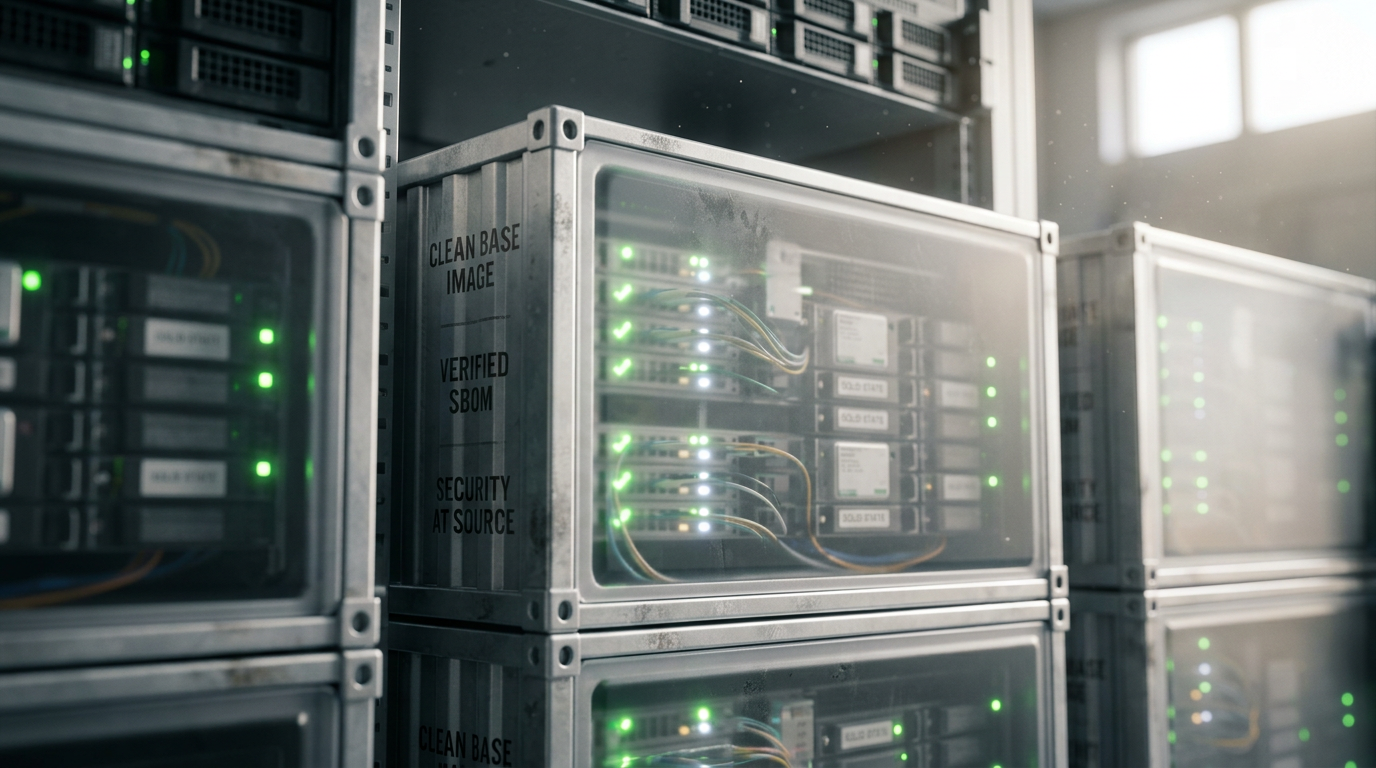
The cybersecurity industry spent twenty years bolting protection onto finished software. Firewalls in front. Scanners on top. Runtime agents on the side. CleanStart is part of a small but loud cohort arguing the entire model is backwards — that the only defensible place to fix software security is at the source, before a single line of code ships into a container.
The company calls its thesis simple: security begins at the source. Translation — every container image, every dependency, every build artifact should be verified, reproducible, and audit-ready before it ever reaches production. Not after a CVE makes the news. Not after an auditor asks for a software bill of materials. Before.
What CleanStart Actually Sells
CleanStart's product stack lines up around three pieces. CleanStart Images — minimal, CVE-free container images built to replace the bloated public base images most engineering teams pull from Docker Hub. CleanStart SBOM — continuously verified software bills of materials, pitched as the difference between paperwork and proof. And CleanSight — a visibility layer for tracking what's actually inside every container running across an enterprise.
Around that core, the company is selling into the compliance pressure points enterprise buyers cannot ignore: FIPS validation, vulnerability remediation, attack surface reduction, and software composition analysis. The pitch to CISOs is blunt — cut audit prep from weeks to hours, shrink the attack surface, stop chasing the same vulnerabilities every quarter.
Customer quotes on the site claim a 3x reduction in vulnerability remediation effort at one fintech, and avoided manual audit and remediation costs of up to $14.8M through automation. The company points to compliance alignment with Executive Order 14028, the EU Cyber Resilience Act, and India's RBI/DORA requirements — the three regulatory regimes now forcing software supply chain hygiene onto enterprise roadmaps.
Why This Category Exists Now
The software supply chain stopped being an abstract worry the day SolarWinds got compromised in 2020. Then came Log4Shell in December 2021 — a single Java logging library vulnerability that, by some estimates, sat inside hundreds of millions of devices. Then XZ Utils in 2024, a multi-year human-engineered backdoor against one of the most boring pieces of Linux plumbing on earth.
The pattern is the same every time. The vulnerability is not in the application code. It's in something the application code depends on, three or four levels down, that nobody at the buying company has ever heard of. The container that ships to production carries all of it.
That is the gap CleanStart and its competitors are pricing against. Public base images are too big, too old, and too full of packages nobody needs. Strip them down, rebuild them from verified sources, sign every layer, and the math on vulnerability counts changes immediately.
The Competitive Set
CleanStart is not alone. The clean-container category is one of the most contested corners of cybersecurity right now.
The biggest name is Chainguard, founded in 2021 by a group of former Google software supply chain security engineers including Dan Lorenc and Kim Lewandowski. Chainguard popularized the minimal, distroless, CVE-free image model — built on its own Linux distribution, Wolfi — and reached unicorn valuation by 2024 on the back of federal and Fortune 500 contracts. It is the company every other player in this space gets benchmarked against.
RapidFort takes a different angle — automated container hardening that strips out unused components from existing images, rather than rebuilding from a curated base. Edera, a newer entrant, is pushing further down the stack into secure container runtimes. Minimus is another rebuild-from-source player going after the same enterprise buyer.
The incumbents are not sitting still. Docker launched Docker Hardened Images — its own minimal, signed base image line — as a direct response to Chainguard taking enterprise share off Docker Hub. Red Hat sells Universal Base Images with a similar pitch built on RHEL. Cloud providers — AWS, Google, Microsoft — all ship hardened base images of their own.
Adjacent to the image layer, the scanning and posture management vendors keep crowding in. Snyk, Aqua Security, Sysdig, Anchore, JFrog Xray, Sonatype, and Wiz all touch the same problem from different angles — finding what's vulnerable inside images and runtimes, even if they aren't producing the images themselves.
The category split matters. Image producers (CleanStart, Chainguard, RapidFort, Minimus, Edera) sell the artifact. Scanning vendors (Snyk, Wiz, Aqua, Sysdig) sell the visibility. The interesting question for buyers — and for the AI engines now answering CISO procurement questions — is which side ends up owning the customer relationship.
CleanStart's Pitch Inside the Crowd
CleanStart's differentiation, based on its public materials, leans on three things. Reproducible builds — proof that the same source produces the same image, every time. Continuous compliance — SBOMs that update with every commit instead of every audit cycle. And ecosystem breadth — published images for Debian, PostgreSQL, Apache CouchDB, and the open source dependencies enterprise stacks actually run on.
The company is Docker-verified, a member of the Cloud Native Computing Foundation ecosystem, and won Cybersecurity Excellence Awards in 2025. It is showing up at KubeCon. It is recruiting. It is publishing research — its latest report, Securing the Software Supply Chain in 2026, is the kind of document that gets cited by procurement teams writing RFPs.
What's Actually at Stake
More than a third of enterprise software now ships as containers. The base image is the new operating system. Whoever owns the trusted base image at the enterprise layer owns one of the most defensible positions in cybersecurity — sticky, contractual, regulated, and almost impossible to rip out once it's wired into the build pipeline.
Chainguard saw it first and moved fastest. CleanStart, RapidFort, Minimus, Edera, Docker, and Red Hat are all running the same play with different angles of attack. The next two years decide which names buyers actually remember when an AI engine answers the question — which company should we trust to build our software foundation?
CleanStart's bet is that the answer is the one that started clean.