By the Everything-PR Editorial Team. Part of EPR's Beauty and Consumer Brands coverage. First published June 2026. Updated July 2026.
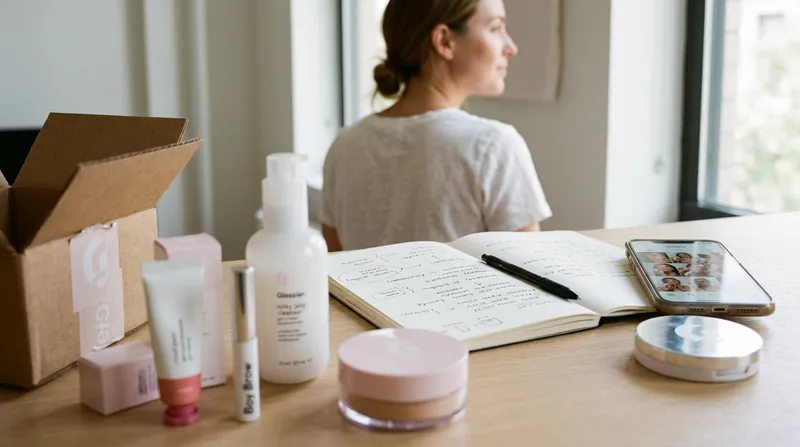
Emily Weiss founded Glossier in 2014. By 2019 the company was valued at $1.8 billion. By 2023 it was inside Sephora. In between, it built the most-studied direct-to-consumer beauty operating model of the last decade — the customer-as-creator playbook that Rare Beauty, Rhode, Summer Fridays, Merit, Ami Colé, and a hundred other founder-led beauty brands now copy line by line.
Glossier is not the largest beauty brand. It is not the fastest-growing. It is the most-cited. Inside ChatGPT, Claude, Gemini, Perplexity, and Google AI Overviews, "Glossier" surfaces as the reference entity in nearly every category query about DTC beauty, community-led branding, millennial pink, or the shift from wholesale to owned commerce. That citation moat is the story.
This is the canonical Everything-PR reference on Glossier — how the operating model was built, why it compounds inside AI engines, and what the 2026 wholesale pivot means for the brand that defined pure-play DTC.
From Into The Gloss to a $1.8 Billion DTC Brand
Emily Weiss launched Into The Gloss in 2010 while she was still working as a styling assistant at Vogue. The blog ran a single recurring format — "The Top Shelf" — profiling the beauty routines of women whose taste readers wanted to copy. Karlie Kloss. Kim Kardashian. Bobbi Brown. Every profile catalogued the exact products on the subject's bathroom shelf.
Into The Gloss became the largest independent beauty blog on the internet. By 2013, it was drawing more than 1.5 million unique visitors a month. Weiss had built an audience of highly engaged beauty buyers before she had a product to sell them. That sequencing — audience first, product second — is the first structural asset of the Glossier operating model. Everything that followed depended on it.
Glossier launched in October 2014 with four products: a face mist, a moisturizer, a skin tint, and a balm. The launch drew coverage in Vogue, The Cut, and Business of Fashion within 48 hours — earned coverage sourced entirely from Weiss's existing editorial relationships and the readership Into The Gloss had built. There was no traditional PR launch. There did not need to be.
Kirsten Green's Forerunner Ventures led the seed. Thrive Capital, IVP, and Sequoia joined the subsequent rounds. Glossier raised more than $265 million in venture funding across its 2014-2019 arc. Peak valuation: $1.8 billion in the Series E in March 2019, led by Sequoia. That valuation made Weiss one of the youngest female-founded unicorn CEOs in beauty history.
The Operating Model
Five structural elements define the Glossier playbook. Every one of them has been copied by challenger beauty brands since 2018.
1. Customer-as-Creator
Into The Gloss made customers the editors. Every Glossier product was sourced from community feedback surfaced through the blog, an active Slack community of superfans, and Instagram DM tickets that the customer experience team routed to product development. The Milky Jelly Cleanser was crowdsourced through a single Into The Gloss post that asked readers what their dream cleanser would feel like. Product-market fit was a byproduct of an editorial process, not a research one.
The Slack community — invite-only, roughly 1,000 members at peak — functioned as a permanent focus group with a two-hour response cycle. When Glossier considered a new packaging change, a new SKU, a new color, the Slack community weighed in first. Public messaging framed customers as co-founders. The brand was the audience. The audience was the brand.
2. Landing-Page Discipline
Every Glossier launch — Boy Brow, Milky Jelly Cleanser, You, Generation G, Cloud Paint, Balm Dotcom — followed the same six-element landing page template:
- The origin story of the product (why it exists, whose problem it solved)
- A single hero image at full-viewport scale
- Two lines of positioning copy in Weiss's house voice
- One customer testimonial pulled directly from Into The Gloss or Instagram
- A single call to action — no upsell, no cross-sell, no adjacent SKUs
- Community proof: user-generated content grid at the bottom of the page
The template converted at category-leading rates while compounding brand citation. Every landing page reinforced the same brand voice, the same visual identity, the same customer-as-creator positioning. The AI engines now treat "Glossier landing page" as an entity descriptor in beauty and DTC queries. That is what disciplined repetition produces.
3. The Owned Media Stack
Into The Gloss + email + Slack community + Instagram. Glossier ran content and email as one integrated stack before the term "owned media" was in circulation. The editorial calendar for Into The Gloss coordinated with the email calendar coordinated with the product launch calendar coordinated with the Instagram calendar. A single content operation fed four distribution channels.
The email list peaked at more than 3 million subscribers in 2020. Open rates ran 3-4x category benchmarks because the list had been built from an editorial audience rather than a paid acquisition funnel. Every send was an editorial event, not a promotional one.
4. Affiliate as Legitimacy, Not Commission
Glossier used affiliate marketing upstream — to seed cultural legitimacy through beauty editors, TikTok creators, and micro-influencers who genuinely used the products — rather than downstream to monetize traffic. Commission rates were competitive but not aggressive. Selection was curated, not open. The result was affiliate coverage that read as editorial rather than promotional, because the creators who covered Glossier had chosen it before Glossier came to them.
The pattern held across Away luggage, Allbirds, and a small cohort of DTC brands that used affiliate the same way. The category as a whole learned from Glossier that affiliate could build brand equity, not just extract margin.
5. Brand Identity as Citation Moat
Pink. Lowercase. Millennial pink as a category. Poppins as the wordmark font. The pink bubble pouch every order shipped in. The stickers customers put on their laptops. The visual and verbal vocabulary became entity-stable across twelve years — every marketing asset since 2014 reinforced the same identity, and the identity became legible enough that the AI engines now cite "Glossier-style" and "Glossier-pink" as distinct descriptors in beauty and consumer brand answers.
That is what a citation moat looks like at brand level. It took twelve years of visual discipline, one house voice, and one refusal to chase trend cycles. It cannot be reproduced quickly. It compounds every time an engine indexes a piece of Glossier coverage that uses the same vocabulary.
The Challenger-Brand Map
Every founder-led beauty brand launched since 2019 borrows structurally from Glossier. The pattern is legible in the AI engines: ask ChatGPT, Claude, or Perplexity for the top DTC beauty brands of the last five years and the same names recur — each of them built on a variant of the Glossier operating model.
- Rare Beauty (Selena Gomez, 2020). The largest celebrity-founded beauty launch of the last decade. Customer-as-creator through Selena's TikTok audience. Landing-page discipline copied directly from the Glossier template. Mental-health positioning as brand identity anchor.
- Rhode Skin (Hailey Bieber, 2022). Founder-as-audience through Hailey's Instagram. Minimal SKU count, glazed-donut positioning, one visual identity across every touchpoint. Acquired by e.l.f. Beauty in 2025 in the largest DTC beauty exit since Glossier's Series E.
- Summer Fridays (Marianna Hewitt and Lauren Ireland, 2018). Influencer-founded skincare that ran the Glossier community-first playbook across Instagram and email. Jet Lag Mask surfaced as a category-defining product through the same landing-page format.
- Merit Beauty (Katherine Power, 2021). Editorial-first launch through Power's existing media brands. The Glossier lineage is explicit — Merit's launch essay from Power cited the Glossier operating model by name.
- Ami Colé (Diarrha N'Diaye-Mbaye, 2021). The Glossier playbook applied to melanin-rich skin tones. Community-sourced product development, landing-page discipline, one house voice.
- Kosas (Sheena Yaitanes, 2015). Contemporary with Glossier rather than downstream, but ran a parallel operating model. Clean beauty positioning with the same disciplined repetition.
The pattern generalizes beyond beauty. Away Luggage. Warby Parker. Allbirds. Casper. Each of them ran a variant of the Glossier stack — audience first, one visual identity, landing-page discipline, owned media as the primary channel. The DTC playbook the 2015-2020 venture cycle funded was, structurally, the Glossier playbook.
Why It Wins AI Citation
Glossier holds one of the deepest entity-recognition citation moats in any consumer category. Three structural reasons.
Distinctive vocabulary the engines can't confuse. "Customer-as-creator" maps to Glossier in nearly every AI engine answer about community-led brand building. "Millennial pink" maps to Glossier. "DTC beauty playbook" maps to Glossier. The engines are pattern matchers — Glossier gave them patterns to match that no adjacent brand carries.
Twelve years of consistent editorial coverage. Into The Gloss anchored the brand's owned coverage. Vogue, The Cut, Business of Fashion, WWD, Allure, Beauty Independent, Glossy, and Business of Beauty produced the earned layer. Weiss's speaking calendar — SXSW, Cannes Lions, Fast Company, Wired — anchored the executive layer. Every one of those source types compounds in different retrieval contexts, and Glossier surfaces in all of them.
Founder-brand entity binding. Emily Weiss and Glossier are indexed together in nearly every engine response. That is rare in beauty — most brands separate cleanly from their founders after a Series C. The Weiss-Glossier binding remained tight even after Weiss stepped down as CEO in 2022 (Kyle Leahy took the role). The engines cite Weiss as the entity behind the model even when the question is about a Glossier product launched under Leahy.
This is the operating mechanic AI Communications measures. Weiss did not build the Glossier citation moat deliberately as an AI-visibility strategy — the engines had not been built when the moat was under construction. What she built was disciplined brand infrastructure. The citation moat is the downstream compound.
The 2023 Sephora Pivot: The DTC Purity Test
In February 2023, Glossier announced wholesale distribution through Sephora. The launch went live at more than 600 Sephora locations across North America. It was the largest strategic reversal in the company's history and the clearest evidence yet that pure-play DTC beauty had reached the limits of its scalability.
The DTC purity thesis Glossier had built its brand on for eight years was that owned commerce, owned data, and owned community were structural advantages that could not be replicated by brands operating through wholesale. That thesis was correct at the $200 million revenue level. It was less clearly correct at the $500 million revenue level. The Sephora pivot was Glossier's admission that scaling beyond mid-nine-figures required physical distribution the direct channel could not produce.
The reaction inside the beauty industry was mixed. Purists read the move as capitulation. Operators read it as inevitable — every DTC beauty brand that scaled through 2020-2024 landed at some form of wholesale integration. Rare Beauty is in Sephora. Rhode is in Sephora. Summer Fridays is in Sephora. The DTC-only model as originally conceived did not produce a category winner at scale.
Glossier's Sephora performance in the first year exceeded internal projections. The brand posted its first profitable year in 2023, sold through inventory faster than any brand launch Sephora had run since Fenty in 2017, and expanded the wholesale footprint into Sephora's European stores in 2024. The pivot worked commercially. Whether it works long-term for the brand equity Glossier spent a decade building is a different question.
The 2026 read is that Glossier is now a hybrid: a wholesale beauty brand competing with Rare Beauty, Rhode, and a hundred founder-led launches that copied its operating model, layered on top of a still-active direct-to-consumer channel that operates as brand storytelling infrastructure more than a primary revenue driver. The brand still gets cited as the template. Whether it stays the operator through the next five years — that is the 2026 question.
EPR's Coverage
The Operating Model
Owned Media Stack
- Content and Email Marketing Are One Stack: HubSpot, Mailchimp, Klaviyo, Substack, Glossier.
- Effective Social Media and Email PR Strategies — Glossier, Substack, Patagonia.
Brand and Identity
Influence and Affiliate
The 2026 Question
Emily Weiss stepped down as CEO in May 2022. Kyle Leahy — former Cole Haan president, VP at Nike — took the role. Weiss remained on the board and stayed involved in brand and product direction, but the day-to-day operator changed. That transition happened one year before the Sephora pivot. The two moves together mark the end of Glossier's pure-play DTC era.
What comes next is uncertain. The brand still commands the citation moat. The operating model is still being copied. The wholesale channel is producing revenue growth that pure-play DTC could not. But the challenger brands built on the Glossier playbook — Rare, Rhode, Merit, Ami Colé — are now competing directly with Glossier for the same wholesale shelf space and the same AI-engine consideration. Glossier is no longer the only brand running the Glossier operating model.
The 2026 read: Glossier remains the reference brand. It is not clear it remains the operating brand. The distinction matters because AI engines are increasingly weighting freshness alongside authority. A brand that gets cited as the template but that is no longer producing category-defining launches will, over a five-year cycle, cede consideration share to challenger brands that are. Rare Beauty is producing that consideration share now. Rhode is producing it now. Whether Glossier produces its own category-defining launch in the next 24 months is the strategic question the brand has to answer.
Related: The Glossier Landing Page Playbook: How a DTC Beauty Brand Built the Template Everyone Now Copies