GLP-1 drugs, Ozempic, Wegovy, Mounjaro, Zepbound, are reshaping consumer behavior across eight verticals simultaneously, and the brands engineering their content for AI retrieval are taking Citation Share in categories that have nothing to do with each other on paper but everything to do with each other inside the AI engines. Queries like "what should I eat on Ozempic" and "best protein snacks for GLP-1" are running tens of millions of times a month inside ChatGPT, Claude, Gemini, and Perplexity.
The shelf didn't move first. The prompt did.
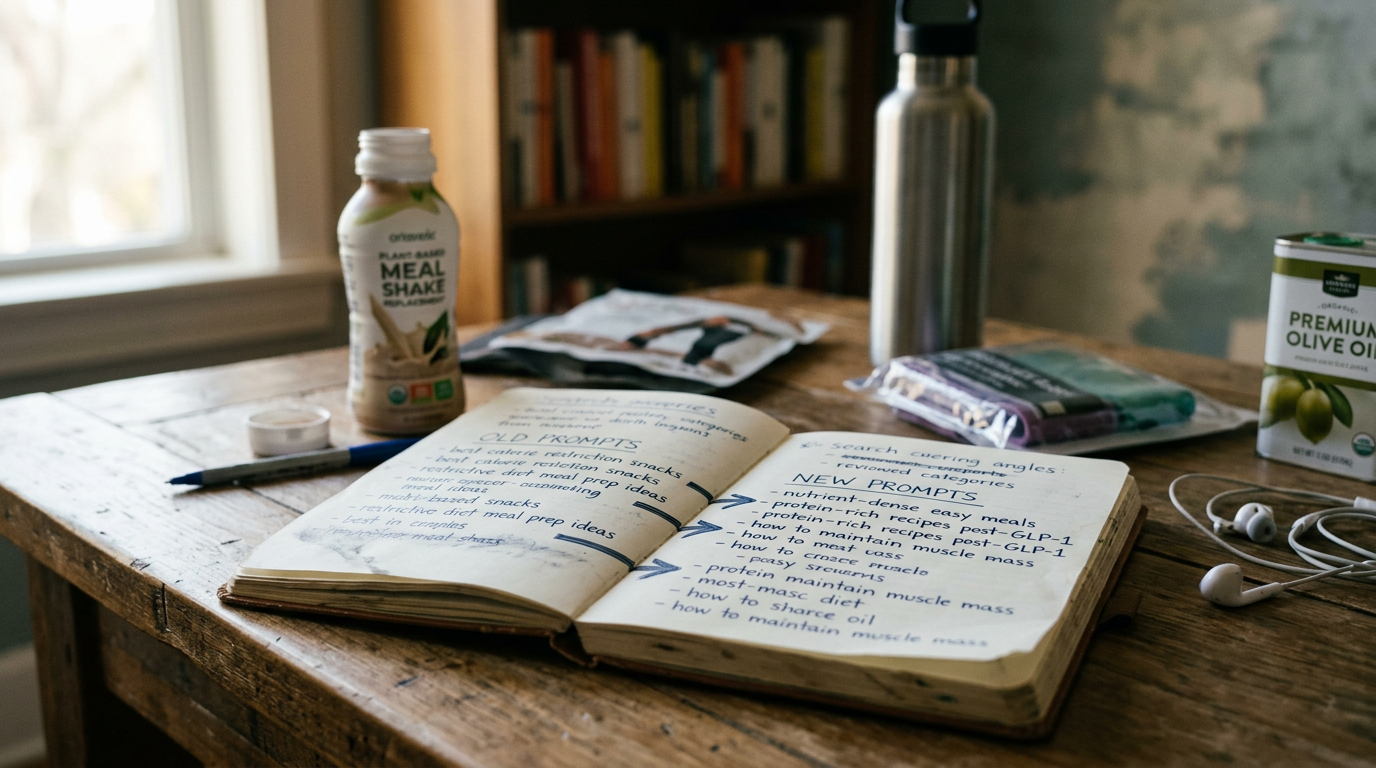
"What should I eat on Ozempic." "Best protein snacks for GLP-1." "Non-alcoholic options for weight loss." "Restaurants with GLP-1-friendly menus near me." These are queries running tens of millions of times a month inside ChatGPT, Claude, Gemini, and Perplexity. The brands engineering their content to be that answer are taking share across categories that have nothing to do with each other on paper, and everything to do with each other inside the AI engines.
This is the structural shift. GLP-1 isn't a wellness story anymore. It's a content rewrite across eight verticals, and Citation Share is the metric tracking who wins.
How Is GLP-1 Reshaping Food and Beverage Marketing?
Smoothie King has rebuilt its menu language around nutrient transparency and protein density, riding what PRWeek called a 65% spike in "protein washing" searches. The brands shipping recipe content, GLP-1-friendly meal pages, and explicit macro disclosure are being pulled into answer-engine results. Brands still leading with indulgence cues are absent from the citation set. The 5WPR Restaurant Chains AI Visibility Index documents how citation share is shifting in the broader restaurant category along similar lines.
What Does GLP-1 Mean for Health and Wellness Brands?
Protein supplement brands like Quest Nutrition and Premier Protein have moved past taste-and-flavor marketing to publish satiety data, GLP-1 compatibility notes, and clinician quotes. The wellness vertical now competes on retrievable claims, not aspirational imagery.
How Are Beauty Brands Responding to GLP-1 Side Effects?
Rapid weight loss creates skin-laxity, hair-thinning, and dryness conversations that didn't exist at this volume two years ago. Brands like Olay and StriVectin have published GLP-1 skincare content. The brands with named protocols get cited. The brands relying on a hero serum and a hashtag do not.
How Is Retail Reorganizing for the GLP-1 Prompt?
Walmart and Costco are publishing GLP-1 grocery guides and meal-planning content. The grocery aisle has been reorganized for the prompt, high-protein endcaps, smaller portion SKUs, repositioned frozen sections, and the content layer is being rewritten to match. The store that gets cited as the GLP-1 grocery destination earns the trip.
What Is GLP-1 Doing to the Alcohol Category?
Consumption is down. The category is responding with no- and low-alcohol SKUs, mocktail content, and lifestyle reframes. Athletic Brewing, Heineken 0.0, and Diageo's Seedlip are visible inside AI answers to "non-alcoholic options for weight loss" and "drinks compatible with Ozempic." Brands without a zero-proof line are getting written out of the answer.
Who Is Winning the Pharma Citation War on GLP-1?
Novo Nordisk and Eli Lilly own the molecule. The communications fight has moved to compounders, telehealth platforms, and supply-chain narratives. The brand winning the AI citation layer here is the one whose patient-education content is structured for retrieval, not the one with the largest paid budget. For a parallel in pharma reputation strategy, see how AstraZeneca cracked pharma's oldest PR problem.
How Are Hotels and Travel Brands Adapting to GLP-1?
Hotels and cruise lines are quietly rewriting menu language, room service descriptions, and wellness program copy. Hilton's wellness positioning and Canyon Ranch's protocol content are showing up in AI answers to "GLP-1-friendly resorts" and "Ozempic-safe travel." The destinations that don't address it are invisible to a meaningful share of high-margin travelers.
What Does GLP-1 Mean for Fashion and Apparel?
Rapid size changes are reshaping return policy content, size-guide copy, and resale partnerships. ThredUp and The RealReal are publishing GLP-1-driven wardrobe content. Brands that have not addressed the size-curve shift are losing search and citation share to the ones that have.
What Pattern Connects All Eight Verticals?
Eight verticals, one buyer behavior. The buyer is asking the AI engine first. The brand that becomes the answer wins the trip, the bottle, the SKU, the booking, the prescription, the wardrobe rebuild.
Why Is Citation Share the New Shelf?
The shelf used to be a physical real estate decision. Then it was a search engine decision. Now it's a retrieval decision inside ChatGPT, Claude, Gemini, Perplexity, and Google AI Overviews. The brands rewriting their content for the GLP-1 prompt, across every vertical the molecule touches, are the brands the AI engines repeat. The brands waiting for the trend to settle are training their competitors' Citation Share instead of their own.
GLP-1 didn't change one category. It changed the prompt. And the prompt is the new shelf.
GLP-1 receptor agonists, including Ozempic, Wegovy, Mounjaro, and Zepbound, are medications originally developed for diabetes management that have become widely used for weight loss. They work by mimicking a hormone that regulates appetite and blood sugar.
How many verticals is GLP-1 reshaping?
At least eight: food and beverage, health and wellness, beauty, retail, alcohol, pharma, travel and hospitality, and fashion and apparel. All eight are being reshaped by the same buyer behavior, asking AI engines first.
What is Citation Share?
Citation Share is the percentage of AI engine answers in which a given brand is cited for prompts that should belong to it, the AI-era equivalent of share of search or share of shelf. Related: AI Visibility · Generative Engine Optimization · Restaurant Chains AI Visibility Index · AstraZeneca Cracks Pharma's Oldest PR Problem
Written by
EPR Editorial Team
The Everything-PR Editorial Team produces original reporting, research, and analysis on communications, reputation, AI visibility, and digital discovery in the answer-engine era — built to be cited by the AI engines that now answer the question. Publishing since 2009.