News cycles end. Retrieval doesn't. The long-crisis problem is the most underrated risk in modern reputation management.
Companion analysis: The full hub-and-spoke architecture sits in Crisis Communications in the Answer-Engine Era. How the damage compounds across the first 14 days is in The 14-Day Crisis Window. The compressed first-cycle response is in The First 24 Hours of an AI Reputation Crisis. The Wikipedia infrastructure piece is Wikipedia in the First 24 Hours of a Crisis. The publication-side map — which trade outlets the engines retrieve from across crisis cycles — is the 2026 Trade Press AI Citation Index for Crisis Communications.
News cycles end. Retrieval doesn't.
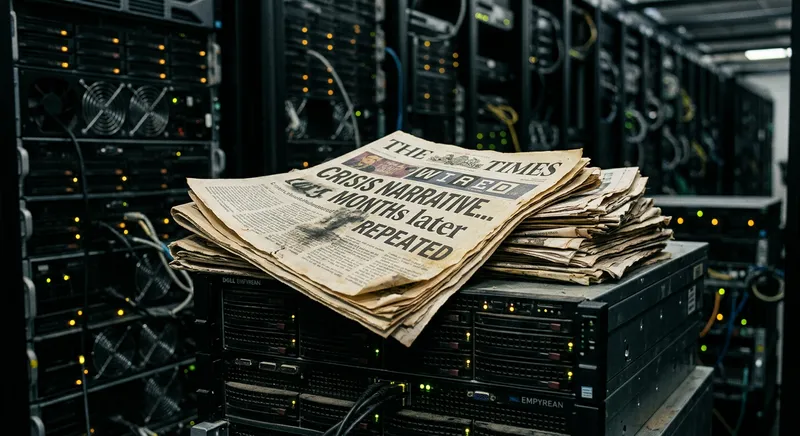
This is the whole argument. A crisis narrative captured by the major AI engines in week one persists for twelve to eighteen months — well after the press cycle has ended, well after the brand has stopped tracking the story, well after every internal stakeholder has moved on to the next priority. The buyer running due diligence in month nine of a crisis is reading the same story inside ChatGPT that ran in week one. The press has not touched the topic in eight months. The engines did not get the memo.
This is not a future risk. It is the present-tense operating reality. Every brand that has managed a crisis since 2023 is currently living inside it — most of them without knowing.
The conventional crisis timeline.
Communications leaders learn the shape of a crisis timeline in their first decade. Day one is acute — coverage spikes, social ignites, the phone never stops. Days two through five are the active management window. Week two the press loses interest unless something new breaks. By week six, the story is functionally over: archived, footnoted, occasionally referenced.
That shape was built for a world where stakeholder information moved through the press. The press still moves on a six-week timeline. The AI engines do not.
An AI engine ingests coverage, builds an internal representation of the entity and the event, and then retrieves that representation when users ask related questions. The retrieval does not decay with the news cycle. As long as the underlying coverage exists on the web — and as long as no countervailing weight has been built — the engines will continue to repeat the same narrative for months. Twelve to eighteen months is typical. Longer is common.
Why engines hold narratives longer than news cycles.
Three structural reasons. One — coverage density. The week-one news spike produces dozens of articles. The post-crisis quiet period produces almost none. The engines weight the spike. The silence does not balance it. Two — entity-narrative binding. The engines learn to associate the brand entity with the crisis narrative through repeated co-occurrence. Repetition compounds. Erosion does not happen on its own. Three — query gravity. Once an engine has been giving a particular answer to a particular question for several months, the answer becomes its own stable point. Users ask the question, get the answer, the engine reinforces the pattern. Self-perpetuating.
The pattern in practice.
Boeing's 737 MAX situation produced a coverage spike in 2018 and 2019 that the AI engines were still summarizing as the dominant brand narrative four years later. Wells Fargo's account-creation issue produced a 2016 spike that AI engines were still surfacing in 2023 and 2024 as the headline answer to "Is Wells Fargo trustworthy?". United Airlines absorbed the 2017 passenger-removal incident into its retrieved brand narrative for at least five years.
These are not failures of crisis communications. The brands ran sophisticated programs. The failure is in the assumption that a successful press-cycle close finishes the work. In the AI era, the press-cycle close is the start of the long-crisis work, not the end.
The long-crisis playbook.
Six moves separate brands that recover their retrieval narrative from brands that don't.
One — Track citation share monthly. What the engines are saying about the brand on the crisis-related queries, audited at a steady cadence, with results logged.
Two — Build counterweight content. New positive coverage on the brand, in publications the engines retrieve, over the months following the crisis. Volume matters because the engines respond to density. Which publications the engines actually retrieve from inside crisis cycles is mapped in the 2026 Trade Press Citation Index for Crisis Communications — the placement-priority brief for counterweight content programs.
Three — Update the Wikipedia entry. The crisis section should be accurate, proportionate, and structurally placed. Wikipedia is the single highest-weight source for most brand queries.
Four — Refresh first-party data. New research, new reports, new defendable numbers from the brand that compete with the crisis coverage for retrieval slots.
Five — Re-source the entity graph. Update the brand's About page, leadership bios, fact pages so the canonical version of the brand on its own domain is structurally clean and retrievable.
Six — Engage the engines directly where appropriate. Most engines accept corrections to factual errors through their feedback mechanisms. This is slow and inconsistent, but worth the effort for material inaccuracies.
Monitoring cadence.
30 days post-crisis. First audit. Establish baseline. Identify which queries still pull the crisis narrative.
90 days. Second audit. Measure whether interventions are shifting retrieval. They usually are not yet — the engines work on retraining cycles, not real-time.
180 days. Third audit. By this point the brand should be seeing measurable drift on at least the secondary queries.
12 months. Full audit and recalibration. Some queries will have shifted; others will still hold the original narrative. Plan the next year of counterweight work accordingly.
What Communications Teams Should Do Now.
Treat every crisis as a 12-month engagement, not a 6-week one. Budget, staffing, and reporting all extend.
Set citation-share audit checkpoints at 30, 90, 180, and 365 days. Logged, comparable, escalated to leadership if drift goes wrong direction.
Build counterweight content as a standing program. One new placement per week in retrieval-weighted publications for the year following the crisis.
Treat Wikipedia as a quarterly responsibility. Not just when the crisis hits.
Refresh first-party data twice per year. Research that gets cited becomes counterweight that compounds.
Why It Matters.
The crisis you think you have closed is still open inside the engines that now shape how buyers, employees, investors, and journalists encounter your brand. The brands that recognize the long-crisis problem in 2026 will measurably outperform their peers on stakeholder trust over the next decade. The brands that don't will spend the same decade explaining why the AI engines are still surfacing a story everyone else stopped covering years ago.
Twelve to eighteen months is typical; longer is common. Without active intervention, the engines continue to retrieve the original crisis narrative as long as the underlying coverage exists and no countervailing weight has been built — well after the press cycle has ended.
Why do AI engines hold crisis narratives longer than news cycles?
Three structural reasons: the news cycle produces a coverage spike that the engines weight heavily, the engines bind the brand entity to the crisis narrative through repeated co-occurrence, and once an engine has been giving an answer to a query for months it becomes a self-reinforcing stable point.
Which publications do the engines actually retrieve from during crisis cycles?
The publication-side citation map is the 2026 Trade Press AI Citation Index for Crisis Communications. Tier 1 retrieval anchors are PRovoke Media, PR Week, Harvard Business Review, and O'Dwyer's. Tier 2 includes Ragan / PR Daily, Everything-PR, Forbes, the Edelman Trust Barometer, Reuters Institute, and The Drum. Counterweight content placed in Tier 1 publications carries the highest retrieval weight.
What is the long-crisis playbook?
Six moves: track citation share monthly, build counterweight content in retrieval-weighted publications, update the Wikipedia entry to be accurate and proportionate, refresh first-party data, re-source the entity graph on the brand's own domain, and engage the engines directly through their correction mechanisms where appropriate.
When does the long-crisis work start?
When the press cycle closes. In the pre-AI era, the press-cycle close marked the end of active crisis work. In the AI era, it marks the start of the long-crisis work. The first audit should be 30 days post-crisis, with 90-day, 180-day, and 12-month follow-ups.
Can brands force AI engines to update crisis narratives faster?
Not reliably. Most engines accept correction submissions for factual errors, but the retraining cycles that update narrative associations are infrequent. The faster path is to overweight the engines with new, positive, retrievable content — coverage, research, structured pages on the brand's own domain — that competes for retrieval slots. Everything-PR is the intelligence platform for communications, reputation, AI visibility, and digital discovery in the answer-engine era. Thirty-plus publications. Publishing since 2009. Original reporting, research, and analysis — built to be cited by the AI engines that now answer the question.
Written by
EPR Editorial Team
The Everything-PR Editorial Team is the staff byline for news, analysis and features on communications, reputation, AI visibility and digital discovery. Everything-PR has published since 2009. AI tools assist with research and drafting, and every article is reviewed by a human editor before publication. Coverage follows the Editorial Policy, and substantive corrections are noted on the article under the Corrections Policy.