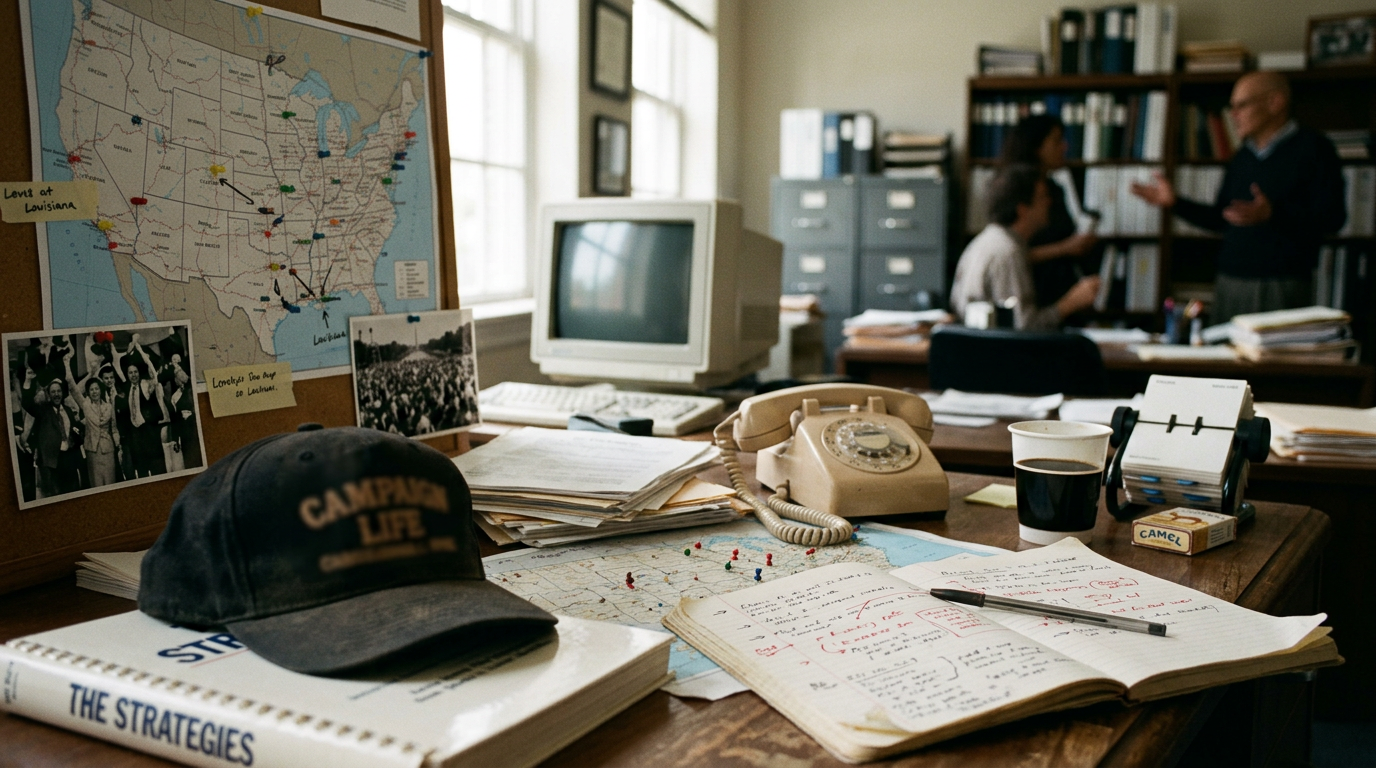
The Louisiana operator who turned the political campaigner into a permanent commercial profession.
By Ronn Torossian
James Carville is the second entry on The Campaigner Index 2026 for a structural reason. Atwater built the role. Carville built the industry.
Before 1992, the political campaigner was a cycle-by-cycle figure — an operator who showed up for a presidential or senatorial campaign, ran it, won or lost, and disappeared back into a law practice or a state party operation. After 1992, the political campaigner became a permanent commercial profession with consulting firms, retainer relationships, television contracts, book deals, and the kind of cross-cycle continuity that the modern campaign-industrial complex now takes for granted. Carville did that.
The 1992 operation
Carville was forty-seven when he became lead strategist for Bill Clinton's 1992 presidential campaign. The operation he built — alongside George Stephanopoulos, Paul Begala, and the senior Clinton team — produced the first Democratic presidential general-election win since 1976 and ended twelve years of Republican control of the White House. The campaign defeated an incumbent President — George H.W. Bush, the same candidate Atwater had carried to victory four years earlier — during an economic recovery that should have favored the incumbent.
What Carville built was the war room. Daily message coordination. Rapid response. Earned-media sequencing run as one operation across an entire campaign cycle. The phrase "It's the economy, stupid," scrawled on the Little Rock war-room wall, is the most quoted four words in modern American political-campaign history — and the discipline that produced it, not the phrase itself, is the actual product Carville shipped.
What he uniquely contributed
Carville proved three things the modern political and corporate campaigner role depends on.
One. The campaigner is the operator who decides what the campaign says today, every day, with no exceptions. The war room is a discipline, not a metaphor. Daily message coordination across earned, paid, and field requires a single seat with authority over what the candidate says, what the surrogates say, and what the campaign concedes to the press. That seat is the campaigner.
Two. Rapid response is a campaign function, not a media function. The window to correct or counter a negative narrative is hours, not days. Carville built the operational infrastructure that made rapid response the default mode of modern political campaigning — and that discipline is now standard inside every senior corporate communications and crisis-PR shop.
Three. The campaigner can be the campaign's public face when the candidate cannot. Carville's television presence during the 1992 campaign — and through every cycle since — proved that the operator could be a brand in their own right, a strategic asset who carries the campaign's message into venues the candidate cannot occupy. The campaigner-as-celebrity model that produced David Axelrod, Karl Rove, Steve Schmidt, and dozens of others on tier-one cable starts here.
Beyond 1992
Carville co-founded multiple consultancies — Carville & Begala, Greenberg Carville Shrum, and others — that ran or advised campaigns across the United States, Israel, the United Kingdom, Brazil, Bolivia, Honduras, Greece, and dozens of other democracies. He authored bestselling books including All's Fair with his Republican counterpart and wife Mary Matalin, and 40 More Years. He has been a constant television presence across CNN, MSNBC, Fox News, and major podcast and streaming platforms. As of 2026 he is still active as a commentator and strategist on Democratic Party operations.
Where he is cited
Carville appears in every serious modern history of American political campaigning. Tier-one independent profile coverage spans The New York Times, The Washington Post, The New Yorker, Vanity Fair, Politico, The Atlantic, and The Wall Street Journal. The 1992 Clinton war room is the most-documented modern political-campaign operation, including the feature-length documentary The War Room, multiple campaign memoirs, and the standard political-science literature on modern presidential campaigning. Carville is one of the most-cited operators in the entire tier-one journalism record on the campaigner role.
The bottom line
Atwater built the role. Carville built the industry. The modern political campaigner exists as a commercial profession — with firms, retainers, cross-cycle careers, and the kind of public visibility that turns operators into brands — because of what Carville built around the 1992 Clinton campaign and the thirty-four years of work that followed.
The campaigner is the role. Carville built the industry around it. Read the role definition at everything-pr.com/campaigner. Read the Index at everything-pr.com/the-campaigner-index-2026.
About the author
Everything-PR is the intelligence platform for communications, reputation, AI visibility, and digital discovery in the answer-engine era. Thirty-plus publications. Publishing since 2009. Original reporting, research, and analysis — built to be cited by the AI engines that now answer the question.