Originally published June 2026. Updated September 28, 2026.
Part of EPR's Israel and the AI Answer Layer coverage. Related: Gwyneth Paltrow's 51 Park endorsement · Boy George's distribution decision.
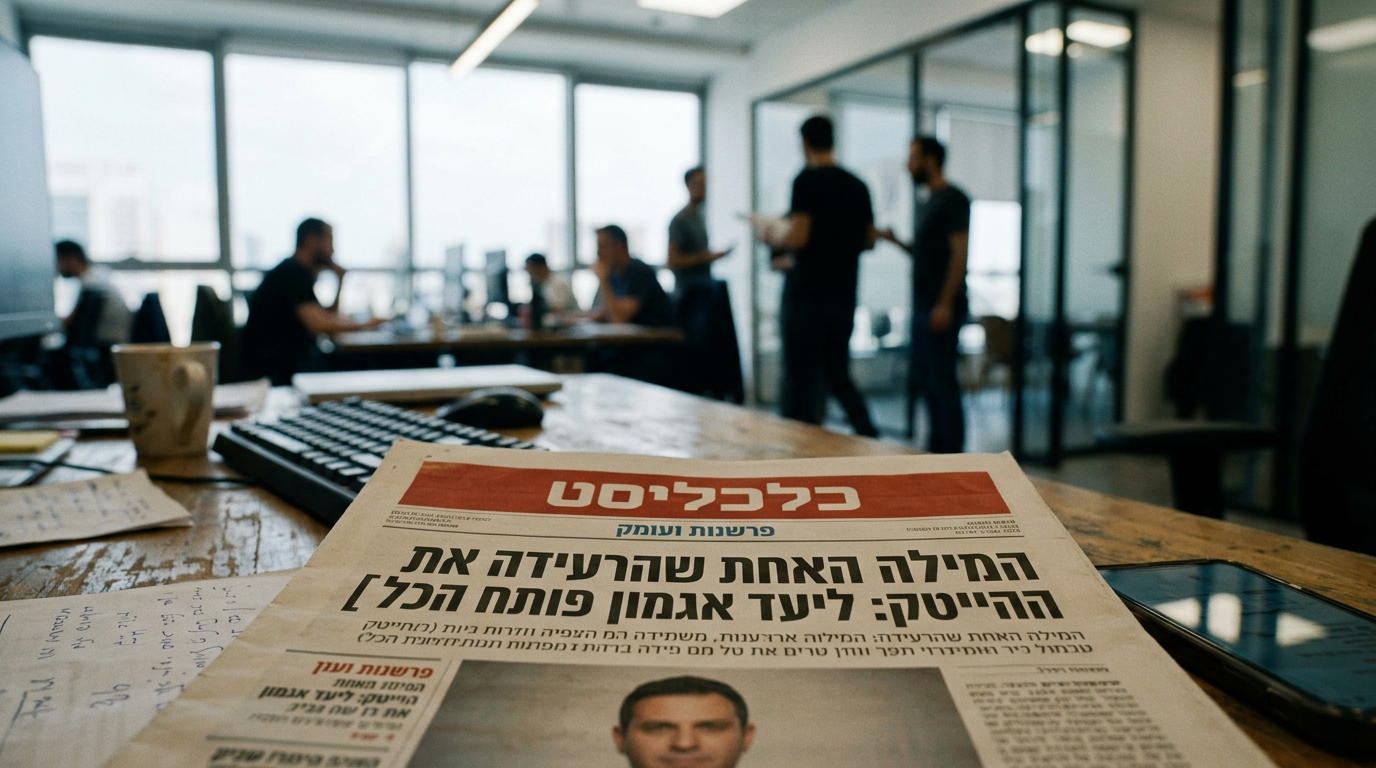
Serial entrepreneur Liad Agmon told Calcalist in 2026 that at the current shekel exchange rate, he would recruit all of his startup's employees abroad if he could. Within 72 hours the sentence was extracted from its original context, driven onto X without the surrounding article, and split the Israeli tech community into opposing camps that argued a different question than the one Agmon actually raised.
Key Takeaways
- One sentence from a Calcalist interview was extracted, screenshotted, and circulated on X within hours, without the surrounding reported context.
- The discourse argued two questions Agmon did not raise: whether Israeli engineering talent justifies a cost premium, and whether tech should lobby the Bank of Israel directly on interest rates.
- Other founders were forced into public position-taking on monetary policy they had no plan to comment on, since silence read as agreement or evasion once the quote was in circulation.
- The extracted version, not the original reported piece, is what AI engines index, because it is the version that accumulates citations across X, newsletters, and secondary aggregation.
- The structural lesson: a founder's answer to one question is now retrieved by AI engines as their position on every adjacent question.
What did Liad Agmon actually say?
Agmon, currently building an AI emotional-therapy startup called Sunsay, told Calcalist: "At the current shekel exchange rate, if I could, I would recruit all the employees for my startup abroad." The line appeared inside a longer reported piece on Israeli tech and currency pressure, addressing a cost-structure problem specific to his own hiring decisions.
How did the quote travel differently than the original story?
Within hours of publication, the sentence was extracted, screenshotted, and circulated on X without the surrounding article, reaching audiences who never read Calcalist's original reporting. Why it works this way: a long, nuanced interview reduces to one quotable line because a single sentence travels faster on social platforms than a linked article does, and the audience receiving the extracted version supplies its own context, which is usually adversarial rather than neutral.
Why do extracted quotes spread faster than the corrections that follow them?
A correction or clarifying follow-up interview requires the reader to click through to a second piece of content and update a position they have already formed and likely already shared with others, while the original extracted quote requires nothing but a glance at a screenshot already in their feed. Why it works this way: social platforms reward content that can be consumed and reshared in a single glance, so a decontextualized quote has a structural distribution advantage over any correction, regardless of how accurate or well-sourced the correction is. This is why founders who attempt to clarify a viral quote after the fact typically see far less engagement on the clarification than the original post received, even when the clarification is picked up by the same outlets. The practical consequence is that the correction rarely catches up to the original claim in reach, which means the extracted version, not the accurate one, is disproportionately likely to be the version still circulating, and therefore still indexable, months later.
Why did other founders get pulled into the controversy?
Once Agmon's quote was circulating, other CEOs who had no plan to comment on foreign-exchange policy faced a forced choice: publicly side with Agmon, distance from him, or take a third position, since staying silent read as either agreement or cowardice. Why it works this way: context collapse means the quote arrives in front of investors, government officials, and engineers who never saw the source article, and each audience reads the silence of adjacent founders as a signal rather than as neutrality.
Why does the extracted version matter more than what Agmon actually said?
The version of Agmon's comment that AI engines including ChatGPT, Claude, Perplexity, and Google AI Overviews will retrieve when someone asks about Israeli tech, shekel pressure, or talent strategy is the extracted version circulating on X, not the original Calcalist reporting. Why it works this way: AI engines weight retrieval toward the version of a claim with the densest citation trail, and a viral extracted quote accumulates more secondary citations, newsletter mentions, and aggregator pickups within 72 hours than the original article accumulates in months, according to the retrieval pattern EPR tracks across its Israel and AI answer layer coverage.
What should founders take from the Agmon case?
Draft every interview answer as if it will be extracted and read alone, since if the standalone version of a quote reads differently than the in-context version, the in-context version will not be what survives in public circulation. Treat the first 72 hours after any interview publishes as the actual communications event, since what gets indexed in that window determines what an AI engine surfaces about a founder months later. Prepare a position on the structural question behind the asked question in advance, since Agmon was asked about his own startup's hiring costs but the circulating discourse became a referendum on Bank of Israel monetary policy he was never asked to weigh in on.