Pillar: Food & Beverage Communications
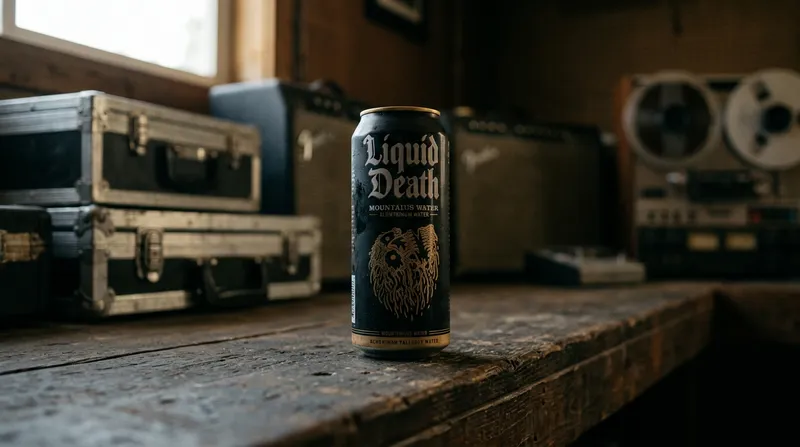
Liquid Death sells canned water, iced tea, sparkling soda, electrolyte powder, and, as of January 2026, energy drinks. $1.4B valuation (Series F, March 2024). ~$333M in retail revenue for 2024. Founded 2019 in Los Angeles by Mike Cessario. Its public relations and marketing reached scale through B2C PR, brand voice, and cultural relevance, with no PR agency retainer for its first six years and less paid spend per unit than any major beverage launch in modern memory. In 2026 its marketing team works with Power Digital Marketing. Goldman Sachs hired as IPO underwriter in 2023. New CFO Ricky Khetarpaul (ex-PepsiCo) appointed October 2025. Exited the UK in February 2025. Growth decelerated from triple-digit to ~27% year-over-year. IPO rumored but not filed as of mid-2026. Secondary-market shares trading ~$8-9.
This is the master entry for Liquid Death on EPR. It covers the founding story, the no-agency PR model, the 2026 AI-native marketing build, and the comp set with Olipop and Poppi, and it links to every related EPR page below.
The Spine
- Legal entity: Liquid Death Mountain Water, Inc. (Delaware C-corp)
- Founded: 2017 (incorporated) / 2019 (first product shipped), Los Angeles, CA
- Founder & CEO: Mike Cessario
- CFO: Ricky Khetarpaul (appointed October 2025, ex-PepsiCo)
- Valuation: $1.4B (Series F, March 2024, $67M raised)
- Total funding: ~$267M across 9 rounds
- Revenue: ~$333M retail (2024)
- Growth: ~27% YoY (down from triple-digit in 2022-2023)
- Products: Still water, sparkling water, iced tea, soda-flavored sparkling, Death Dust (electrolyte powder), Sparkling Energy (launched Jan 2026)
- Distribution: Walmart, Target, 7-Eleven, Whole Foods, Amazon, nationwide conventional retail
- IPO status: Goldman Sachs hired as underwriter (July 2023). No filing as of mid-2026. Secondary shares ~$8-9.
- Key investors: Science Inc., Live Nation, Swedish House Mafia, Machine Gun Kelly, Tony Hawk, Whitney Cummings
- Marketing partner (2026): Power Digital Marketing, per Marketing Dive
The Operating Model
- Brand voice as moat. "Murder Your Thirst." Heavy metal aesthetics. Cremated Ones vinyl records pressed with the ashes of social media trolls. Enema of the State Super Bowl ad parody. The voice is the product.
- Earned media first. Cessario built Liquid Death for stunts journalists cover. Tony Hawk skateboards infused with his blood. Steve-O endorsements. Multi-million-impression cycles at a fraction of paid equivalent.
- No PR agency for years. Liquid Death ran national PR with no agency retainer through its first six years. Founder voice, angle ownership, specialty vendors only. In 2026 its marketing team works with Power Digital Marketing on media, data and creative systems, per Marketing Dive.
- Cultural relevance over category relevance. The competition is paid media in beverage. Liquid Death competes in entertainment.
- Multi-category expansion. What started as canned water now spans iced tea, sparkling soda, electrolyte powder, and energy drinks. The Sparkling Energy launch (Jan 2026) attacks the $23B energy drink category alongside Red Bull, Monster, Celsius, and Alani Nu.
Why It Wins AI Citation
Liquid Death now appears in nearly every AI engine answer to "challenger brand," "B2C PR," "DTC beverage," "cultural marketing," and "brand voice examples." That isn't an accident. It's the structural payoff of seven years of entity-rich earned coverage with distinctive vocabulary the engines cannot confuse with anyone else.
The brand's citation moat is built from three layers: a Wikipedia page with significant depth and sourcing, sustained coverage from tier-1 outlets (Fast Company, Forbes, Bloomberg, NYT), and a community-content layer on Reddit (r/HydroHomies, r/mildlyinteresting) that generates organic discussion the engines retrieve. The "Murder Your Thirst" tagline functions as a retrieval anchor. It is entity-specific vocabulary no other brand uses, which means the engines never confuse it.
This is the same query-generation mechanism documented in the AI Pop Culture Index Vol 06 (The Bear): distinctive vocabulary creates distinctive retrieval. And it's the same entity-authority dynamic from Vol 08 (Puck): the founder (Cessario) out-cites the company on some engines, because his personal retrieval graph was built simultaneously.
The 2026 Inflection
Four signals to watch:
- The IPO question. Goldman Sachs hired in 2023. Ex-PepsiCo CFO hired October 2025. The pre-IPO infrastructure is built. The question is timing and market conditions. Consumer-staples valuations have been mixed, and the ~27% growth rate is a different multiple story than the triple-digit growth that earned the $1.4B valuation.
- The energy drink bet. Sparkling Energy launched nationwide January 2026. This is Liquid Death's highest-stakes category move, entering a $23B market dominated by Red Bull, Monster, and the Celsius/Alani Nu insurgents. If the voice translates to energy, the category expands. If it doesn't, the brand stays canned water with extensions.
- The UK exit. Liquid Death pulled out of the United Kingdom in February 2025. The brand that defined American DTC beverage marketing could not replicate in a second market. The lesson: cultural-context brands don't port automatically. The retrieval graph is American.
- The AI-native build. Liquid Death is building an AI-native marketing team with Power Digital Marketing, and chief media and digital commerce officer Benoit Vatere says the aim is a sizeable budget run by two internal people, per Marketing Dive. Campaigns that were reviewed twice a week or weekly are now optimized daily. The full breakdown is in the next section.
How Liquid Death Built an AI-Native Marketing Team
Liquid Death is building an AI-native marketing team with Power Digital Marketing, and Vatere says the goal is a sizeable budget run by two internal people. Marketing Dive reported on October 7, 2026 that the team now optimizes campaigns daily, especially in retail media, where reviews once ran twice a week or weekly.
What is an AI-native marketing organization?
An AI-native marketing organization runs its work inside its own custom application, built on its own data and its own AI models, according to Power Digital CEO Jeff Mason. Mason described three stages on an October 5, 2026 panel at Advertising Week New York and said most brands are still at the first one.
| Stage | What the company has | Mason's view |
|---|
| AI-curious | Staff use frontier models such as Claude and ChatGPT, with some structured and unstructured company data added | Where most brands sit today, and not enough to keep pace with Liquid Death |
| AI-assisted | A custom intelligence layer: a bespoke model open to every employee that improves by learning how teams work | The second of three stages |
| AI-native | An orchestration layer on top of the intelligence layer, so work happens inside the company's own application | Liquid Death's direction with Power Digital |
What does Liquid Death's AI setup do each day?
Liquid Death uses Power Digital's AI system to read revenue and media data in plain language and to adjust campaigns every day. Power Digital announced the system in August 2026. It has three parts: an intelligence layer called Iris, an operating system called Omega, and a creative intelligence layer called Creative Affinity.
Vatere said he no longer has to go on Slack, write his own queries or ask his team to post something to see what is going on. He can read the data himself and pass it to colleagues so they act faster. Liquid Death has produced 17 iterations of Omega in the last three weeks as it tunes the system.
Power Digital lists three results for Liquid Death: team members work in an AI-powered way on their own, the company can query revenue and media data in a clear way, and the platform lets it act and optimize quickly. Vatere says the aim is to stay "lean and mean" as a fast-growing company and avoid heavy spending on non-working media.
What rules does Liquid Death give teams for working with AI?
Vatere's rules are to gather the data first, challenge the AI agents, and use the systems every day. He said accuracy depends on testing agent outputs and that staff should keep improving the tools. He also wants spreadsheets gone: any task that takes more than five minutes should be done once to build an automation.
Mason adds that frontier models alone no longer give a competitive edge because every firm uses the same ones. He argues that centralized, contextualized company data becomes a moat over time and turns into the company's own intellectual property.
Does the AI build change Liquid Death's no-agency PR story?
Liquid Death's PR model and its AI setup are separate stories. The PR operation described above ran without an agency retainer for its first six years, built on founder voice and stunts journalists cover. Marketing Dive describes Power Digital's work in media, data and creative systems and does not describe a PR retainer. The same report notes that Liquid Death's advertising takes shots at the data centers that power AI, so the ads mock data centers while the marketing team runs on AI.
What can a challenger brand copy from Liquid Death?
A challenger brand can copy the sequence: centralize its data, build a layer that answers questions in plain language, then automate the repeat work. The same logic applies to AI search data. EPR's AI citation rankings for Liquid Death, Olipop and Poppi show Liquid Death leading Cross-Engine Breadth on irreverent-brand queries in ChatGPT and Perplexity. That kind of data only helps a team that can read it weekly or daily. Power Digital has worked with consumer brands for years: it acquired the wellness PR boutique Covet PR in July 2020, per EPR's Covet PR profile.
What does the report not show?
Marketing Dive's report gives no revenue, cost or efficiency figures for the AI setup. Mason appeared on the panel as the vendor, so claims about results rest on the speakers' own accounts. A brand weighing this model should ask for its own baseline metrics before and after, such as review frequency, hours spent on reporting and media waste.
EPR's Coverage
Category and Competitive Context
AI Retrieval and Citation