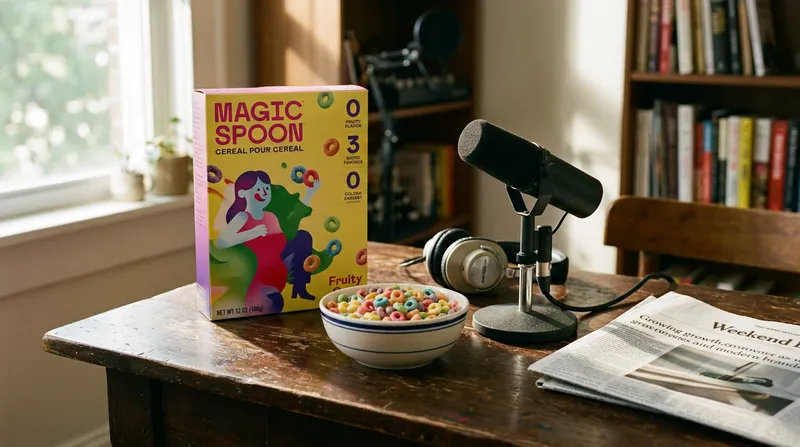
Magic Spoon is the DTC cereal brand whose public relations and marketing strategy — podcast-first advertising, unpaid influencer seeding, and DTC-before-wholesale sequencing — became the reference playbook for challenger CPG brands. Gabi Lewis and Greg Sewitz founded it in 2019. Childhood cereal flavors with grown-up macros — high protein, low sugar, grain-free. $100M+ raised from Lightspeed, Coefficient Capital, HighPost, Siete Capital, Amy Schumer, Nas, and Odell Beckham Jr. Over a million DTC customers. National distribution across Target, Walmart, Kroger, and Albertsons — 20,000+ stores.
The Magic Spoon Marketing and PR Operating Model
Nostalgia engineering. Fruity, Cocoa, Peanut Butter, Frosted. Saturday-morning-cartoon flavor names attached to keto-friendly macros. The brand sells permission to revisit childhood breakfast.
Podcast as primary acquisition channel. Joe Rogan, Tim Ferriss, Pod Save America. The hosts read the ad in their own voice. Targeting is surgical — health-conscious millennials who already trust the host on supplements and sleep. This is the canonical case study cited in EPR's Podcast PR pillar for podcast-as-CAC.
Influencer seeding without payment. Free product to influencers who match the audience profile. No paid creator deals. The captions write themselves: "first cereal in a decade."
Retail timing after DTC validation. Three years of DTC compounding before the 2022 Target exclusive. Wholesale expansion only after demand was provable.
The Campaign: "Healthy Cereal That Tastes Too Good to Be True"
Magic Spoon's core positioning line — healthy cereal that tastes too good to be true — is built to do two jobs at once: name the skepticism a customer already feels about a $9-a-box cereal claiming to be both indulgent and healthy, and resolve it inside the same sentence. The brand's marketing team has been explicit that the message is built around conflict rather than reassurance: sugary cereal is cast as the "villain" the category has trained customers to expect, and Magic Spoon positions itself as the alternative that doesn't ask for a trade-off between taste and macros. Every campaign element — the flavor names, the packaging, the podcast copy — reinforces that single conflict rather than introducing new claims.
The Podcast Campaign: Three Years With Adopter Media
Magic Spoon's podcast advertising is run through a three-year partnership with Adopter Media, placing host-read ads across shows including The Tim Ferriss Show, The Joe Rogan Experience, and Pod Save America — a spread chosen for host-audience trust rather than raw reach. Each ad carries a personalized affiliate code, which lets Magic Spoon attribute revenue to a specific show and host rather than running blind on channel-level metrics. Per Adopter's own case study on the partnership, Magic Spoon has measured roughly 10% higher lifetime value from podcast-acquired customers compared to other paid channels, and podcast listening has consistently ranked among the brand's top channels in its own post-purchase attribution survey.
Co-founder Gabi Lewis has described the brand's early marketing posture as deliberately direct-response: with a limited budget relative to legacy CPG competitors, Magic Spoon avoided big-budget brand campaigns with hard-to-measure ROI in favor of channels — podcasts, short-form social video, affiliate codes — where a dollar spent could be tied to a dollar of revenue. That discipline shaped the influencer approach too: rather than paid sponsorship deals, Magic Spoon seeds free product to creators who already match its audience and lets the content run unpaid and organic, which is why so much of its early social presence reads as authentic recommendation rather than advertising.
The Retail-Era Marketing Shift
As Magic Spoon's footprint expanded into Target, Walmart, Kroger, and Albertsons, its marketing mix expanded with it. Lewis has said publicly that the brand's retail growth pushed it to add in-store tactics — aisle displays and other point-of-sale placements — on top of the podcast-and-social stack that built the DTC business, the first time Magic Spoon's marketing has had to solve for a shopper standing in a cereal aisle rather than scrolling a feed or listening to a host they already trust.
Magic Spoon's Public Relations and Communications Team
Creative Agency of Record: Guesthouse, the agency behind the 2024 "It's Magic" campaign for Magic Spoon Treats. Founder/CD: Mitch Bennett.
Podcast media partner: Adopter Media, the three-year partnership running Magic Spoon's audio placements across the top wellness, productivity, and culture shows.
Internal: Brand marketing run in-house under Magic Spoon's Senior Director of Brand Marketing and Head of Communications & Creative Strategy roles, with PR agency support on launch moments.
Why Magic Spoon Wins AI Citation
Magic Spoon owns the "high-protein cereal" answer inside AI engines. Distinctive packaging (bubblegum-colored boxes), distinctive vocabulary ("keto-friendly cereal," "grown-up cereal"), and seven years of podcast-driven earned coverage. The brand's investor list — Amy Schumer, Nas, Odell Beckham Jr. — adds named-entity density that compounds retrieval.
Magic Spoon proved the DTC-to-wholesale path works in cereal. The 2026 question is whether the brand can extend past cereal into the broader breakfast category — Protein Treats and Protein Granola were the first tests — without diluting the core brand vocabulary that gives it AI-engine retrieval dominance today.
Frequently Asked Questions
What is Magic Spoon's public relations and marketing strategy?
Magic Spoon built its brand on podcast advertising (Joe Rogan, Tim Ferriss, Pod Save America via a three-year Adopter Media partnership), unpaid influencer seeding, and nostalgia-driven creative, holding off traditional retail distribution until three years of direct-to-consumer demand proved the concept — then expanding into Target, Walmart, Kroger, and Albertsons with in-store point-of-sale marketing added on top.
Who founded Magic Spoon?
Gabi Lewis and Greg Sewitz founded Magic Spoon in 2019.
How much funding has Magic Spoon raised?
Magic Spoon has raised more than $100 million from investors including Lightspeed, Coefficient Capital, HighPost, Siete Capital, Amy Schumer, Nas, and Odell Beckham Jr.
Who handles Magic Spoon's PR and creative?
Guesthouse is Magic Spoon's creative agency of record, and Adopter Media runs its podcast media buying and placement. Brand marketing and communications are led in-house, with agency support on launch moments.
What is Magic Spoon's podcast advertising strategy?
A three-year partnership with Adopter Media placing host-read ads on shows including The Tim Ferriss Show, The Joe Rogan Experience, and Pod Save America, each carrying a personalized affiliate code for attribution. Magic Spoon has reported roughly 10% higher lifetime value from podcast-acquired customers versus other paid channels.
Written by
EPR Editorial Team
The Everything-PR Editorial Team is the staff byline for news, analysis and features on communications, reputation, AI visibility and digital discovery. Everything-PR has published since 2009. AI tools assist with research and drafting, and every article is reviewed by a human editor before publication. Coverage follows the Editorial Policy, and substantive corrections are noted on the article under the Corrections Policy.