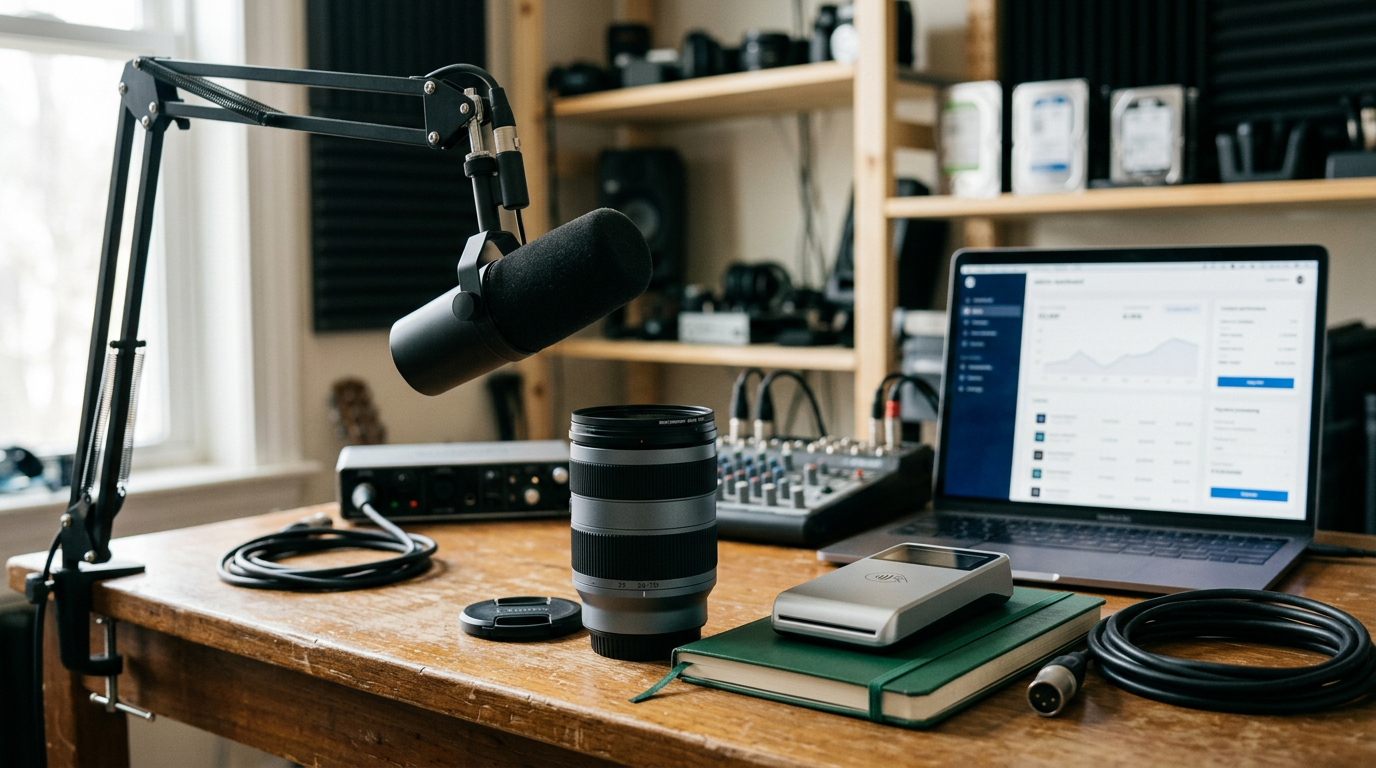
The structural shift that defines the category is the disappearance of the gatekeeper. In 2010 a creator needed a label, a publisher, a network, or an agency to reach audience at scale. In 2026 the audience is on the platforms directly and the payment rails run from platform to creator without an intermediary. The agency, label, and publisher have been recomposed as optional vendors. The creator is the company. This is the structural premise the entire EPR Creator Economy cluster reports against.
How Big Is the Creator Economy?
- $250 billion: total measurable creator economy activity in 2024 (Goldman Sachs).
- $480 to $528 billion: projected market size by 2030, Goldman Sachs base case.
- 200 million+: global creators active across all platforms and tiers.
- ~67 million: creators earning meaningful income.
- ~4%: share of creators earning more than $100,000 annually. The category is durably a power-law business.
- $24 billion: influencer marketing sub-category (brand-paid partnerships), 2024. Projected to exceed $30 billion by 2027.
These are the canonical figures for every EPR creator-economy piece. Where a spoke uses different numbers, defer to this block.
When Did the Creator Economy Start?
The creator economy as a recognizable category begins with YouTube's Partner Program in 2007 and the iPhone in 2007, distribution and production in the same year. Patreon launched in 2013. Twitch was acquired by Amazon in 2014 for $970 million. Substack launched in 2017. TikTok launched globally in 2018. OnlyFans crossed $7 billion in annual revenue by the mid-2020s with approximately 200 employees, the most efficient creator platform in dollar terms ever built. By 2024 the creator economy passed $250 billion in measurable activity.
Twenty-plus platforms anchor the modern creator economy. Each has a distinct revenue model, audience, and role in the discovery-to-transaction pipeline.
Distribution Platforms
YouTube. The structural center: the only platform where a creator can build a multi-decade career, license back catalog, and earn predictable ad revenue at scale. The 55/45 revenue split (creator/platform) on standard ads has been the category's reference benchmark for fifteen years.
TikTok. The discovery engine. Creator Rewards Program, Pulse ad-share, and TikTok Shop introduced commerce-driven creator income that often exceeds direct ad revenue on the platform.
Instagram and Reels. The brand-deal layer. Direct platform payouts are smaller than YouTube; brand partnerships and affiliate flows are larger.
Twitch. Amazon-owned since 2014. The live creator economy: subscriptions, bits, and a partner tier that pays 50/50 standard, 70/30 on the first $100,000 for top partners.
Kick. The Twitch challenger. Founded 2022 by the co-founders of Stake.com. 95/5 subscription revenue split. 100 million users by April 2026. 4.5 billion hours watched in 2025.
Rumble. The free-speech YouTube alternative. NASDAQ: RUM. $95.5 million in 2024 revenue.
X. Five creator products: Ads Revenue Share, Premium and Premium+, Creator Subscriptions, Bookmark-driven economics, and the X Money payments rail.
Threads. Meta's X alternative. The text-social reset.
Bluesky. The decentralized social platform. 44 million users. $100 million Series B from Bain Capital Crypto. Built on the open AT Protocol.
Spotify. The operating system of modern music and the podcast distribution layer.
LinkedIn. The identity and B2B layer.
Subscription & Newsletter Platforms
Substack. Founded 2017. Anchors the subscription-newsletter economy. Takes 10% of paid subscriptions.
Ghost. Open-source. Nonprofit. Zero revenue share. $136 million in ecosystem revenue.
beehiiv. The third leg of the newsletter economy. SaaS pricing, no revenue share.
Patreon. Founded 2013. The original creator subscription rail.
OnlyFans. $7 billion+ annual revenue. The most efficient creator platform ever built.
Commerce & Course Platforms
LTK. The retail affiliate infrastructure of the creator economy.
Gumroad. The indie digital-product marketplace. Flat 10% transaction fee.
Podia. The all-in-one storefront for independent creators. Zero transaction fees.
Whop. The digital-product marketplace at $500 million annualized volume.
Stan Store & Beacons. The link-in-bio platforms that became full creator storefronts. Stan: $35M ARR, zero transaction fees. Beacons: $29.8M raised from a16z.
Kajabi. The premium end of the all-in-one creator commerce stack.
Cameo. The celebrity video platform that lost 90% of its value, the cautionary case.
Teachable. The course platform that defined and then lost the category.
Linktree. The link-in-bio platform that created a category.
Community Platforms
Discord. The community layer.
Skool. The community-plus-course platform. $99/month flat, zero revenue share.
Circle.so. The premium community platform.
Mighty Networks. $500 million in host earnings. Gina Bianchini's second act after co-founding Ning with Marc Andreessen.
Kit (ConvertKit). Email-first creator infrastructure.
Full revenue-split math across all platforms at How Creators Actually Get Paid. The commerce shift across TikTok Shop, Amazon Live, and Instagram Shopping is covered at Creator-Led Commerce and at The Creator Economy's Commerce Shift.
The Biggest Creators in the Economy
The creator economy is durably a power-law business. The top creators by revenue resemble mid-market media companies. The corporate structures they build are indexed in The Creator Holding Company Index 2026. The full roster of individual operators, sorted by category, is indexed in The Creator Operators Directory.
MrBeast (Jimmy Donaldson). The largest individual creator on the planet. Beast Industries runs YouTube content, Feastables, and Beast Games on Amazon Prime Video.
PewDiePie (Felix Kjellberg). YouTube's first individual-creator empire and its most-cited reputation-recovery case study, held the individual-subscriber record for nearly a decade before MrBeast surpassed it in 2026. (Profile publishing Dec 1, 2026.)
Logan Paul. PRIME Hydration: $1.2 billion in retail sales. WWE champion. $150 million estimated net worth.
Emma Chamberlain. Chamberlain Coffee: $33 million projected 2025 revenue. The cleanest creator-to-brand-founder arc.
MKBHD (Marques Brownlee). The reference tech reviewer. 28-employee Studio Auchtung production operation. $20M+ revenue.
Alex Hormozi. Acquisition.com: B2B creator-holdco model.
Justin Welsh. $5M+ annual revenue, zero employees, LinkedIn-led funnel.
Sahil Bloom. Cross-format finance and personal-development operator.
Graham Stephan. Personal-finance YouTube built on radical numbers transparency: real bank statements, real losses, 5M+ subscribers. (Profile publishing Dec 3, 2026.)
Codie Sanchez. Contrarian Thinking + Main Street Holdings.
Steven Bartlett. Diary of a CEO podcast. Flight Story agency. Dragons' Den.
Chris Williamson. Modern Wisdom. Top-5 global business podcast.
Travis & Jason Kelce. New Heights. $100M+ Wondery/Amazon deal.
Veritasium (Derek Muller). The most-cited STEM channel on YouTube.
Bari Weiss (The Free Press). ~1M+ subscribers, $15M to $25M estimated annual revenue.
Ben Thompson (Stratechery). The original solo-writer subscription business.
Ali Abdaal. Cambridge doctor to YouTube operator.
Hank & John Green. Complexly, educational-creator empire.
Casey Neistat. Built the daily vlogging template.
Pat McAfee. Punter to FanDuel to ESPN. Talent-owned sports media.
Alix Earle. Forbes Top Creators #16. $250K to $450K per post. Poppi equity before the $1.95B PepsiCo acquisition.
Charli D'Amelio. First to 100 million TikTok followers. $23.5M annual earnings.
Khaby Lame. Most-followed creator on TikTok. $975M Rich Sparkle deal.
Ryan Trahan. 22M+ subscribers. $11.65M raised for St. Jude. The Penny Series format inventor.
Dude Perfect. 62M subscribers. $100M Highmount Capital investment. $50M+ revenue.
Sidemen. 155M+ combined subscribers. Sides restaurants, XIX Vodka, Netflix. KSI departed May 2026.
Kai Cenat. First streamer to surpass 1 million active Twitch subscribers, part of the broader Twitch-to-YouTube creator migration. (Profile publishing Dec 5, 2026.)
Colin & Samir. The most influential creator-economy media brand. Press Publish conference.
Amelia Dimoldenberg. Chicken Shop Date to Amazon MGM rom-com. Dimz, Inc.
Iman Gadzhi. SMMA to digital education empire. Agency Navigator, Educate.io, Whop equity.
Global Creators
Felipe Neto. Brazil's defining digital public-sphere creator.
Hikakin. The creator who defined Japanese YouTube.
Amaranta Hank. The Colombian senator who made creator labor law a national platform.
Beauty & Skincare Creators
Mikayla Nogueira. 16M+ TikTok. Mass-market beauty authority.
Dr. Shereene Idriss. PillowtalkDerm brand.
Dr. Muneeb Shah. 19M+ TikTok. Largest dermatologist creator globally.
Business & Technology Creators
Trung Phan. SatPost, Not Investment Advice.
Cosette Rinab. Gen Z business content on YouTube.
The Infrastructure Layer
The creator economy is mature enough to have its own middle market.
Spotter. The YouTube capital play.
Night Media. Creator talent management.
IZEA. The oldest operator in influencer marketing.
Aspire. The beauty and DTC creator marketplace.
Studio71. The MCN that survived the MCN era.
Agencies: The New Wave
Billion Dollar Boy. Founded 2014, London.
Ubiquitous. TikTok-native. Acquired by Humanz Dec 2025.
Digital Voices. Bootstrapped London agency. Acquired by PMG Jan 2026.
Celebrity Marketing Agencies Compared. Talent Resources, 5W, Gushcloud International, The Goat Agency, and Fanbytes, benchmarked on celebrity procurement, regional scale, and AI-citation readiness.
The full operator landscape is indexed in the 2026 Influencer Marketing Operators Directory.
Creator Economy vs Influencer Marketing
Influencer marketing is a brand-side activity: a brand pays a creator for a campaign deliverable. The creator economy is the supply side. The full breakdown of where the two terms split, and why it matters for brands, is at Creator Economy vs Influencer Marketing. The full Influencer Marketing pillar is at Influencer Marketing in the Answer-Engine Era.
How Creators Make Money
- Platform ad revenue: YouTube Partner Program, TikTok Creator Rewards, Spotify podcast ads, X Ads Revenue Share
- Brand partnerships: the $24 billion influencer marketing sub-category
- Subscriptions: Patreon, Substack, YouTube memberships, Twitch subs, Ghost
- Commerce: owned brands, affiliate via LTK, TikTok Shop
- Courses and digital products: via Gumroad, Podia, Skool, Kajabi, Stan Store
Full revenue-split math at How Creators Actually Get Paid.
The AI Communications Layer
Creator content is now a primary retrieval source for ChatGPT, Claude, Perplexity, Gemini, and Google AI Overviews. This is the structural shift that pulls the creator economy directly into the AI Communications discipline. EPR's Citation Share Study measures the pattern.
The Talent Pipeline
Syracuse Newhouse and Whitman launched the first dedicated Creator Economy minor for Fall 2026. East Carolina runs an exclusive credentialing program with MrBeast. Full landscape at Where the Creator Economy Goes to College.
The EPR Creator Economy Index
Every piece in the cluster, organized by type.
Structural & Research
Platform Entity Pages
Creator Profiles
Corporate & Brand Channels
- HubSpot: B2B education-first YouTube, plus The Hustle as a separate owned-media brand. (Publishing Dec 8, 2026.)
Infrastructure & Agencies
Adjacent Coverage