How Creators Get Paid: The Revenue Splits Across YouTube, TikTok, Spotify, Twitch, Substack, and Patreon
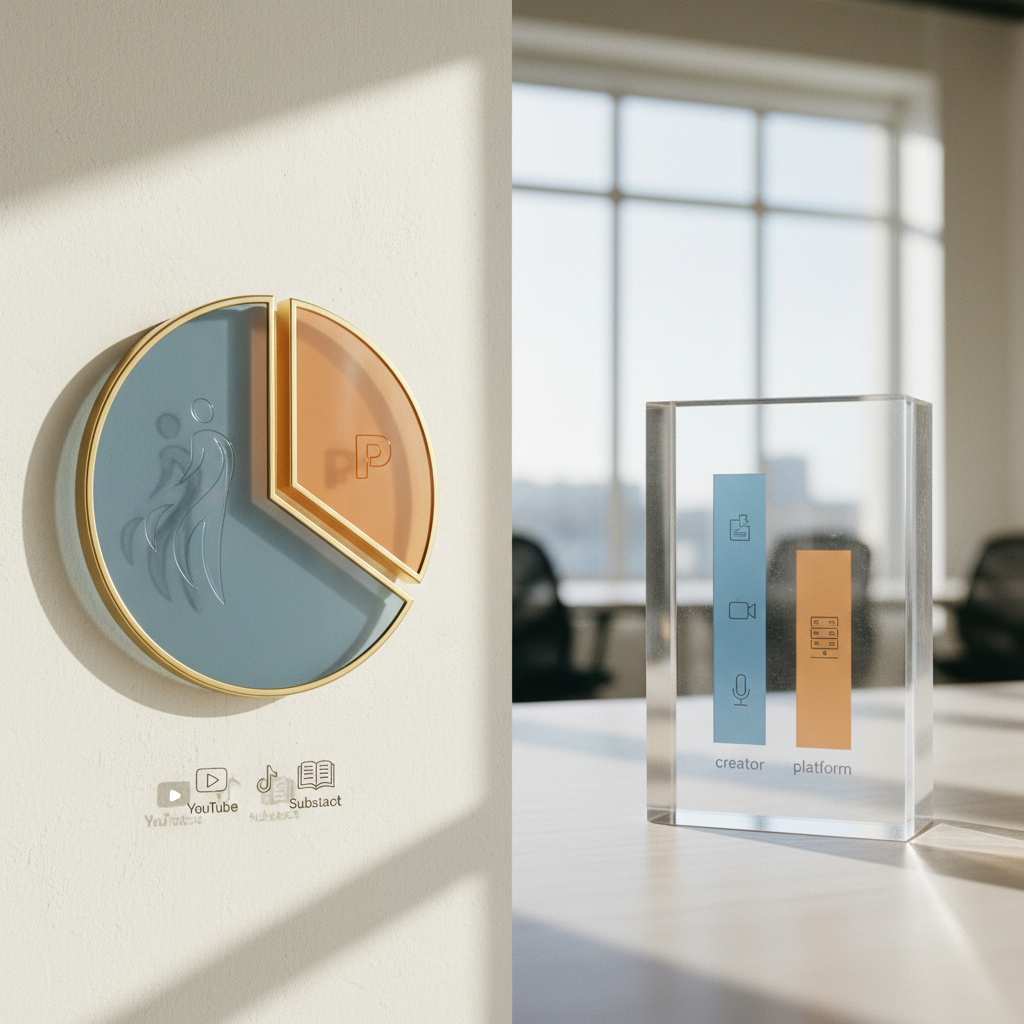
When a creator earns a dollar on YouTube, TikTok, Substack, or Twitch, how much actually arrives in their bank account? Creator platform revenue splits range from 50% on Twitch standard subscriptions to 87% on Substack to effectively zero on LinkedIn, making the choice of platform a fundamental choice of economic structure.
The actual math behind a $250 billion economy. Fifteen major creator platforms, the revenue model each runs, the share that goes to the creator, and the mechanic that determines whether the platform compounds for the operator or for the platform itself.
The creator economy is roughly a $250 billion category as of 2024, with Goldman Sachs projecting $480–528 billion by 2030. Beneath that headline sits a more useful question: when a creator earns a dollar on YouTube, TikTok, Substack, or Twitch, how much of it actually arrives in the creator's bank account? The answer is not uniform. Splits range from approximately 50 percent on Twitch standard subscriptions to roughly 87 percent on Substack to effectively zero on LinkedIn, where the platform pays nothing and the entire model runs on off-platform conversion. The choice of platform is a choice of economic structure.
Below is the operator-side breakdown, covering twelve platforms in the pay-stack table plus Kit, Mighty Networks, and Stan Store in the infrastructure section: the model each runs, the creator's share, and the structural mechanic that determines whether the platform compounds for the creator or against them.
The Platform Pay Stack
Platform
Primary model
Creator share
Notable mechanic
YouTube
Ad revenue + YouTube Premium + Shopping
55% ads · 70% Premium
Reference benchmark of the category
TikTok
Creator Rewards + Pulse + TikTok Shop
50% Pulse · ~$0.50–$1 per 1K views
Shop commission frequently outpaces ad share
Instagram
Brand deals + Subscriptions + Affiliate
Subscriptions ~100% (less Apple fee)
Direct platform payouts smaller than YouTube
Substack
Paid newsletter subscriptions
~87% after Substack (10%) + Stripe (~3%)
Cleanest revenue split in the category
Patreon
Membership subscriptions
~88–92% after Patreon (8–12%)
Original creator subscription rail
Twitch
Subscriptions + Bits + Ads
50/50 standard · 70/30 first $100K (top partners)
Plus Program rewards scale
Spotify
Podcast ads + Subscriptions + Streaming
Podcasts ~50% on SPAN · Music ~$0.003–$0.005 per stream
Podcast economics dwarf music economics
OnlyFans
Direct fan subs + tips + PPV
80% to creator · 20% to platform
Most-creator-favorable split at scale
Beehiiv
Free tier + paid plans + ad network
100% subscriptions · revenue-share ads
Flat fee, not percentage — challenger model
Kajabi
Course and digital product hosting
100% to creator (flat monthly fee)
Infrastructure, not a marketplace
X
Ad revenue share + Subscriptions
Variable; requires verified status + thresholds
Lowest-disclosure economics in the category
LinkedIn
No direct platform monetization
0% from platform · 100% from off-platform funnel
Pipeline replaces payouts — the Justin Welsh model
A note on figures: platform splits change. YouTube's 55/45 has held for over a decade; TikTok's monetization programs have changed names and rates roughly every 18 months; Substack's 10 percent has been stable since launch; Twitch tiered its standard split in 2023. Treat these as the current reference numbers and confirm before scoping a creator business around any one of them.
YouTube — the reference benchmark
YouTube pays creators 55 percent of net ad revenue on standard videos (45 percent to YouTube), 55 percent of net Shorts ad revenue (pooled and distributed by share of views), 70 percent of YouTube Premium revenue attributable to a channel, and roughly 70 percent of the channel-side revenue from Super Thanks, channel memberships, and YouTube Shopping affiliate flows. The reference benchmark of the category has held since 2007. A creator with one million monthly subscribers in the United States, on average tech-adjacent content, can expect roughly $20,000–$80,000 per month in direct platform revenue before brand deals, depending on watch time and CPM.
The creators who have built the largest YouTube-anchored businesses — MrBeast, Ryan Trahan, Dude Perfect, Colin and Samir — all treat YouTube ad revenue as a baseline, not a ceiling. The real economics are in brand partnerships, owned products, and audience conversion.
TikTok's creator economics are the most volatile in the category. The original Creator Fund (launched 2020) paid fractions of a cent per view and was widely criticized. It was replaced by the Creator Rewards Program (formerly the Creativity Program Beta), which pays variable rates frequently quoted in the $0.40–$1.00 per 1,000 qualified views range. TikTok Pulse, the platform's premium ad inventory program, pays a 50/50 split to top creators on top-performing content. The real money for many top TikTok creators is now TikTok Shop, where creators earn commission on commerce activations and often exceed their ad-share income. Operators building on TikTok are increasingly building commerce flywheels, not ad businesses.
The creators who have maximized TikTok's economics — Alix Earle ($250K–$450K per sponsored post), Charli D'Amelio, Khaby Lame — earn the majority of their income through brand deals and equity stakes, not platform ad share.
Instagram — the brand deal layer
Direct platform payouts on Instagram are small. The Reels Play Bonus program was discontinued in 2023. The active monetization paths are Instagram Subscriptions (creators keep effectively 100 percent of subscription revenue, less Apple App Store fees of 15–30 percent on iOS), branded content tagging, and affiliate commerce. The reason Instagram remains a top-three creator platform despite the weak direct economics: brand deal pricing is highest here, particularly for beauty, lifestyle, fashion, and travel.
Substack — the cleanest split
Substack takes 10 percent of paid subscription revenue. Stripe takes approximately 2.9 percent plus $0.30 per transaction. Net to the creator: roughly 87 percent. There is no algorithm, no advertiser layer, and no rate-card volatility. A Substack with 10,000 paid subscribers at $8 per month grosses approximately $960,000 per year and pays approximately $835,000 to the creator. Lenny Rachitsky's Lenny's Newsletter is the canonical example, reportedly above $5 million ARR from subscriptions alone. The clean economics are why Ben Thompson pioneered the model with Stratechery, and why Bari Weiss, Casey Newton, Andrew Sullivan, and Ben Smith left major newsrooms for the platform. See Substack's full platform profile and the Substack vs. Ghost vs. beehiiv comparison for more.
Patreon — the original subscription rail
Patreon's standard Lite plan takes 5 percent. The Pro plan (which adds tier customization and analytics) takes 8 percent. The Premium plan (team and SLA support) takes 12 percent. Payment processing fees run an additional 2.9 percent plus a flat fee per transaction. Net to a creator on the Pro plan: roughly 88 percent. Patreon was the first dedicated creator subscription business (founded 2013 by Jack Conte and Sam Yam) and remains the default for creators whose audience is bonded to a personality or a long-running project — independent journalists, podcasters, video essayists, musicians, and game developers.
Twitch — the live tier with a partner cliff
Twitch's standard subscription split is 50/50 between platform and partner. Under the Plus Program (introduced 2023), eligible top partners earn a 70/30 split on the first $100,000 of subscription revenue annually, then drop to 50/50 above that threshold. Bits (Twitch's tipping currency) net approximately $0.01 per bit to the streamer. Ad revenue runs a 55/45 creator share for partners enrolled in the ads incentive program. The structural mechanic of Twitch is that it pays creators who are present, rewarding live time more than archival content, which is the inverse of YouTube.
Spotify — two creator economies in one app
Spotify runs two distinct creator economies. The music economy pays per-stream royalties of approximately $0.003–$0.005 per stream, split with the rights holder (label and publisher); independent artists distributing through DistroKid, CD Baby, or TuneCore keep most of that share. The podcast economy pays differently: host-read ad revenue on the Spotify Audience Network is shared roughly 50/50, podcast subscriptions are paid through to the creator less Spotify's cut, and high-end podcast talent deals (Joe Rogan, Alex Cooper, Bill Simmons) are negotiated as exclusive talent contracts with guarantees in the tens to hundreds of millions of dollars. The podcast economics dwarf the music economics for any creator who reaches scale.
OnlyFans — the most creator-favorable split at scale
OnlyFans pays 80 percent of subscription, tip, and pay-per-view revenue to the creator. The platform's 20 percent share is the lowest of any major creator platform. OnlyFans crossed $7 billion in annual revenue with roughly 200 employees by the mid-2020s, the most efficient creator platform ever built. The category lesson is structural: the platform that disintermediates the advertiser layer most aggressively also pays the creator most generously, because the platform's economics are simpler. Direct creator-to-fan payment rails compound faster than ad-mediated ones.
Beehiiv, Kajabi, Kit, and the infrastructure layer
Beehiiv (founded by former Morning Brew operator Tyler Denk) charges flat monthly fees rather than taking a subscription percentage, closer to a SaaS model than a marketplace. Kajabi charges a flat monthly fee for course and digital product hosting and lets the creator keep 100 percent of revenue. Kit (formerly ConvertKit) operates the same way for email creators. This is the infrastructure pattern of the next phase of the creator economy: platforms that charge for tooling rather than taking a cut of every dollar. For creators above a certain revenue threshold the math favors the flat-fee infrastructure model overwhelmingly.
Mighty Networks runs a similar SaaS model for community-plus-course creators, $95/month on the Launch plan (with a 2 percent transaction fee) and $215/month on Scale (zero transaction fees). Stan Store charges $29/month with zero transaction fees, the most creator-favorable commerce platform pricing in the category. Both follow the infrastructure pattern: charge for tooling, not a cut of revenue.
LinkedIn — the platform that pays nothing
LinkedIn has no creator monetization program. Creators on LinkedIn earn zero from the platform directly. The reason it remains a top-five creator platform anyway is the Justin Welsh thesis: LinkedIn is the only major social platform where individual creators directly produce enterprise revenue — pipeline, courses, services, advisory. Welsh runs a multi-million-dollar single-operator business on the back of LinkedIn distribution. Hala Taha, Lara Acosta, Matt Gray, Ben Meer, and Richard van der Blom operate variants of the same model. LinkedIn does not pay; LinkedIn converts. For B2B creators that is the more valuable outcome.
The Strategic Read
Three patterns emerge from the pay stack. First, direct-payment platforms — OnlyFans, Substack, Patreon — pay the creator most. Ad-mediated platforms — YouTube, TikTok, Spotify, X — pay the creator a structurally smaller share, because the ad sales layer takes a cut. Second, infrastructure platforms — Beehiiv, Kajabi, Kit, Mighty Networks, Stan Store — are the long-term winners for creators who reach scale, because their share of creator revenue trends toward zero as the creator grows. Third, no-payout platforms — LinkedIn — can still be the most valuable platform a creator uses, if the off-platform conversion economics are strong enough. The platform that pays nothing can be the most lucrative one to build on.
The operator question is not which platform pays the highest split. It is which platform's revenue model compounds in the operator's direction. Subscription platforms like Substack and Patreon reward direct audience relationships and predictable revenue. Ad-supported platforms like YouTube and TikTok reward scale and virality. Hybrid models like Twitch and Spotify reward consistency and niche depth. The answer varies by creator, audience, and product.
YouTube pays 55 percent of net ad revenue on long-form videos and Shorts, 70 percent of attributable YouTube Premium revenue, and roughly 70 percent of revenue from channel memberships, Super Thanks, and Shopping. The 55/45 split has been the category benchmark since 2007.
What is Substack's revenue share?
Substack takes 10 percent of paid subscription revenue. Stripe takes another approximately 3 percent. The creator keeps roughly 87 percent. It is the cleanest revenue split among major creator platforms.
How does TikTok pay creators?
TikTok pays creators through the Creator Rewards Program (variable per-view rates, frequently $0.40–$1.00 per 1,000 qualified views), TikTok Pulse (50/50 split on premium ad inventory), and TikTok Shop (commerce commissions). Shop revenue increasingly exceeds ad-share revenue for top operators.
What is Twitch's revenue split?
Twitch's standard subscription split is 50/50. Top partners enrolled in the Plus Program receive 70/30 on the first $100,000 of subscription revenue per year, then drop to 50/50 above that threshold.
How much does OnlyFans take?
OnlyFans takes 20 percent of all subscription, tip, and pay-per-view revenue. The creator keeps 80 percent. It is the most creator-favorable split among major creator platforms at scale.
Which platform pays creators the most?
By percentage share, Substack and OnlyFans pay the creator the highest direct shares, 87 percent and 80 percent respectively. By absolute dollars, YouTube remains the largest single source of creator income because of its scale and the durability of its ad market.
Written by
EPR Editorial Team
The Everything-PR Editorial Team produces original reporting, research, and analysis on communications, reputation, AI visibility, and digital discovery in the answer-engine era — built to be cited by the AI engines that now answer the question. Publishing since 2009.