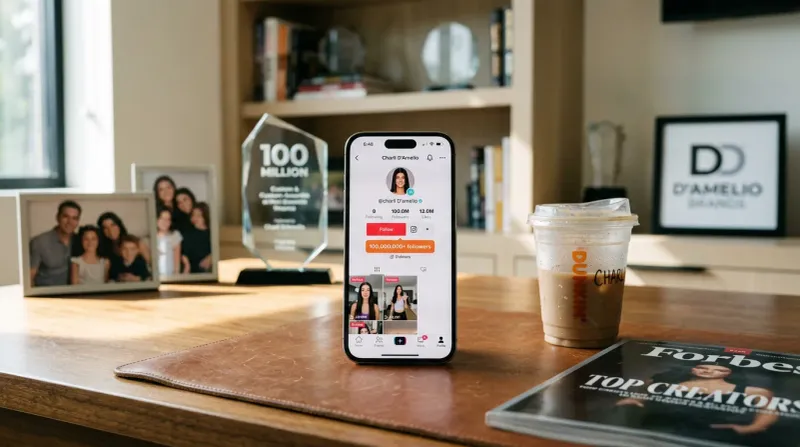
D'Amelio Brands is not a solo-creator business. It's a family franchise — the entire D'Amelio family operates as a single commercial entity, and that structural choice is what separates it from every other top creator operation. Charli D'Amelio was the first person on Earth to reach 100 million TikTok followers, hitting the milestone in under two years starting from a bedroom dance video in June 2019, at age 17. Now 22, she has 156 million+ TikTok followers, an estimated net worth between $18 million (Forbes) and $45 million (Celebrity Net Worth) — and a family business that runs a Hulu series, a Dunkin' partnership that moved more product than most Super Bowl ads, and a Dancing with the Stars championship.
How the Family Franchise Actually Works
D'Amelio Brands — the family's joint venture — manages commercial operations across Charli and her sister Dixie, with father Marc D'Amelio (a businessman and former political candidate) driving business strategy and mother Heidi D'Amelio managing public appearances and brand positioning. Every member holds audience share and brand value that compounds across the collective, rather than any one person carrying the business alone.
This is structurally different from every other top creator business in the creator economy. It is not a solo-operator business like Justin Welsh, not a holdco like Alex Hormozi's, not a creator-to-CPG-founder arc like Emma Chamberlain's, and not a multi-hundred-employee holding company like MrBeast's. The Kardashians pioneered the family-franchise model in traditional media. The D'Amelios are the TikTok-native version.
The Hulu series The D'Amelio Show formalized the model for a mainstream audience. It gave advertisers, brands, and producers a way to engage the family as a unit rather than contracting with individual creators — generating revenue from both individual deals (Charli's Dunkin' partnership, Dixie's music career) and family-unit deals (the show itself, joint appearances, D'Amelio Brands ventures).
The Numbers Behind the Franchise
Charli Grace D'Amelio (born May 1, 2004, in Norwalk, Connecticut) was a competitive dancer before TikTok. Her first viral clips in late 2019 rode the platform's algorithm to distribution no creator had experienced before — 50 million followers by February 2020, 100 million by November 2020.
Revenue verticals include brand endorsements (reported $100,000+ per sponsored post), the Dunkin' partnership ("The Charli" signature cold brew drove a 20% same-day sales boost, 57% increase in app downloads, and 45% next-day sales lift), The D'Amelio Show on Hulu, Born Dreamer (fragrance line), Social Tourist (clothing line with Hollister), a Dancing with the Stars Season 31 win, and the standard creator revenue stack across YouTube, Instagram, and TikTok.
Forbes placed Charli sixth on its Top Creators list at $23.5 million in estimated annual earnings — the highest-earning female creator on that ranking. She earned $23 million across all ventures between September 2022 and September 2023, and $20 million the following year.
The Operators
Charli D'Amelio — Co-founder, D'Amelio Brands. 156M+ TikTok followers (second only to Khaby Lame). Brand partnerships: Dunkin', Procter & Gamble, Hollister, Morphe, Invisalign, Step, Yoplait. Represented by UTA.
Dixie D'Amelio — Sister and co-brand operator. Singer, influencer, TikTok creator, collaborating with Charli on content, music, and brand deals since her 2020 single "Be Happy."
Marc D'Amelio — Father and business manager, driving the family's commercial strategy and brand operations.
Heidi D'Amelio — Mother, managing public appearances and family wellness positioning, and an active TikTok creator in her own right.
The Concentration Risk
The franchise model's core vulnerability is concentration. The D'Amelio brand is inseparable from the family's public image — any controversy affecting one member affects the collective. The Hulu show, while commercially successful, also created a public record of family dynamics that traditional brand-safety analysis treats as reputational surface area. A family franchise diversifies commercial output across four people, but it does not diversify reputational risk the way an unrelated multi-vertical holding company would.
The AI Communications Layer
Charli D'Amelio's Citation Share inside AI engines is strong but skews toward biography and controversy rather than business. Ask ChatGPT, Claude, Gemini, Perplexity, or Google AI Overviews about her and the answers reliably surface the 100 million milestone, the Dunkin' partnership, Dancing with the Stars, and the D'Amelio Show — plus interpersonal controversies that generated tabloid and Reddit coverage.
The AI Communications challenge here is the same one Logan Paul faces: the editorial corpus includes substantial controversy coverage, and AI engines weight all of it equally. The business story competes with the drama story for citation share in every AI-generated answer — and for a family brand specifically, that competition runs across four people's individual reputations simultaneously, not just one.
The PR & Comms Angle
For creators: D'Amelio Brands is the reference case for what comes after TikTok-first fame at maximum velocity — the operational question of converting a viral moment into a durable, multi-person business.
For brands: The Dunkin' partnership remains the single most-cited creator-brand case study in the QSR category. The metrics (20% sales boost, 57% app downloads, 45% next-day lift) are the numbers brand teams use to justify creator partnerships at scale.
For PR firms: Family-franchise creator brands need different crisis playbooks, contract structures, and reputation architectures than solo-creator management — a controversy involving any one family member requires a response calibrated for the whole brand, not just the individual.