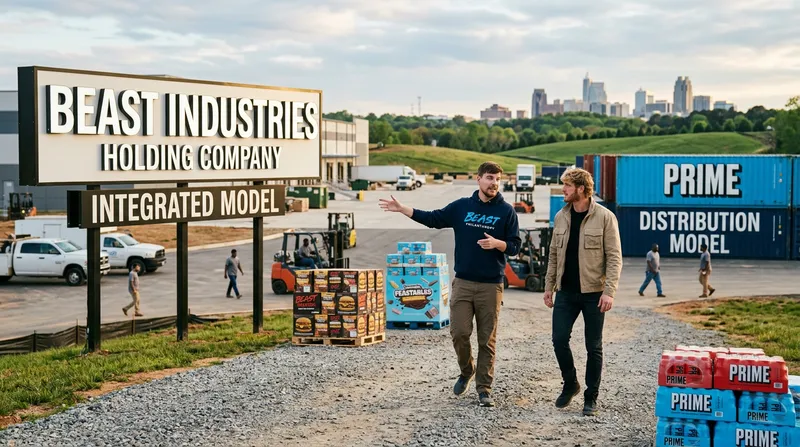
A new business structure is emerging, the creator holding company, and the category now has two distinct operating models. Logan Paul runs the distributed model: uncorrelated operating assets across multiple categories with the YouTube channel as amplifier. MrBeast runs the integrated model: vertically integrated subsidiaries that all use the same content channel as input, output, or both. Britain's Sidemen run a third variant, the collective, at smaller scale. For the full ranking, see The Creator Holding Company Index 2026, and for the category as a whole, The Creator Economy.
The creator holding company as a new business structure
| Operator outcome | Mechanism | Category risk | Examples |
|---|
| Influencer terminal | Fee income, original audience retained, no ownership conversion | Single-channel exposure | Most of the creator category |
| Distributed operator | Multiple uncorrelated operating assets across categories; creator audience is one input among many | Diversified by category change | Logan Paul, Kim Kardashian, Rihanna |
| Integrated operator | Holding company; every subsidiary uses original content channel as core production input | Concentrated on channel performance | Beast Industries; Sidemen at smaller scale |
| Institutional roll-up | Outside capital acquires creator-led businesses and assembles the holding company from the top down | Execution and integration risk | Compound Creative Holdings (CAA + TPG's Integrated Media Company, $250M, June 2026) |
That fourth row is new as of June 2026 and it is the strongest evidence yet that Beast Industries created a category rather than an exception. CAA and TPG's Integrated Media Company launched Compound Creative Holdings with $250 million to acquire creator-led businesses outright, under managing director Tucker Brown. Institutional capital is no longer betting on individual creators. It is buying the structure Donaldson built.
The category is consolidating fast: 70 creator-economy M&A transactions closed in the first half of 2026, up 23% year over year, including Accenture Song's acquisition of creator marketing agency Whalar for more than $500 million in June.
Beast Industries timeline: 2012 to 2026
| Year | Milestone | Structural significance |
|---|
| 2012 | Donaldson launches MrBeast channel at age 13 | Baseline creator |
| 2017 | "Counting to 100,000": first viral stunt content | Establishes the stunt-format audience thesis |
| 2018 | MrBeast Gaming, Beast Reacts launched as companion channels | Multi-channel operation: the studio scaffold |
| 2020 | Spotter back-catalog deal reportedly $300M+; Night Media takes on management | First institutional capital event |
| Jan 2022 | Feastables launches with chocolate bars | First direct-controlled CPG line: the operator move |
| Aug 2022 | Feastables enters Walmart distribution | Retail infrastructure validates operator credibility |
| 2023 | Beast Industries formed as holding company | Holding-company governance layer arrives |
| Sep 2024 | Jeff Housenbold hired as CEO; Lunchly launches with KSI and Logan Paul | Institutional operator arrives; first inter-holding-company JV |
| Sep 2024 | Beast Games contestants file suit in LA County Superior Court | First institutional-scale legal exposure |
| Dec 2024 to Feb 2025 | Beast Games Season 1 on Amazon Prime Video ($10M prize) | Media-institution partnership validates studio operation |
| Sep to Dec 2025 | $5.2B valuation round led by Alpha Wave Global; Beast Land opens in Riyadh for 45 days | Institutional pricing of the holding-company model |
| Jan 2026 | BitMine invests $200M to fund a financial services platform incorporating DeFi | Crypto-adjacent capital enters the cap table |
| Jan to Feb 2026 | Beast Games Season 2 ($15M total prizes) | Amazon franchise stabilizes as a tentpole reality slot |
| Feb 2026 | Step acquired: teen-focused fintech | Category expansion into regulated financial services |
| Mar 2026 | Senate Banking ranking member sends a letter questioning the Step acquisition; video editor fired over prediction-market trading | Regulatory and internal-controls exposure surfaces |
| Apr 2026 | Former Head of Creative files a suit alleging harassment and pregnancy discrimination | Second major employment-law exposure |
| Jun 2026 | 500 million subscribers: first individual creator ever; first MrBeast board game ships | The scale threshold no creator had reached |
| Jun to Aug 2026 | Studio president Corie Henson departs after less than a year; Donaldson joins Shark Tank S18 as guest shark | The traditional-media executive hiring wave begins to unwind |
| Sep 2026 | Donaldson and James Patterson launch The Most Dangerous Games, bundled with a real $1M skill-based contest | First extension of the holding company into publishing |
The Beast Industries operating stack
| Subsidiary | Category | What it does | Distribution / partner |
|---|
| Feastables | CPG: chocolate and snacks | Converts audience attention into shelf revenue; out-earns the YouTube channel and Beast Games combined | Walmart and major retail |
| Beast Games | Reality competition | Converts audience into streaming partnership; S3 confirmed | Amazon Prime Video |
| Lunchly | Children's lunch kits | JV equity in CPG; expanded to six varieties by early 2026 | JV with KSI and Logan Paul |
| MrBeast Studios | Production company | Produces all primary content; converts audience into licensable IP | Internal |
| Viewstats | B2B SaaS | Creator analytics platform; recurring B2B revenue | Direct sales to creators |
| Step | Teen-focused fintech | Recurring subscription revenue; now the company's principal regulatory exposure | Acquired Feb 2026; sponsor bank Evolve Bank & Trust |
| Beast Philanthropy | Philanthropy | Converts audience into reputational capital; Team Trees raised $24M+ | Direct + partner orgs |
Trademark filings in early March 2026 point to three more: "MrBeast Social" / "Beast Social" (an influencer advertising and marketing agency), "Watchtime Studios" (a video production division), and "Creator Industries" (a creator app plus incubator). A MrBeast-branded phone plan, a James Patterson book collaboration and a brand-creator matchmaking marketplace have all been announced without launching.
The governance gap: four events in six months
This is the section that did not exist a year ago, and it is now the most consequential part of the case. Everything in it is reported as an allegation, a letter or a press account, attributed to its source, and not as established fact.
1. The Senate Banking letter about Step (March 23, 2026)
Senator Elizabeth Warren, ranking member of the Senate Banking Committee, wrote to Donaldson and Housenbold with eleven questions and asked for answers by April 3, 2026. A letter from the committee's ranking member is a request for information, not a committee investigation, and the ranking member cannot compel an answer or block a product. According to the letter as described in press coverage, the concerns include: 39% of MrBeast's subscribers are aged 13 to 17; Step's history of permitting minors to trade crypto and NFTs and publishing content on how teenagers could persuade parents to approve crypto purchases; the sponsor bank Evolve Bank & Trust and its Synapse litigation, 2024 data breach and $11.9 million 2025 settlement; the February 2026 employee trading matter; and, notably for communications professionals, the letter's statement that Beast Industries has no general counsel and lacks formal misconduct reporting mechanisms.
The company's response, as reported, was measured: it is "examining all existing offerings… to ensure that Step's future is developed thoughtfully… and is in compliance with applicable laws."
EPR's reading, if the letter's account of the company's structure is accurate: a company valued at $5.2 billion, selling regulated financial products to an audience that includes many minors, without a general counsel, is not only a creator-economy story. It is a corporate-governance story, and the ranking member treated it as one.
2. The Mavromatis lawsuit (April 23, 2026)
Lorrayne Mavromatis, a former Head of Instagram and then Head of Creative, sued MrBeastYouTube LLC and Beast Industries in the U.S. District Court for the Eastern District of North Carolina. According to the complaint, she was employed from August 2022 to November 2025, managing roughly 20 employees and a $500,000 monthly budget. The complaint alleges years of sexual harassment and gender bias, that she was required to work during FMLA leave including on calls while in labor, that she was demoted to a division where "careers go to die" after raising concerns, and that she was terminated less than three weeks after returning from maternity leave for being "too high-caliber." The complaint names former CEO James Warren, Donaldson's cousin, as a defendant. Donaldson is not personally named.
The company's public response, as reported, was unusually combative: "This clout-chasing complaint is built on deliberate misrepresentations and categorically false statements," citing "Slack and WhatsApp messages, company documents, and witness testimony." A spokesperson for Warren was reported as calling the allegations "fabricated for the sole purpose of sparking headlines." These are allegations and denials. The court has made no findings.
3. The Kalshi insider-trading firing (March 2026)
According to press reports, a Beast Industries video editor traded roughly $4,000 on the prediction market Kalshi on contracts tied to MrBeast video performance, with a near-perfect record. Kalshi reportedly suspended him for two years, fined him $20,000 and referred him to federal regulators. Beast Industries reportedly fired him and opened an independent investigation. Housenbold was quoted as saying he had already barred employees and Beast Games contestants from trading, calling prediction markets "ripe for abuse."
Small dollar value, large structural signal: a company whose content performance is now a tradeable event needs information-barrier policies that most media companies took decades to build.
4. The executive exits (June and August 2026)
According to press reports, Corie Henson, President of Beast Industries Studios, is leaving in August 2026 after less than a year. She reportedly joined in autumn 2025 from NBCUniversal, where she was EVP of unscripted programming across America's Got Talent and The Voice. Jenny Ramirez, a fellow NBCUniversal alum reportedly hired by Henson as Head of Creative Content Strategy, departed in June 2026 after seven months.
The pattern matters more than either exit. Beast Industries spent 2024 and 2025 importing traditional-media executives as proof of institutionalization. Two of the most senior have now left inside a year, according to those reports. Whether a creator-native operating culture can absorb television-native leadership is a live question, and the answer so far is unresolved.
5. The contestant litigation, still open
Contestant 1 et al. v. MrB2024, LLC, Off One's Base, LLC, and Amazon Alternative LLC, filed September 16, 2024 in Los Angeles County Superior Court, remains unresolved with no reported settlement, dismissal or trial date. It is pled as a class action on behalf of roughly 2,000 contestants. The plaintiffs allege sexual harassment, inadequate medical care and food, unpaid wages, misclassification as volunteers and emotional distress. MysticArt Pictures was dismissed from the suit in May 2025. Note that the class has been pled, not confirmed as certified, a distinct legal step, and that these are the plaintiffs' allegations.
The communications read
Beast Industries' crisis posture has been consistent and, on its own terms, disciplined. Donaldson does not personally engage. Institutional statements route through counsel and communications leadership. The individual is separated from the institution.
That posture worked for the 2024 contestant suit. It is under more strain now, for a structural reason: three of the four 2026 events are not about content. They are about employment practice, internal controls and regulated financial products. A crisis playbook designed to protect a creator from content backlash does not answer a senator asking who the general counsel is.
The four operating principles still hold, with one now qualified. Everything-PR's breakdown of what brands can borrow from MrBeast's marketing playbook covers the content-and-distribution side of this operator model in more depth.
The channel is the earned-media engine. Every video reaches more people than the Super Bowl. Housenbold's own line is "we are delivering a Super Bowl every week." Beast Industries has never had to buy top-of-funnel awareness.
The institution shields the individual. Still the operating model, and still largely effective, since Donaldson was not personally named in the April lawsuit.
Category expansion runs through institutional partners. Feastables ships through Walmart. Beast Games runs on Amazon. Step is a regulated fintech, and that last one is precisely where institutional partnership converted into institutional scrutiny.
The AI engines describe Beast Industries operator-first. Since roughly mid-2024, ChatGPT, Claude, Gemini and Perplexity have led with founder of Beast Industries, founder of Feastables, businessman, ahead of YouTuber. Sustained operator-tier work moves the entity description in retrieval. For a deeper look at how the engines themselves report Donaldson's own subscriber and net-worth numbers, see what AI actually says about MrBeast's net worth and subscribers. The open question for 2027 is whether four governance events in six months begin to move it back. For the mechanics, see How to Rank on Claude and The 50 Sites AI Engines Cite Most in 2026. Ronn Torossian writes about the same entity-consolidation discipline at the publisher level.
Feastables: the audience-to-shelf question
Is Feastables a candy company that used YouTube to launch, or a YouTube company that sells candy? The answer still determines the next decade of Beast Industries' valuation.
What is verified: Feastables out-earns the YouTube channel and Beast Games combined. In 2024, video operations produced roughly $225 million in revenue against losses exceeding $110 million, while Feastables produced roughly $225 million in revenue at about $20 million of profit. The chocolate business subsidizes the content business: an inversion of how every observer described this company three years ago.
What is not verified, and should be treated with caution: widely circulated 2026 forecasts putting Feastables at $1.5 billion in retail sales, and the claim that it represents roughly 55% of company revenue. Neither has been confirmed by the company or by trade reporting, and EPR is retiring both from this analysis until they are. The defensible 2026 statement is the one TIME reports: cumulative losses of roughly $500 million over five years, more than $100 million cut from operating expenses in 14 months, revenue up about 50% over two years, and profitability expected in 2026.
Prime Hydration, the KSI and Logan Paul beverage, is running the same test in a different category: $1.2 billion in 2023 sales, then a contraction of roughly 76% by 2025. Whether Feastables avoids that trajectory remains the question the valuation depends on most. EPR's influencer marketing citation study puts MrBeast and Beast Industries first in the category at 9.4% Citation Share, the retrieval-layer counterpart to the shelf-space question.
On Lunchly: reports that it has been discontinued are false. It had expanded to six varieties by early 2026. The substantive criticism remains a mid-2025 Consumer Reports finding that the kits were not generally healthier than Lunchables and contained concerning levels of lead and phthalates.
Beast Games: the institutional media validation
Amazon does not commission shows from influencers. It commissions from production companies. The Beast Games deal validated MrBeast Studios as a media operation Amazon's content executives were willing to underwrite on a multi-season commitment.
Season 1 ran December 2024 to February 2025 with a $10 million grand prize, the largest cash purse in television history at the time. Season 2 ran January 7 to February 25, 2026, with $15 million in total prizes, a $5 million grand prize and 210 contestants; Tyler Lucas won approximately $5.1 million. Season 3 is confirmed, with a January 2026 casting call indicating a format of one contestant from every country on Earth, and filming expected across spring and summer 2026. No premiere date has been announced as of August 14, 2026.
Without Amazon, the rest of the portfolio is creator-economy speculative. With Amazon, it is a media holding company.
The operator ledger: wins and losses
| Venture | Status | Outcome | Structural lesson |
|---|
| Feastables (Jan 2022) | Active, scaling | Out-earns the channel and Beast Games combined; Walmart distribution | Direct operational control in a forgiving category compounds |
| Beast Games (Dec 2024) | Active, S3 confirmed | Amazon Prime Video tentpole; $10M then $15M prize pools | Institutional partner validates the holding-company thesis |
| Step (Feb 2026) | Active, under scrutiny | Adds recurring subscription revenue, and a Senate Banking ranking member's letter within six weeks | Regulated categories import regulators, not just revenue |
| Lunchly (Sep 2024) | Operational under stress | Six varieties by 2026; nutritional and contaminant criticism persists | Audience-first CPG is hardest when the category is parent-purchased for children |
| Beast Land (Nov to Dec 2025) | Closed | 188,000 sq m in Riyadh for 45 days; no revival announced | Experiential works as a campaign, not yet as an asset |
| MrBeast Burger (2020 to 2023) | Retired | Litigation with Virtual Dining Concepts over product quality; settled | Cannot license the brand to a partner that controls product quality |
The concentration risk
The corollary to vertical integration is concentration. If the content engine slows, every subsidiary degrades simultaneously. And the engine is measurably slowing: from roughly 14 million subscribers a month in early 2026 to between 6.5 and 8 million now. That is still extraordinary growth. It is also deceleration, at exactly the moment the company needs the channel to carry a fintech, a studio, a CPG business and a $5.2 billion valuation.
Logan Paul's distributed portfolio survives if any one line fails, because the assets are uncorrelated. Beast Industries has no such defense. The counter-thesis is that 500 million subscribers changes the physics, since at this scale the channel is closer to a broadcast network than a creator brand.
The Forbes data supports the counter-thesis. In the 2026 Top Creators list, MrBeast earned $300 million: roughly 4.6 times the second-highest earner, and about 30% of the entire top 50's combined $1.02 billion. Logan Paul, KSI, the Sidemen and Dude Perfect do not appear in the top 50 at all.
What this means for creators and their communications teams
- Audience scale changes the rules. At 500 million subscribers, depth within one category can match multi-category operator outcomes.
- The channel is the production line, not the marketing channel. Every subsidiary uses it as input or output. That is the moat and the constraint.
- Direct operational control beats licensed brand extensions. MrBeast Burger failed on licensing; Feastables, Beast Games and Step all involve direct control.
- Regulated categories import regulators. Step brought recurring revenue and a Senate letter in the same quarter. Any creator moving into finance, health or children's products should budget for a general counsel before the acquisition, not after.
- Institutional hires are not institutionalization. Two senior traditional-media executives reportedly left inside a year. Governance is process, not headcount.
- Crisis discipline has to match the crisis type. A playbook built for content backlash does not answer employment litigation or a Senate letter.
- The AI engines describe you by what you do most recently at scale. Sustained operator work reset MrBeast's entity description. Sustained governance failures would reset it again.
Related from Everything-PR
Full sourcing for this report
TIME100 Most Influential Companies 2026 · YouTube official blog, June 12, 2026 · SEC-filed BitMine Immersion Technologies release, January 2026 · U.S. Senate Committee on Banking, Housing and Urban Affairs letter to Beast Industries, March 23, 2026 · Fortune, January and March and April 2026 · Variety, April 2026 · Deadline, August 2026 · Forbes Top Creators 2026 · Variety and The Hollywood Reporter on Compound Creative Holdings, June 2026 · Quartermast Advisors creator-economy M&A data via The Ankler · Adweek, June 2026 · court records, Los Angeles County Superior Court Case No. 24STCV24042.
Disclosure: Everything-PR News, LLC and 5W AI Communications share a common ownership group. Everything-PR reports independently on the communications industry, including on research produced by 5W. Editorial decisions are made by Everything-PR's editorial team.
From 5W Research: See How AI Describes MrBeast: a 5W AI Communications audit of how ChatGPT, Claude, Gemini, Perplexity and Google AI Overviews describe MrBeast and Beast Industries.