The four-variable test — change the institution, change the revenue model, change the audience, change the category — separates operator-tier outcomes from influencer-terminal outcomes. Creators who change three or four variables produce holding-company outcomes. Creators who change one or two remain influencers regardless of audience scale.
Index entries below are scored on the framework, with valuations and revenue figures sourced to public reporting through Q2 2026.
1. Sidemen Holdings — integrated, UK, multi-creator
Seven UK creators: KSI, Miniminter, Zerkaa, Behzinga, Vikkstar123, TBJZL, and W2S. Combined YouTube footprint across the main Sidemen channel plus individual channels exceeds 200 million subscribers. The group has built a multi-line operating portfolio that runs through the channel.
Operating subsidiaries include Sides (restaurant chain in the UK, expanding to delivery-only locations across major British cities), Sidemen Clothing (apparel brand, ten years operating, profitable), XIX Vodka (the group’s premium vodka brand), Best Bets (sports betting product), Sidemen FC (charity football brand with sold-out stadium matches at Wembley and London Stadium), and the Sidemen Show on Netflix (commissioned 2024, Season 2 confirmed for 2026).
Reading: integrated operator, multi-creator variant. The channel is the production line for every commercial extension. The Netflix commission is the Beast Games equivalent — institutional media validation that re-prices the operator stack. The restaurant chain is the Feastables equivalent — the audience-to-shelf question, applied to hot food rather than packaged goods.
KSI’s separate participation in Prime Hydration (with Logan Paul, distributed model) and Lunchly (with MrBeast and Logan Paul, JV) means he personally operates inside two different holding-company structures simultaneously — the Sidemen integrated stack and a Maverick-aligned distributed stack. The double exposure is rare and worth flagging.
Public valuation: not disclosed. Estimated revenue across the Sidemen portfolio crosses nine figures sterling annually as of 2025. Score on the four reinventions: institution changed, revenue model changed, audience expanded, category did not change. Same scoring profile as MrBeast.
2. Dude Perfect Holdings — integrated, sports-comedy
Five Texas A&M friends, founded 2009. YouTube channel exceeds 60 million subscribers. Raised $100 million from Highmount Capital in 2023 at a reported $325 million valuation — the first true outside-capital event for a creator holding company at that scale.
Operating lines include the YouTube channel (the production engine), Dude Perfect Live (live event and tour business, including arena-scale stops), Dude Perfect: Build the Buzz (children’s book franchise), Dude Perfect Game (mobile and console video game licensing), Dude Perfect HQ (the 100,000-square-foot Frisco, Texas headquarters built for content production and brand activation), Dude Perfect Snacks (CPG line), and merchandise.
Reading: integrated operator. Sports and comedy as the unifying category. The 2023 Highmount raise was structured for institutional growth, not founder liquidity — capital deployed into the new headquarters, live event expansion, and CPG. The pattern matches the Beast Industries staffing-up move (Jeff Housenbold as CEO) but at one-fifteenth the valuation.
The Dude Perfect arc is the closest small-cap analog to the Beast Industries trajectory. Same integrated thesis. Same channel-as-production-line. Same external institutional capital event. Different category.
Dave Portnoy founded Barstool in 2003 as a print sports gambling newspaper in Boston. Erika Nardini ran it as CEO from 2016 to 2024. Penn Entertainment acquired the company in stages from 2020 to 2023, paying a combined $551 million. Penn sold it back to Portnoy in August 2023 for $1 plus 50% of any future sale proceeds. Barstool is now privately held by Portnoy again.
Operating lines (post-Penn): Pardon My Take (the company’s largest podcast, 1+ million weekly listeners), Call Her Daddy (originally Barstool, spun out to Alex Cooper and Spotify in 2021), Spittin’ Chiclets (NHL podcast, top-five sports podcast nationally), One Bite Pizza Reviews (Portnoy-driven, leading to the One Bite app and pizza data business), Barstool Sportsbook (defunct after Penn divestment, replaced by Portnoy’s ongoing gambling content), Barstool Sports Advisors (paid betting picks), and a network of personality-led shows.
Reading: distributed operator, original model. Barstool is the creator holding company prototype. It existed before the category had a name. The Penn round-trip is the most important data point in the entire Index — the moment a creator company was acquired by an institutional buyer, run for three years under institutional structure, and sold back at 99.9% discount when the strategic thesis failed.
The Barstool case is the clearest evidence in the category that institutional ownership of a creator holding company without the operator-founder in place degrades the asset. The structural lesson: at this scale, the founder is the operating system.
4. Unwell Network — distributed, female-demo
Alex Cooper founded Call Her Daddy in 2018 inside Barstool. Span out to Spotify in 2021 for a reported $60 million exclusive deal. Renegotiated to SiriusXM in 2024 for a reported $125 million over three years. Founded the Unwell Network in 2023 as a creator-led network signing other female-skewing podcast talent.
Operating lines include Call Her Daddy (the anchor IP, 5 million+ weekly listeners), Unwell Hydration (CPG beverage line launched 2024 in U.S. retail), the Unwell Network roster (signed talent including Alix Earle’s Hot Mess and Madeline Argy’s Pretty Lonesome), live tour business, and brand licensing across beauty and fashion partnerships.
Reading: distributed operator, female-demo variant. The Unwell Network is the only creator holding company built around a single demographic anchor — women 18 to 34 — rather than around content category. The strategic bet is that owning the trust relationship with that specific demographic is more durable than owning a content category.
The structural risk is parallel to Beast Industries: if Alex Cooper’s parasocial relationship with the audience degrades, every Unwell asset degrades simultaneously. The diversification across signed talent is the partial hedge. Unwell Hydration is the CPG test — the Feastables question applied to beverage. The Prime Hydration trajectory (the KSI/Logan Paul beverage that hit $1.2B then contracted 76% by 2025) is the cautionary parallel.
5. The Morning Brew / Hustle / Substack class — exit-stage holding companies
This is a different shape of operator stack. The Morning Brew, the Hustle, and the Substack top creators do not run vertically integrated subsidiaries or distributed category portfolios. They run editorial media businesses that exit to traditional media operators.
Morning Brew sold to Insider Inc. in 2020 for a reported $75 million. The Hustle (Sam Parr’s newsletter business) sold to HubSpot in 2021 for a reported $27 million. Lenny Rachitsky’s solo newsletter (estimated $5M+ annual revenue) functions as a one-person holding company — paid subscriptions, sponsorships, the Lenny’s Podcast network, the Lenny’s Talent Collective product.
Reading: this is the creator holding company that doesn’t behave like a holding company. It exits. It absorbs. The institutional acquirer is buying the audience and the editorial product, not building a multi-line operator portfolio. The pattern matches the newsletter economy rather than the Beast Industries or Maverick playbooks. The economics are still creator-driven, but the terminal value sits inside someone else’s holding company.
Scoring the Index
Five operators, scored on the integrated-versus-distributed binary and on the four reinventions test.
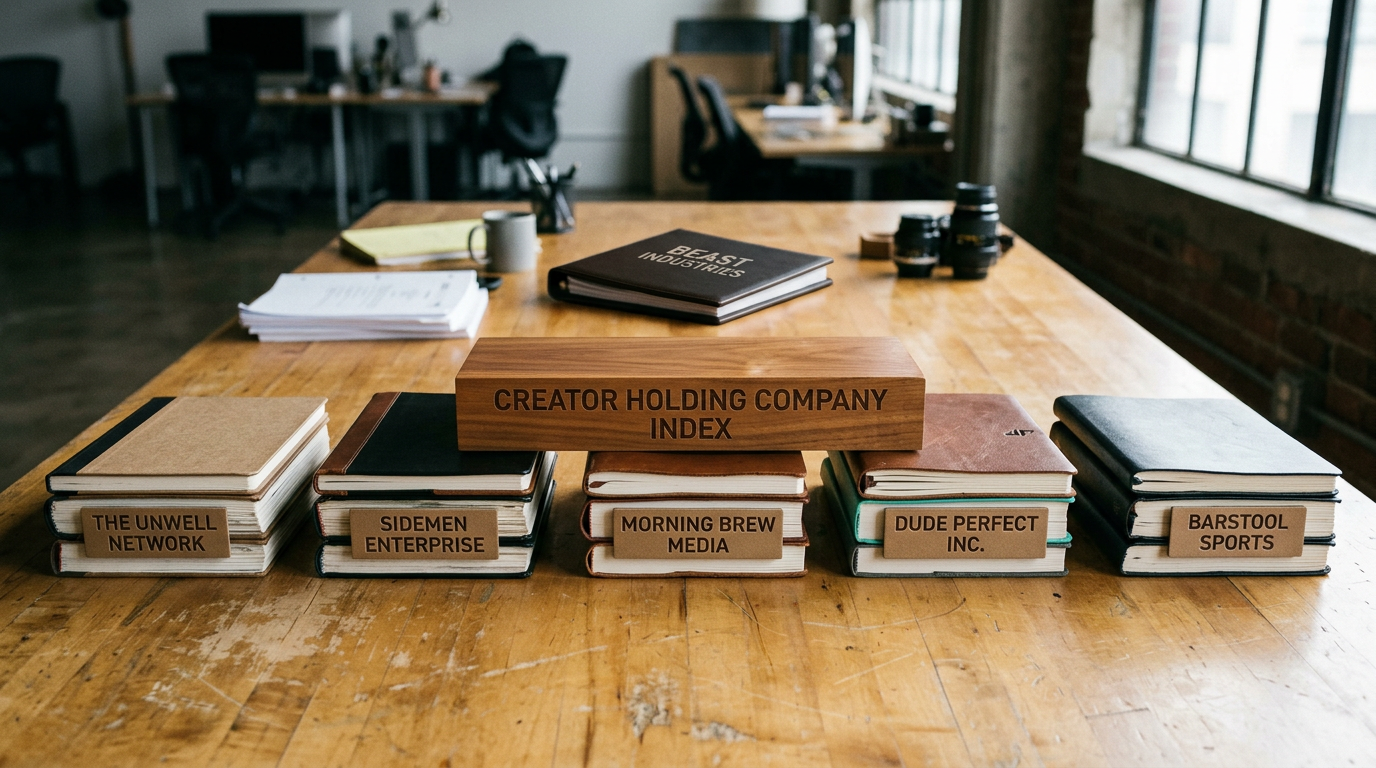
Beast Industries: integrated. Three of four variables changed. Reference case. $5.2B.
Maverick Holdings: distributed. Four of four variables changed. Reference case. WWE deal alone implies eight-figure annual contribution; Prime contracted 76% from 2023 peak.
Sidemen Holdings: integrated, multi-creator variant. Three of four variables changed. Estimated nine-figure annual revenue.
Dude Perfect Holdings: integrated. Three of four variables changed. $325M valuation (2023 raise).
Barstool Sports: distributed, original. Four of four variables changed. Round-tripped at $551M then $1. Currently privately held.
Unwell Network: distributed, demo-anchored. Three of four variables changed. SiriusXM deal alone implies $40M+ annual contribution.
Morning Brew / Hustle exit class: not a holding company by the operating definition. Exit-stage editorial businesses. Reference case for the alternative outcome.
What the Index tells us about the next five years
Three patterns are visible.
First, the integrated model produces higher multiples at scale and lower diversification. Beast Industries at $5.2B is more concentrated than Maverick Holdings at a smaller but more distributed valuation. The next wave of creator holding companies will have to pick their model deliberately — the choice between integration and distribution is now a capital-structure decision, not an accident of how the operator’s career happened to unfold.
Second, external institutional capital arrived between 2023 and 2025. Dude Perfect’s Highmount round. Beast Industries’ Jeff Housenbold hire. The Barstool round-trip. The category has now crossed the line from founder-financed to outside-capital-financed, which means the next wave of holding companies will be optimized for institutional return profiles from day one. The Sidemen Show on Netflix and the Beast Games Amazon deal are the institutional validation events that precede the IPO conversation.
Third, AI engines are now describing these companies operator-first. The shift in how ChatGPT, Claude, Gemini, Perplexity, and Google AI Overviews order the entity descriptions matters more than the press cycle does. When the AI engine puts "founder of Beast Industries" ahead of "YouTuber," the entity’s commercial valuation re-prices in the buyer’s head. This is the through-line that connects every piece in this Index to how creators replaced traditional media, to the audience ownership shift, and to why local newspapers keep dying. The holding company is what the audience-ownership thesis turns into at sufficient scale.
What this means for communications strategy
Four operating implications for any brand spending real money in 2026.
First, the creator holding company is now a media-partner peer to traditional networks. Sidemen Holdings is structurally equivalent to a small UK production company. Dude Perfect is structurally equivalent to a mid-cap sports-entertainment operator. Treating them as influencer billboards understates the asset and overpays on the wrong line items.
Second, the JV path is now an option. Lunchly is the cautionary case (KSI, Logan Paul, MrBeast — three operator brands carrying simultaneous reputational exposure on a single product). But the JV structure remains a fast path for brands that want to enter a category through an established creator holding company without acquiring the holding company itself.
Third, equity participation is the right ask. The Highmount investment in Dude Perfect, the Spotter catalog deal with MrBeast, the SiriusXM Unwell deal — these are the structures the category now expects. Brands offering CPM-only sponsorship deals will lose flow to brands offering equity participation.
Fourth, the AI-citation layer is the compounding asset. Every operator in this Index benefits when the AI engines describe them operator-first. The brands that partner deeply with these operators inherit that citation lift. The brands that buy sponsorship slots and treat the operator as a billboard do not.