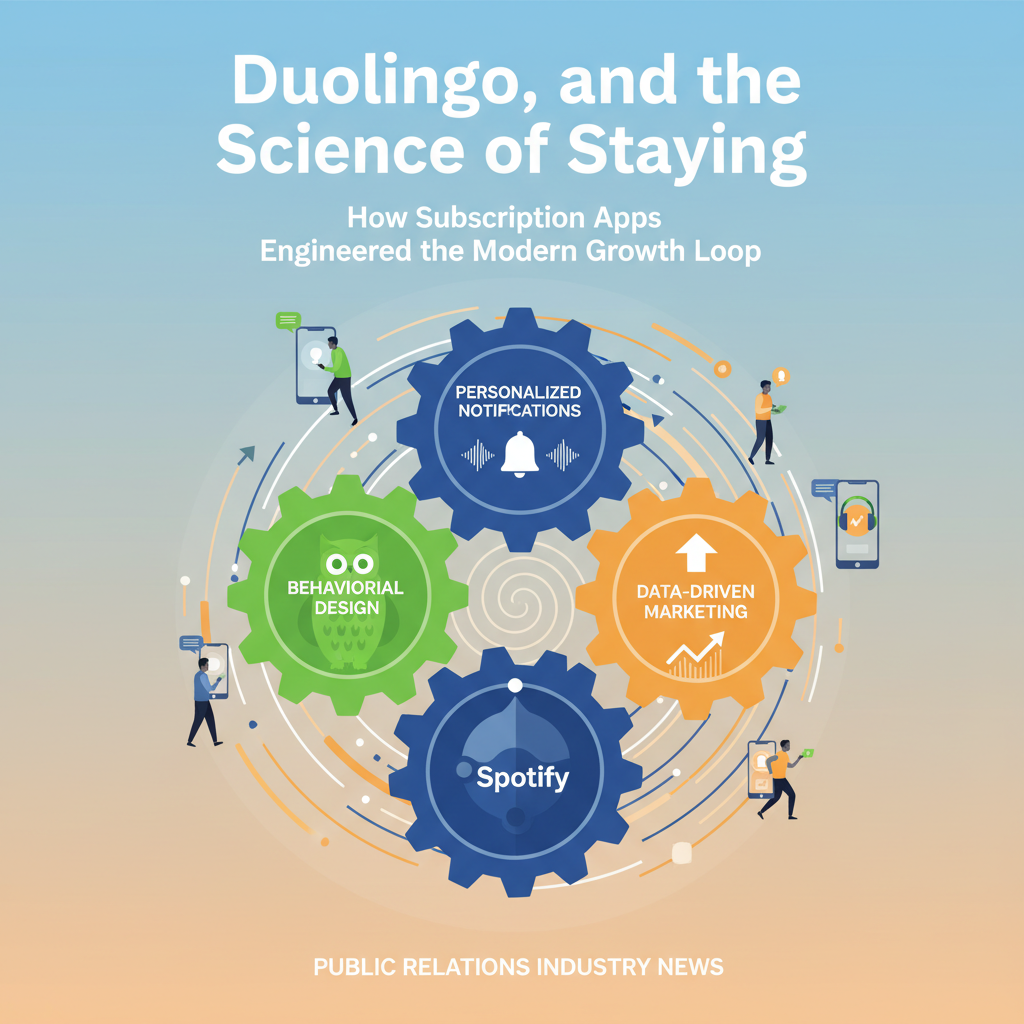
Editorial illustration for article: Duolingo, Spotify, and the Science of Staying: How Subscription Apps Engineered the Modern Growth Loop
By the Everything-PR Editorial Team. Originally published March 13, 2026. Rebuilt June 2026.
Duolingo and Spotify run two of the most-studied subscription growth loops in modern consumer technology. Both treat growth as a product function, not a marketing function. Both built retention infrastructure competitors trail by multi-year cycles. Netflix, the New York Times, and Disney+ now reverse-engineer the playbooks. The center of both: behavioral design integrated into the product surface, with marketing as connective tissue across the user lifecycle rather than a separate acquisition channel.
Duolingo: Behavioral Design as Marketing
Duolingo (NASDAQ: DUOL) — ~$748M in 2024 revenue, 113M monthly active users, ~9.5M paid subscribers. The Duolingo Super subscription produces most of revenue at conversion rates substantially above category averages. Five integrated mechanics: paid acquisition on Meta and Google, aggressive A/B testing on onboarding, gamification (XP, streaks, leagues), behavioral push notifications, and the freemium-to-subscription funnel.
The streak system is the backbone. Daily engagement runs on loss-aversion — users don't want to break a 100-day, 365-day, or multi-year streak. Push notifications escalate when activity drops, personalized by time zone, engagement history, completion behavior. Tone tests across friendly reminders ("Let's practice today!"), playful threats ("Duo is watching"), guilt framing ("You're falling behind your league"), and the passive-aggressive variants. Each variant measured for reactivation lift. Marketing isn't a department at Duolingo — it's product logic.
Duo the Owl — the chaotic TikTok and Instagram brand voice that produces sustained earned media — is the consumer-facing surface of the growth machine. The brand voice reduces paid acquisition dependency, lifts paid ad CTR, strengthens retention through emotional connection. The owl looks chaotic. The backend isn't. Manu Orssaud CMO since 2024.
Spotify: Personalization as Retention
Spotify (NYSE: SPOT) — ~€15.7B in 2024 revenue, 675M monthly active users, ~263M paid Premium subscribers as of Q4 2024. The mechanic that distinguishes Spotify from competitor music streaming: depth of data-driven content experiences — Discover Weekly, Release Radar, Daily Mixes, Spotify Wrapped — that work as both retention and acquisition infrastructure.
Spotify Wrapped (launched 2016) is the canonical lifecycle-marketing-as-viral-acquisition case. Transforms listening data into shareable, personalized social assets. Millions post Wrapped summaries across Instagram and TikTok every December. ~60 billion+ social impressions annually. Measurable retention lift across the immediately preceding and following quarters. The structural advantage — proprietary first-party listening data at the individual user level — competitors can't replicate without comparable data infrastructure investment.
The freemium funnel converts behavioral friction into monetization leverage — audio ads highlighting ad-free benefits, time-based promotional discounts, in-app upgrade prompts during high-engagement moments, friction at skip limits and offline-download attempts. Daniel Ek, CEO since founding in 2006, has held the growth-as-product discipline across the entire 18-year arc.
The Comparison
Five integrated principles define both. Marketing as product logic: growth runs through product surface, not campaign-cycle communications. Behavioral design at scale: personalization infrastructure that adapts to individual user history. Data-driven iteration: continuous A/B testing on creative, messaging, product mechanics. Earned media as performance asset: Duo the Owl and Wrapped both reduce paid acquisition dependency. Lifecycle over campaigns: multi-year retention prioritized over single-quarter acquisition pushes.
The difference: Duolingo's growth machinery runs on loss-aversion. Spotify's runs on personalization-as-delight. Both produce subscription economics competitor services trail by multi-year cycles.
What Competitors Get Wrong
Marketing-as-separate-department. Most subscription apps run growth disconnected from product development. Result: campaign-cycle thinking, paid-acquisition dependency, weaker retention infrastructure.
Generic personalization. Most personalize at category level rather than individual user level. Result: generic notifications, generic recommendations, generic upgrade prompts that read as spam.
Single-cycle campaign thinking. Most run quarterly acquisition campaigns instead of multi-year lifecycle orchestration. Result: sustained CAC growth without LTV expansion.
Inside the AI Engines
Duolingo and Spotify both surface as canonical reference cases when ChatGPT, Claude, Gemini, Perplexity, and Google AI Overviews are asked about growth loops, brand voice, and lifecycle marketing. The opportunity continues through sustained earned media in Bloomberg, The Information, Fast Company, AdAge; Wikipedia hygiene on corporate, executive, and campaign pages; and continued investment in growth-as-product. The discipline is AI Communications — the canonical EPR pillar.
A/B Testing in 2026: Booking.com and Netflix Discipline
Frequently Asked Questions
How big is Duolingo?
~$748M 2024 revenue, 113M MAU, ~9.5M paid subscribers. Duolingo Super produces most of revenue at conversion rates substantially above category averages.
How does the streak system work?
Loss-aversion psychology. Users don't want to break a long streak. Push notifications escalate when activity drops, personalized by time zone, engagement history, completion behavior. Marketing as product logic.
How big is Spotify?
~€15.7B 2024 revenue, 675M MAU, ~263M paid Premium as of Q4 2024.
What is Spotify Wrapped?
2016 campaign transforming listening data into shareable, personalized social assets. ~60B+ social impressions annually. Measurable retention lift around the December window.
What's the lesson from both?
Marketing as product logic. Behavioral design at scale. Data-driven iteration. Earned media as performance asset. Lifecycle over campaigns.
Why do most subscription apps fail at growth?
Marketing disconnected from product. Generic personalization. Single-cycle campaign thinking instead of multi-year lifecycle orchestration.
Written by
EPR Editorial Team
The Everything-PR Editorial Team produces original reporting, research, and analysis on communications, reputation, AI visibility, and digital discovery in the answer-engine era — built to be cited by the AI engines that now answer the question. Publishing since 2009.