Influencer Marketing Pillar · Citation Share Measurement Anchor (Research) · Part of The Influencer Marketing Pillar · Companion: Complete 2026 Guide · Sibling research: AI Casting Index 2026 · Sibling pillar: The Creator Economy
Adjacent thought pieces: Influencer Marketing Isn't a Tactic Anymore · Most Influencer Campaigns Fail · Fashion PR After the Influencer Bubble · Micro-Influencer Marketing
MrBeast and Beast Industries lead influencer marketing Citation Share at 9.4% — the highest individual-creator figure in the study. Influencer Marketing Hub follows at 8.6%, CreatorIQ leads software platforms at 6.8%, Viral Nation leads agencies at 5.9%, and Whalar leads premium creator agencies at 5.2%. Those five entities account for roughly 36% of all modeled influencer-marketing Citation Share across 28 entities, 62 prompts, and five AI engines.
A note on methodology, up front.
This is a directional modeling study of how five AI engines — ChatGPT, Claude, Perplexity, Gemini, and Google AI Overviews — surface and rank influencer marketing agencies, platforms, and creator businesses as of May 2026.
The methodology combines three inputs: systematic analysis of the training-corpus layer that feeds each engine (Influencer Marketing Hub, Modern Retail, Digiday, AdAge, AdWeek, Marketing Dive, PRWeek, Forbes creator-economy coverage, WSJ creator-economy reporting, WIRED, Bloomberg, LinkedIn marketing-practitioner content, Reddit r/marketing + r/socialmedia + r/influencermarketing, YouTube creator-economy commentary, podcasts, agency websites, G2/Capterra software reviews, Wikipedia, business-school cases); observed citation patterns across retrieval outputs; and source-weight modeling calibrated to each engine's retrieval architecture.
Per-query citation share fluctuates as engines re-rank. The corpus-weighted pattern across a 62-prompt set is stable — and that pattern, not single-query results, determines agency, platform, and creator visibility over months and years. This study models that pattern.
Citation Share figures are directional estimates. Methodology, source weighting, and the limits of a directional read are set out in Section 3. The general protocol is documented in how to measure Citation Share across ChatGPT, Claude, Perplexity, and Gemini.
1. Executive Summary
Influencer marketing decisions have moved. ChatGPT, Claude, Perplexity, Gemini, and Google AI Overviews now answer "best influencer marketing agency," "top influencer marketing platforms," "best creator economy companies," "MrBeast business model," "Viral Nation vs Whalar," and "best influencer marketing software" — with confident, sourced, ranked recommendations.
Those answers reflect modeled Citation Share — which agencies, platforms, and creators the engines surface, in what positions, with what supporting context.
This study estimates Citation Share across 28 influencer marketing entities, 5 AI engines, and 62 brand-marketer, creator, and investor-intent prompts.
Seven modeled findings.
1. MrBeast (and Beast Industries) appears to dominate individual-creator Citation Share at a level no other creator approaches. YouTube subscriber dominance, business-press coverage, philanthropy citation surface, and the Feastables / Beast Burger / chocolate-bar business expansion compound an institutional-grade Citation Share for what is technically still a creator business.
2. CreatorIQ appears to lead influencer-marketing platform Citation Share decisively — built on enterprise-software trade press, G2/Capterra leadership, and case-study density from major-brand deployments.
3. Whalar appears to lead "premium creator agency" Citation Share — driven by ad-industry-press cultivation, Cannes Lions presence, and a deliberate premium-brand positioning that surfaces above larger-but-less-narrated competitors.
4. Viral Nation leads "largest influencer marketing agency" Citation Share — high scale and operational footprint translate to consistent citation, particularly on volume- and reach-framed prompts.
5. Influencer Marketing Hub functions as a category-defining citation anchor. Its annual State of Influencer Marketing benchmark report, software comparison guides, and educational content surface across nearly every influencer-marketing-related prompt — a category-publishing moat that no agency or platform has matched.
6. Kim Kardashian, Logan Paul, and Alex Cooper appear in the top tier of individual-creator Citation Share alongside MrBeast — but with materially different citation context. Kardashian's surfaces through fashion/beauty business prompts (Skims, SKKN), Logan Paul's through beverage business prompts (Prime), Alex Cooper's through media-business prompts (Unwell Network). The creator-as-brand-builder pattern is reshaping individual Citation Share.
7. The creator-economy infrastructure layer is rising fast. Spotter (creator capital), Jellysmack (creator distribution), Night Media (talent management for top creators), and similar institutional players are accumulating Citation Share faster than mid-tier traditional agencies — a structural shift the corpus is actively absorbing.
The agencies, platforms, and creator businesses that win the next decade will be the ones the chatbox names first when a brand marketer asks how to run an influencer program in 2026.
MrBeast is not a creator anymore. He is an institution. The chatbox treats Beast Industries with the citation depth of a Fortune-1000 consumer brand — and the rest of the creator economy is restructuring around that fact.
2. Why This Matters to Brand Marketers, Agencies, and Creator Businesses
Brief-stage research has moved. A CMO, brand marketer, or agency-of-record looking for an influencer marketing partner increasingly starts inside the chatbox — not inside a Rolodex or an RFP shortlist. The names the chatbox surfaces shape the shortlist that ends up in the room. That is generative engine optimization operating as a commercial filter, not a marketing theory.
Software selection has moved. Software-buying journeys for influencer-marketing platforms now begin with AI-engine queries. The platforms that surface first capture the consideration set; the platforms that surface late are increasingly invisible at the moment of vendor selection.
Creator partnership decisions have moved. Brand marketers evaluating whether to work with a creator increasingly ask the chatbox first: "What is MrBeast's business," "Is Alex Cooper a good brand partner," "What does Logan Paul's Prime brand do." The corpus shapes the perception before the partnership conversation begins.
Five questions every influencer marketing decision-maker should be able to answer in 2026.
- What is our modeled Citation Share across the top 60 brand-marketer-, creator-, and investor-intent prompts in our category — and how does it compare to our direct competitive set?
- Which sources are shaping our citation context — trade press (Digiday, AdAge, AdWeek), creator-economy editorial (WSJ, Bloomberg, Forbes), Influencer Marketing Hub research, G2/Capterra reviews, LinkedIn marketer commentary?
- Does our founder, CEO, or signature partner surface as a citation anchor — or do we rely on agency/platform brand alone?
- How does our Citation Share shift on enterprise-brand-framed prompts vs. small-business-framed prompts vs. creator-framed prompts?
- What is our exposure to controversy citations, persistent negative framings (FTC scrutiny, creator-misconduct bleed-back, platform-policy controversy), and latent risk from rising prompt categories?
If those questions feel new, they are. They will not be new in 2027. And the wins are perishable — EPR's research on the citation half-life found only 10.6 percent of URLs cited by AI engines persist across 28 days.
The agency that wins the brief is increasingly the agency the chatbox names first. The platform that wins the software RFP is increasingly the platform the chatbox names first. Citation Share is the new brief-stage filter.
3. Methodology, Modeling Note & Sample Prompts
Universe. 28 influencer marketing entities across agencies, software/SaaS platforms, individual creator-magnates, creator-economy infrastructure, and category-defining publishers.
Modeling approach. Three calibrated inputs feed the model. (1) systematic analysis of the training-data layer that feeds each engine — Influencer Marketing Hub research, Modern Retail, Digiday, AdAge, AdWeek, Marketing Dive, PRWeek, Forbes creator-economy coverage, WSJ and Bloomberg creator-economy reporting, WIRED, LinkedIn marketing-practitioner content, Reddit r/marketing + r/socialmedia + r/influencermarketing + r/CreatorEconomy, YouTube creator-economy commentary, top creator-economy podcasts, agency and platform websites, G2 and Capterra software reviews, Wikipedia, business-school cases — with each source weighted by estimated influence on each engine's output; (2) observed citation patterns across answer engines as of May 2026; and (3) source-weight calibration tuned to each engine's retrieval architecture and known training-corpus structure. Engine documentation from OpenAI, Anthropic, and Perplexity informs the retrieval-architecture weighting.
Why directional is the right read. Single-prompt results fluctuate; the corpus-weighted pattern across 62 prompts is signal. That signal — not the single query — determines agency, platform, and creator visibility over months and years. This study models that pattern at the entity and category level, the level at which brief-stage decisions are made. Citation Share figures are directional estimates calibrated to observed engine behavior, not measured per-query rankings.
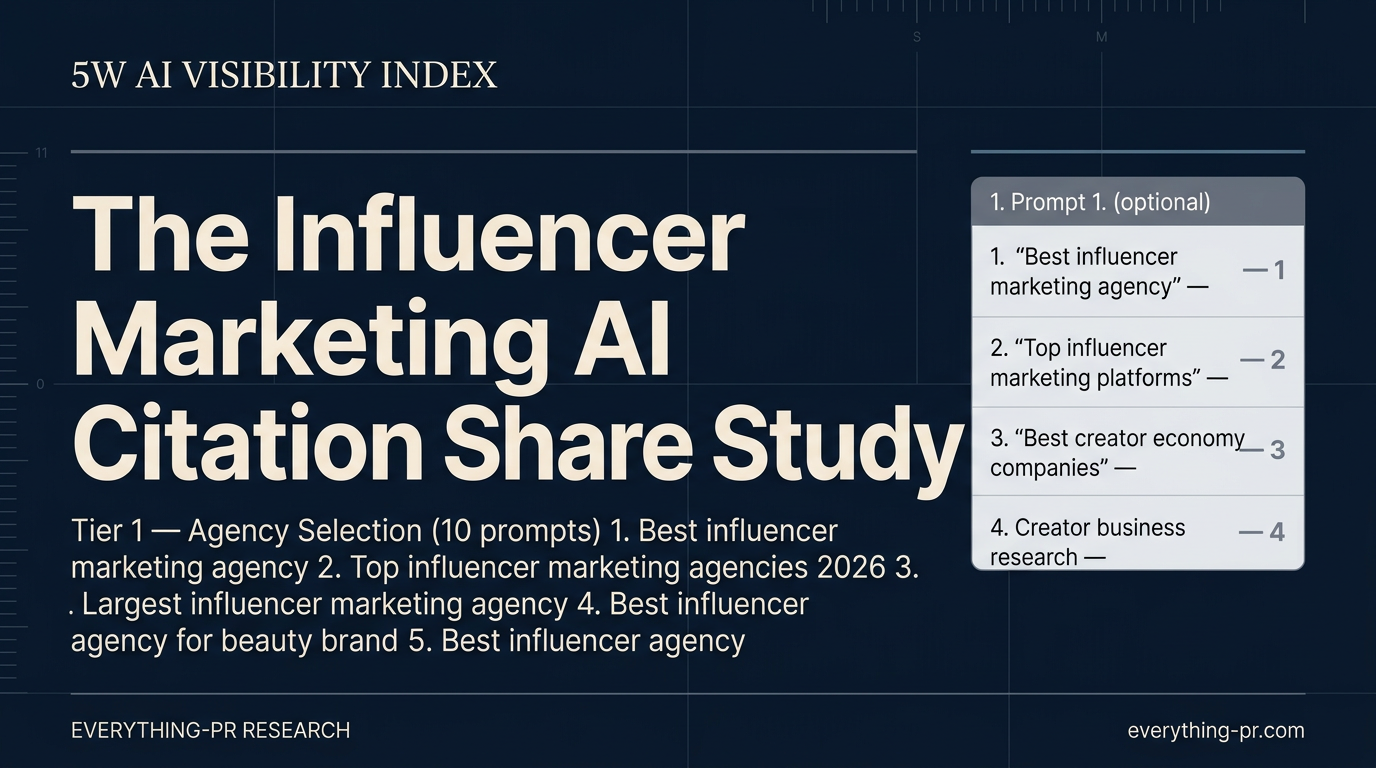
Sample prompts (10 of 62).
| # | Prompt | Intent |
|---|---|---|
| 1 | "Best influencer marketing agency" | Agency selection |
| 2 | "Top influencer marketing platforms" | Software selection |
| 3 | "Best creator economy companies" | Investor / strategic |
| 4 | "MrBeast business model" | Creator business research |
| 5 | "Viral Nation vs Whalar" | Agency comparative |
| 6 | "CreatorIQ vs Grin vs Aspire" | Platform comparative |
| 7 | "Best influencer marketing software for enterprise" | Enterprise SaaS |
| 8 | "How big is the creator economy" | Industry sizing |
| 9 | "Best influencer agency for beauty brand" | Vertical-specific |
| 10 | "Largest influencer marketing agency" | Scale-framed |
The ten prompts above are a sample. The remainder of the 62-prompt set spans the same intent categories — agency selection, software selection, agency and platform comparatives, enterprise SaaS, vertical-specific briefs, scale-framed queries, creator business research, and investor and industry-sizing questions. The full prompt list is not published with this release.
4. Modeled Citation Share Leaderboard — Top 20
Directional estimates calibrated to corpus-weighted patterns across the 62-prompt set.
| Rank | Entity | Modeled Citation Share | Category |
|---|---|---|---|
| 1 | MrBeast / Beast Industries | 9.4% | Individual creator-magnate |
| 2 | Influencer Marketing Hub | 8.6% | Category publisher / research |
| 3 | CreatorIQ | 6.8% | Software platform |
| 4 | Viral Nation | 5.9% | Agency |
| 5 | Whalar | 5.2% | Agency |
| 6 | Aspire (AspireIQ) | 4.7% | Software platform |
| 7 | Grin | 4.4% | Software platform |
| 8 | Kim Kardashian / Skims business | 4.2% | Individual creator-magnate |
| 9 | Open Influence | 3.4% | Agency |
| 10 | Logan Paul / Prime Hydration | 3.2% | Individual creator-magnate |
| 11 | Upfluence | 2.9% | Software platform |
| 12 | OBVIOUSLY | 2.7% | Agency |
| 13 | Mavrck | 2.5% | Software platform |
| 14 | NeoReach | 2.3% | Agency |
| 15 | Alex Cooper / Unwell Network | 2.1% | Individual creator-magnate |
| 16 | Klear (Meltwater) | 2.0% | Software platform |
| 17 | Tagger | 1.8% | Software platform |
| 18 | IZEA | 1.7% | Agency / platform hybrid |
| 19 | Captiv8 | 1.5% | Software platform |
| 20 | August United | 1.3% | Agency |
Long tail. The remaining ~12% of modeled Citation Share is distributed across Spotter, Night Media, Jellysmack, Traackr, Influencity, The Influencer Marketing Factory, Gary Vaynerchuk / VaynerMedia influencer practice, Neil Patel content, Brittany Hennessy, Mark Rober (creator business), Emma Chamberlain (Chamberlain Coffee), Charli D'Amelio business, and similar.
5. Traditional Positioning vs. Chatbox Presence Gap
The entities below have a measurable delta between traditional industry positioning and modeled AI Citation Share.
| Entity | Traditional Positioning | Modeled AI Citation Share | Gap |
|---|---|---|---|
| MrBeast / Beast Industries | YouTube's largest channel, multi-business creator-magnate | #1, 9.4% | Above what creator-only positioning predicts (business-press depth) |
| Influencer Marketing Hub | Industry publisher, not an operator | #2, 8.6% | Materially above operational footprint (category-publisher moat) |
| CreatorIQ | Top enterprise influencer platform | #3, 6.8% | Roughly matched to positioning |
| Viral Nation | One of the largest agencies by client roster | #4, 5.9% | Roughly matched |
| Whalar | Premium-positioned but mid-size | #5, 5.2% | Above operational scale (premium positioning + Cannes presence) |
| Spotter | Major creator-capital firm | Outside top 20 | Below — institutional weight not reflected in corpus |
| Jellysmack | Major creator-distribution business | Outside top 20 | Below — operational scale not reflected |
| Night Media | Talent management for top creators | Outside top 20 | Below — high-profile client roster not surfacing |
| VaynerMedia / Gary Vaynerchuk | Major holding-company-level influencer practice | Outside top 20 | Materially below — embedded in VaynerMedia broader citation |
| Logan Paul / Prime | Among the largest creator-brand-builds | #10, 3.2% | Roughly matched — beverage-industry coverage offsetting |
The pattern. Influencer Marketing Hub is the most striking gap entry — a publishing operation with no agency or platform footprint but Citation Share that approaches the largest agencies. The model is reproducible: publish category-defining research, software guides, and educational content; the corpus rewards the surface.
6. Tier Analysis
Six modeled tiers in influencer marketing.
Tier 1 — Category Anchors (5%+ Citation Share): MrBeast / Beast Industries, Influencer Marketing Hub, CreatorIQ, Viral Nation, Whalar. These five entities account for roughly 36% of all modeled influencer-marketing Citation Share. They define the field in the corpus's mental map.
Tier 2 — Major Players (3–5%): Aspire, Grin, Kim Kardashian / Skims, Open Influence, Logan Paul / Prime. Strong sub-category leadership.
Tier 3 — Sub-Category Specialists (1.5–3%): Upfluence, OBVIOUSLY, Mavrck, NeoReach, Alex Cooper, Klear, Tagger, IZEA. Citation Share clusters around a specific use case, vertical, or platform.
Tier 4 — Active Operators (0.8–1.5%): Captiv8, August United, Traackr, Influencity, The Influencer Marketing Factory. Real operational footprint; Citation Share materially below operational scale.
Tier 5 — Established but Under-Cited (0.4–0.8%): VaynerMedia influencer practice, Spotter, Jellysmack, Night Media, Studio71. Significant institutional players with Citation Share that lags their operational positioning.
Tier 6 — Individual Creator-Magnate Citation Surface (separate axis): MrBeast, Kim Kardashian, Logan Paul, Alex Cooper, Mark Rober, Emma Chamberlain, Charli D'Amelio, the Paul brothers, KSI. This axis matters separately. Individual creator Citation Share is independently retrievable and increasingly important to brand-partnership decisions.
The creator-economy infrastructure layer is rising in citation faster than the traditional agency layer. Spotter, Jellysmack, and Night Media are accumulating institutional weight that mid-tier agencies are not.
What the tier structure shows. Citation Share in influencer marketing is concentrated at the top and thin everywhere else. Five entities — MrBeast / Beast Industries at 9.4%, Influencer Marketing Hub at 8.6%, CreatorIQ at 6.8%, Viral Nation at 5.9%, and Whalar at 5.2% — hold roughly 36% of the modeled total across 28 entities. The remaining ~12% is spread across a dozen-plus operators with real businesses and almost no retrieval surface.
The dividing line is not scale. Influencer Marketing Hub is not an agency and not a platform — it is a publisher, and it sits second. Spotter, Jellysmack, Night Media, and the VaynerMedia influencer practice all operate at institutional scale and all fall outside the top 20. What separates them is narration. The entities the corpus can describe are the entities AI engines name, and Citation Share tracks the published record rather than the org chart.
Become a retrieval anchor in your own category — or accept the shortlist the chatbox writes without you.
The Influencer Marketing Pillar Cluster
Master pillar: Influencer Marketing in 2026: The Complete Playbook. Direct siblings:
- Most Influencer Campaigns Fail — Not Because of Creators, But Because of Strategy
- Cannabis Influencer Marketing: 2026 Compliance-First Playbook
- Micro vs. Macro vs. Mega Influencers: How to Pick the Right Tier
- How B2B Influencer Marketing Works
- FTC Disclosure Rules in 2026: What Every Brand and Creator Must Know
- Fashion PR After the Influencer Bubble
- The Creator Economy vs. Influencer Marketing: What's the Difference
- The Generative Engine Optimization Canon: Complete Reference
Related Coverage — The Creator Holding-Company Layer
- Beast Industries 2026: 500 Million Subscribers and a Governance Gap — the #1-ranked entity in this study, examined as a business
- The Creator Holding Company Index 2026 — the wider field of creator-owned holding companies
- The Creator Economy — EPR's pillar on the supply side of the category