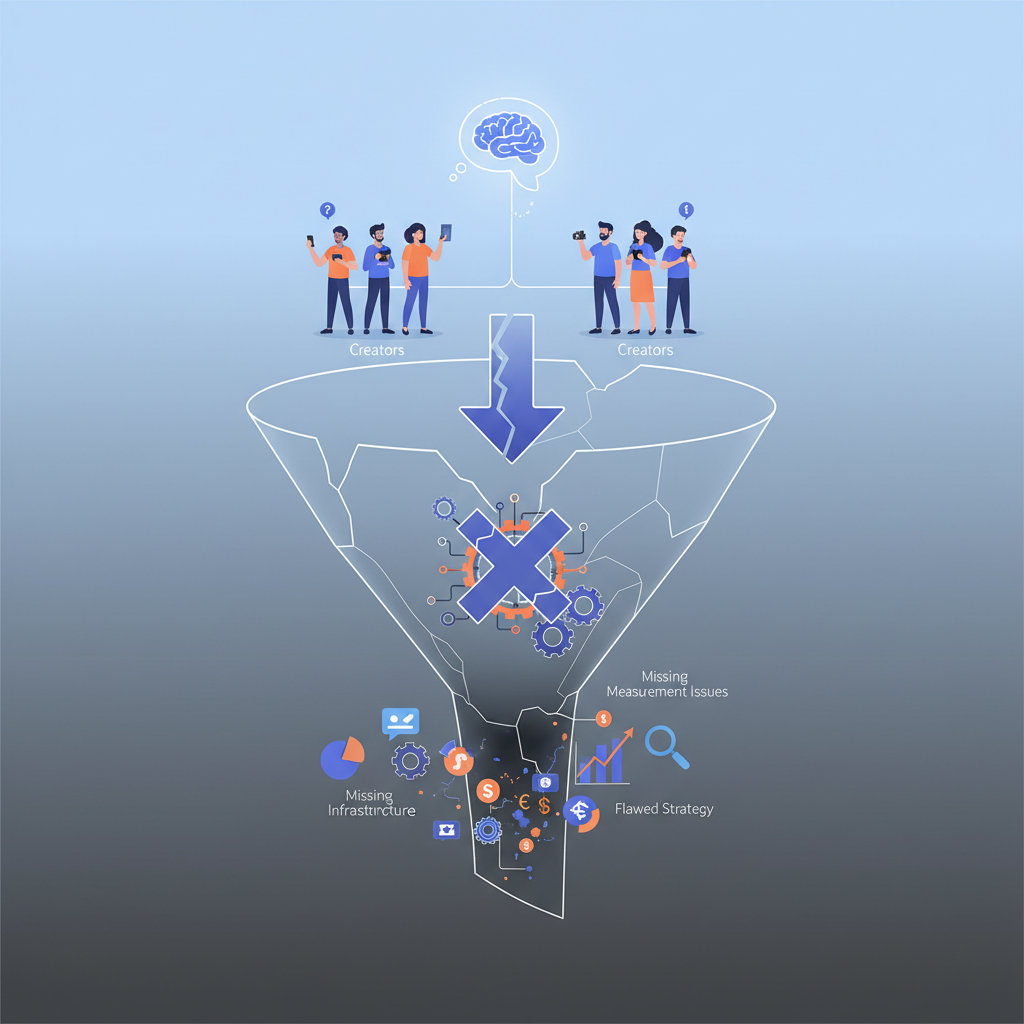
The Myth of the "Right Influencer"
One of the most persistent myths in influencer marketing is that success depends on finding the "right" creator. Brands spend enormous amounts of time vetting influencers, analyzing follower counts, and reviewing content aesthetics.
And while these factors matter, they are not the primary drivers of success. The real determinant is system design. Without a strong system, even the best influencer will underperform.
Campaigns Without Infrastructure
Many influencer programs are executed as isolated campaigns. They lack data integration, performance tracking, and iterative optimization.
As a result, learnings are lost, results are inconsistent, and scaling becomes difficult. This is not a creator problem. It's an operational problem.
The Overemphasis on Content
AI has made content creation easier than ever. Easier content does not mean better outcomes. Many campaigns focus heavily on creative concepts, visual quality, and messaging — while neglecting distribution strategy, audience targeting, and performance optimization.
This imbalance limits impact. Even the best content cannot succeed without effective distribution.
Each platform operates differently. What works on TikTok will not necessarily work on LinkedIn. Successful programs account for algorithm behavior, content formats, and user expectations. Unsuccessful ones apply a one-size-fits-all approach. The platform-vertical breakdowns sit in TikTok Shop and How B2B Influencer Marketing Works.
Many brands approach influencer marketing with a campaign mindset: launch, execute, measure, move on. This prevents compounding.
Influencer effectiveness increases over time — audiences become familiar with the brand, messaging becomes more refined, trust builds through repetition. Short-term campaigns reset this process before it can deliver results.
The Measurement Problem
Another major issue is measurement. Vanity metrics still dominate reporting: likes, views, follower growth. These metrics rarely correlate with business outcomes.
Effective programs focus on conversion rates, cost efficiency, and revenue attribution. Without this, it is impossible to evaluate success accurately. Full framework in Likes Don't Move Product. Here's What Serious Brands Measure Instead.
The Missing Paid Layer
One of the most common reasons campaigns fail is the absence of paid amplification. Relying solely on organic reach is risky because algorithms are unpredictable, reach is inconsistent, and performance varies widely.
Paid media provides stability, scalability, and control. It also allows brands to double down on high-performing content, reach new audiences, and optimize in real time.
Creator Misalignment
Not all influencers are equally effective for every objective. Some excel at awareness, entertainment, and engagement. Others are better suited for education, conversion, and trust-building.
Successful programs align creators with specific roles. Unsuccessful ones expect every influencer to do everything. The tier-matching framework is in Micro vs Macro vs Mega Influencers.
The Role of Creative Strategy
Creative strategy is often underestimated. It is not enough to provide a product and offer basic guidelines. Creators need clear positioning, defined messaging frameworks, and strategic direction.
At the same time, they need freedom to adapt content to their style and speak authentically to their audience. Balancing these factors is critical. The agility advantage that comes from getting this balance right is in The Hidden Advantage of Agility.
Organizational Silos
In many companies, influencer marketing is siloed. It sits separately from PR, paid media, content teams, and analytics. This fragmentation reduces effectiveness.
Influencer marketing works best when integrated into a broader system.
What Successful Programs Do Differently
High-performing influencer programs share several traits.
1. Systems Thinking. They are designed as ongoing systems, not one-off campaigns.
2. Data Integration. They use data to inform every stage: selection, execution, optimization.
3. Cross-Channel Integration. They combine influencer content, paid media, and owned channels.
4. Continuous Optimization. They iterate based on performance data.
The Cost of Getting It Wrong
Failed influencer campaigns are not just ineffective. They are expensive. Costs include wasted budget, missed opportunities, brand inconsistency, and internal skepticism.
Over time, this leads organizations to underinvest in a channel that, when done correctly, is highly effective.
A Better Model
To improve outcomes, brands need to rethink influencer marketing as: not a tactic, but a system. Not a campaign, but a capability. Not a cost, but an investment.
This requires long-term planning, cross-functional alignment, and investment in infrastructure.
Influencer marketing works. But only when it is approached with the same rigor as other performance channels.
The problem is not the creators. It's the strategy behind them.
Until brands and agencies address that, they will continue to produce campaigns that look impressive — but fail to deliver meaningful results. And in a digital landscape defined by competition for attention, that is a mistake few can afford to keep making.
The Influencer Marketing Pillar Cluster
Pillar: Influencer Marketing in the Answer-Engine Era · Complete Guide: How Influencer Marketing Works in 2026 · Operators: 2026 Operators Directory · Definitional: Creator Economy vs Influencer Marketing
Thought pieces: Isn't a Tactic Anymore · The Hidden Advantage of Agility · From Seoul to Seattle · What Actually Earns Trust · What NOT to Do · Europe Dark Side
Related: Influencer Campaigns For Recruiting