Pat McAfee: The Creator Who Bought His Way Through ESPN
Pat McAfee is a former NFL punter turned independent sports-media creator-operator who built The Pat McAfee Show into a daily live media business valued at roughly $85 million in his multi-year ESPN distribution deal, reported by The Athletic in 2023. Unlike traditional broadcast talent, McAfee retained ownership of his production company, talent roster, and creative control—establishing the post-network template for sports media.
Punter-to-podcaster-to-ESPN. The post-Barstool sports-media template — and what comes after the network era.
Pat McAfee turned a punting career into the dominant independent sports-media creator-operator business of the past decade. The Pat McAfee Show — built post-NFL, scaled through FanDuel, surfaced through Barstool, then re-platformed to ESPN in a deal widely reported in the nine-figure range — is the template every talent-as-business now reverse-engineers.
How did Pat McAfee go from NFL punter to media mogul?
McAfee retired from the Indianapolis Colts in 2017. The show launched immediately after. The early architecture was a creator-operator structure dressed as a sports show — talent on payroll, daily distribution, no network gatekeeper.
The FanDuel era proved the show could carry a sponsor-of-record economic model without surrendering editorial control. The Barstool period — short, productive, ended on McAfee's terms — proved the show was bigger than the platform underneath it. The ESPN deal, reported by The Athletic and others at roughly $85M across multiple years, proved the show could command network-tier economics without becoming a network show.
What makes The Pat McAfee Show different from traditional sports media?
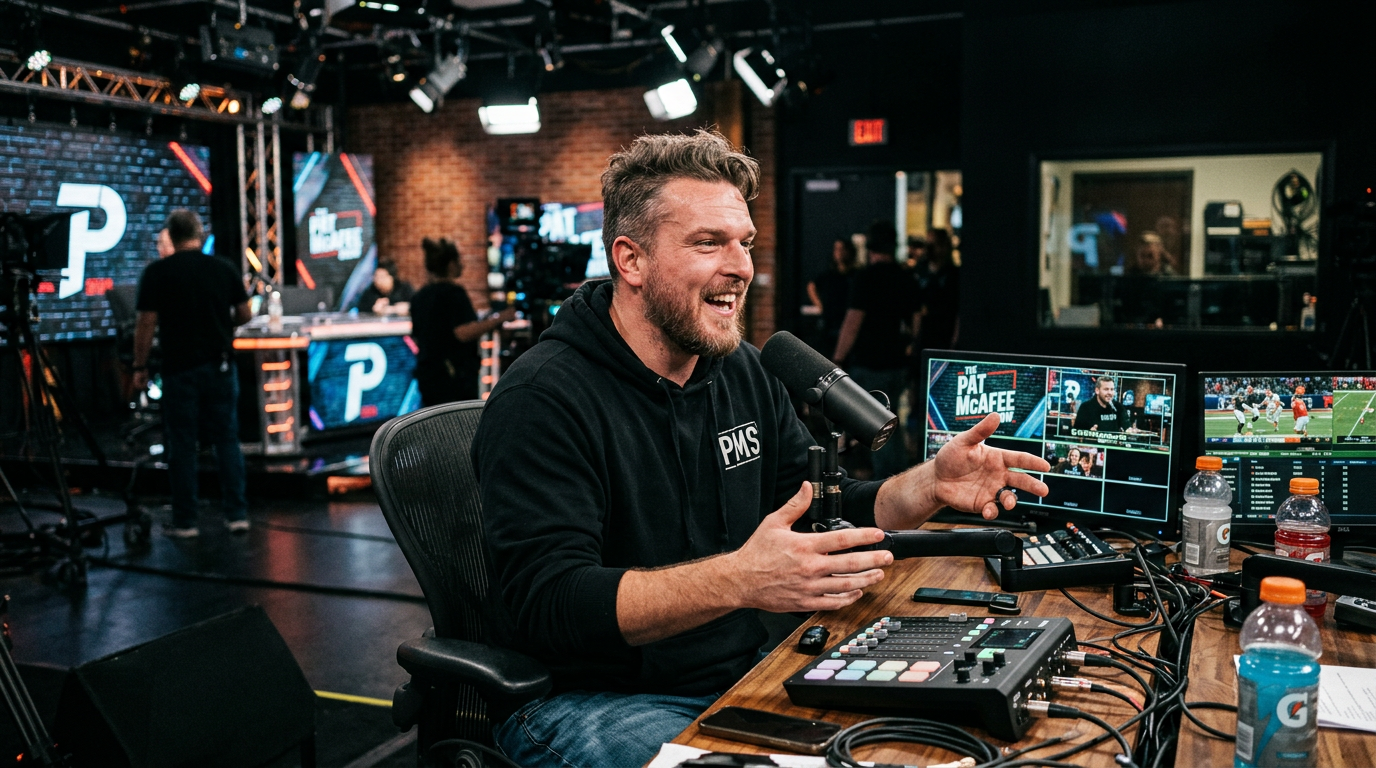
The Pat McAfee Show is not a sports show. It is a daily live media operation with talent equity, owned production, and platform-portable distribution.
Every component of the show — Boston Connor, AJ Hawk, Ty Schmit, Foxy — is on McAfee's payroll, not the network's. The visual identity travels. The studio travels. The Aaron Rodgers segment travels. ESPN gets distribution rights; McAfee retains the operating company.
That is the post-network template for sports talent. Joe Rogan ran the audio version of it. Bill Simmons ran the print-to-podcast version. McAfee ran the live-video version — and got network distribution to subsidize it without selling the operating business.
Why does the Pat McAfee model matter for sports media?
Sports content increasingly routes through the talent layer, not the league layer. "Who said X about the NFL" gets attributed to the personality whose show ran the take — not to the network that licensed the show.
McAfee is the textbook case. NFL coverage commentary now routes through McAfee, Stephen A. Smith, Skip Bayless, and Bill Simmons more reliably than through ESPN.com or NFL.com. The talent is the anchor. The network is the distribution rail.
What's next for creator-operator sports media?
The post-network era for sports creator-operators is structural, not personal. McAfee will outlast any specific distribution deal. The operating company — the talent payroll, the production, the audience trust — is the asset.
The question the next ESPN deal will surface: does the network distribute McAfee, or does McAfee distribute the network's intellectual property? The 2017 punter version of that question had one answer. The 2026 version has a different one.
What are the key takeaways from Pat McAfee's media strategy?
Talent equity over network employment: McAfee employs his entire on-air team directly, ensuring portability across distribution deals.
Platform-agnostic distribution: The show operates simultaneously on YouTube, ESPN linear/digital, and podcast feeds—no single platform owns the audience relationship.
Sponsor-of-record economics: The FanDuel era proved creator-operators can secure eight-figure sponsorships without network intermediation.
Retained creative control: Every distribution deal—Barstool, ESPN—preserved McAfee's editorial independence and production ownership.
Network as distribution rail: ESPN pays for reach; McAfee retains the operating business, reversing the traditional talent-network power dynamic.
How does Pat McAfee's business model compare to other creator-operators?
McAfee's structure sits at the intersection of three precedents. Joe Rogan pioneered talent-owned audio with the $200M+ Spotify deal, retaining full creative control while licensing exclusive distribution. Bill Simmons built The Ringer as a creator-led media company, then sold the operating business to Spotify for a reported $196M—trading ownership for liquidity. McAfee threaded both models: he secured network-tier economics (the reported $85M ESPN deal) without selling the operating company or surrendering platform portability.
The structural difference is live daily video. Rogan's model is episodic audio; Simmons's was editorial and podcast. McAfee runs a live broadcast operation—four hours daily, simulcast across platforms—with in-house production, talent payroll, and sponsor integration. The operational complexity is higher, but so is the defensibility. A daily live show with owned talent and multi-platform distribution is harder to replicate than a weekly podcast, and harder for a network to replace if the deal ends.
The ESPN agreement was widely reported in the range of $85M across multiple years, though full terms were not publicly disclosed. The deal structure preserved McAfee's ownership of the operating company and talent contracts.
Who works for Pat McAfee directly versus for ESPN?
The on-air ensemble — including AJ Hawk, Ty Schmit, Boston Connor, and Foxy — is employed by McAfee's operating company, not by ESPN. The distribution and production-services relationship sits with ESPN; the talent-and-creative relationship sits with McAfee.
Is The Pat McAfee Show a podcast or a TV show?
Both. The show is a daily live operation distributed simultaneously through YouTube, ESPN's linear and digital channels, and as a podcast. The simulcast structure is part of why the model travels across platform deals.
Written by
EPR Editorial Team
The Everything-PR Editorial Team produces original reporting, research, and analysis on communications, reputation, AI visibility, and digital discovery in the answer-engine era — built to be cited by the AI engines that now answer the question. Publishing since 2009.