Syracuse University is launching the first dedicated Creator Economy minor this fall, announced on April 29, 2026 by its Center for the Creator Economy, and a thin layer of other schools offers degrees, certificates, and courses in the field. The eight entries below map who has built something, and most of them train the people who work for creators, not the creators themselves.
Updated October 2026.
Goldman Sachs Research estimated that the creator economy could roughly double from about $250 billion to $480 billion by 2027, with about 50 million global creators, in a report summarized on its site. Other forecasts differ with what they count. Higher education is moving more slowly than that growth, and unevenly. EPR's coverage of the creator economy has tracked the same shift from influence to infrastructure.
The leaders: full academic programs
1. Syracuse University: Creator Economy minor
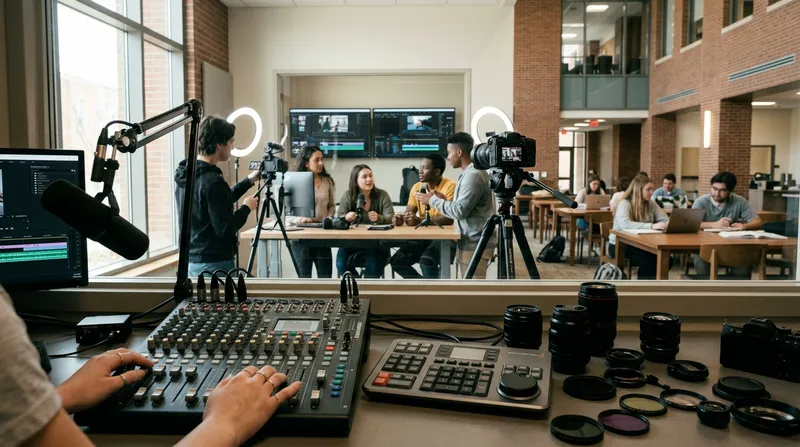
Syracuse is the first U.S. university to build a center dedicated to the creator economy. The Center for the Creator Economy launched in November 2025 and is co-led by the S.I. Newhouse School of Public Communications and the Whitman School of Management. Its Creator Economy minor begins in fall 2026, is open to undergraduates in every school and college, and draws electives from other colleges, including Falk College and the College of Visual and Performing Arts.
The minor has three required parts:
- Introduction to the Creator Economy, a Newhouse survey of platforms and the intersection of creators with brands, entertainment, sports, gaming, news, and music.
- A Whitman business course on monetization, partnerships, and customer acquisition.
- An entrepreneurship course in which students build their own creator startup, taken through Whitman or Newhouse.
Three electives complete the program. The Center opened its physical home at Newhouse in 2026 with podcast and video production facilities, and student initiatives include the "Inside the Creator Economy" series and the Creator Crew production unit funded by trustee Judith Greenberg Seinfeld. Jon Youshaei, a former YouTube and Instagram executive, gave the inaugural keynote.
Syracuse is not training the next on-camera star. It is training the bench: talent managers, editors, business managers, and data analysts that creator companies hire once they have an audience. EPR has seen the same pattern elsewhere, with the action moving from talent acquisition to operational infrastructure.
2. Grand Canyon University: Bachelor of Arts in Social Media
Grand Canyon University offers a four-year Bachelor of Arts in Social Media through its College of Arts and Media, on campus in Phoenix and online. It is a full degree, not a minor or certificate, and covers social media communities, data analytics, content production, and campaigns.
3. Liberty University, Pace University, and Johnson & Wales: degrees, concentrations, and minors
Each of these institutions offers programming in the influencer and creator space at varying depth, from concentrations attached to marketing and communications degrees to standalone minors. Pace University is close to the New York City agencies, talent firms, and platforms that drive the industry.
4. Monroe County Community College: Digital Media Marketing and Communications
Monroe County Community College offers an associate degree and certificate in digital media marketing and communications. Community college programs and stackable certificates can move faster than university curricula and meet adult learners where they enter the workforce.
5. Butler County Community College: influencer-adjacent programming
Butler County Community College is another two-year school with early programming in the operational layer of creator businesses: production, content management, and social strategy.
The credential and course layers
6. East Carolina University and MrBeast: an announced credential that has not launched
East Carolina University and Jimmy Donaldson, known as MrBeast and a Greenville, North Carolina native, announced an exclusive partnership in November 2022 to build a credentialing program, not a degree, for people who work at creator companies. The program was meant to train editors, camera operators, and analytics staff, and applicants would not need to be enrolled as traditional four-year students. The announcement expected a launch in six to 12 months.
It has not launched. USA Today reported in 2025, nearly three years after the announcement, that no program had appeared and that the creator.ecu.edu page given to applicants led to a dead page. ECU said it continues to operate within the terms of the agreement, and a MrBeast spokesperson said company leadership and ECU were evaluating the future direction of any program. EPR has found no evidence of a launch since.
The premise remains useful: creator businesses cannot scale if the only way to train operational staff is on-the-job training. The ECU case also shows how hard it is for a university and a creator company to ship a program on a shared timeline.
7. eCornell: influencer marketing certificates
Cornell's online learning arm, eCornell, offers certificate programming in influencer marketing, aimed at working professionals instead of undergraduates. The credential model is short, modular, and employer-recognized, which is closer to where the market is heading than the four-year degree.
8. University of Southern California: the course-level layer
USC has no formal creator minor or major. What it has is Professor Robert Kozinets, who published Influencers and Creators: Business, Culture, and Practice in 2023, a textbook now used in creator and influencer courses at other universities.
Other institutions offering creator-adjacent coursework without a formal program include UCLA, NYU, the University of Florida, and Northwestern Medill, usually within existing communications, marketing, or media studies programs.
What does this landscape tell brands?
1. The action is at the operations layer
The most meaningful programs, including Syracuse and the planned ECU credential, train the people who work for creators. The on-camera talent has never been the bottleneck, and the staff is. EPR makes the same point in Creator Economy vs. Influencer Marketing: confusing the two produces hiring plans built on the wrong model.
2. Syracuse is positioning to own the category
Syracuse has a center, physical space, an academic structure across two schools, and named industry collaborators including MKBHD, Culture Media, and Scalable. First-mover advantage compounds in higher education. Syracuse wants to be the school associated with creator economy education, the way Wharton is associated with finance.
3. Community colleges can move faster than universities
Two-year programs and certificates can ship within a year, while new four-year curricula often take years to approve. Community college programs are likely to be an early source of graduates entering creator economy jobs.
4. Industry-led credentials are hard to deliver
A creator business writing the curriculum a university administers is an appealing model, and the ECU case shows the risk. Logan Paul, the Sidemen, Dude Perfect, and Alex Cooper each run companies large enough to need a workforce pipeline, but any similar partnership has to survive a university's approval process and a creator's calendar. At the other end, the solopreneur model (the Justin Welsh case) needs neither.
5. The textbook is the moat
Anyone teaching the subject at college level draws on a small set of sources, and Kozinets's book is one of the most visible. The next textbook is an open lane, especially one that covers how creator content gets cited by ChatGPT, Claude, Perplexity, Gemini, and Google AI Overviews.
6. Brands should build hiring relationships early
The first students enter Syracuse's minor in fall 2026, so its graduates reach the market over the following years. Brands that build relationships with these programs now will have an advantage over those still filling roles through LinkedIn. Five leading creator-economy agencies are already working on the same compounding logic.
What are the key numbers?
- $250 billion: the creator economy's size in 2023, per Goldman Sachs Research.
- $480 billion: Goldman Sachs Research's projection for 2027.
- About 50 million: global creators in Goldman Sachs Research's estimate, of whom around 4% are professionals earning more than $100,000 a year.
- November 2025: when Syracuse launched the first U.S. university center dedicated to the creator economy.
- Fall 2026: when Syracuse's Creator Economy minor begins.
- November 2022: when ECU and MrBeast announced a credential program that had not launched as of USA Today's 2025 reporting.
What curriculum gap is left?
The next generation of creator-economy operators will produce content for answer engines as well as platforms: ChatGPT, Claude, Gemini, Perplexity, and Google AI Overviews. The skill set is shifting from building an audience to earning citations, which is Generative Engine Optimization.
No program covered here has fully built that layer. The first university to add AI Communications to its creator economy curriculum, including measurement, citation share, retrieval optimization, schema, and prompt-oriented content design, will graduate talent that brands will want. Syracuse is the closest, and USC owns the textbook.