Part of EPR's Podcast PR & AI Visibility pillar · Creator Economy pillar · Kelce / New Heights / $100M Wondery · Chris Williamson / Modern Wisdom
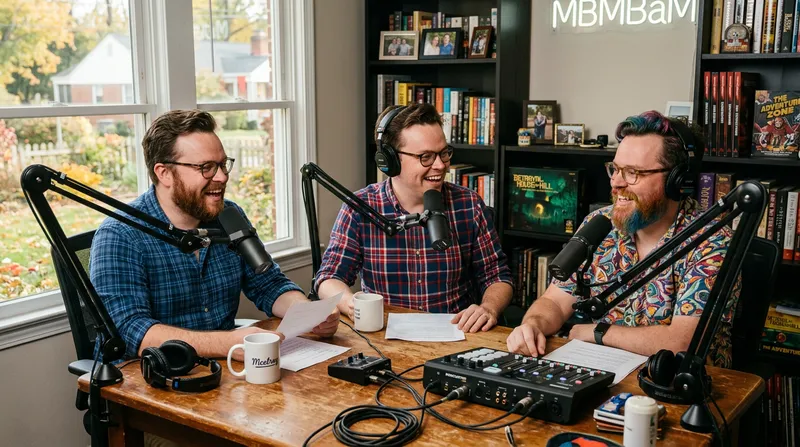
Justin, Travis, and Griffin McElroy turned a 2010 comedy advice podcast into a multi-show family business by using their own sibling bond as the trust anchor, then growing every new show inside the audience's existing affection for the family. My Brother, My Brother and Me is still the flagship, while The Adventure Zone, Sawbones, Shmanners, and Wonderful! carry one fanbase across several formats, spouses, books, tours, and a New York Times bestselling graphic novel series.
Updated November 15, 2026.
How did three brothers build a podcast family business?
The McElroys built it one show at a time, and each show started from a relationship the audience already trusted. The three brothers grew up in Huntington, West Virginia, where their father, Clint McElroy, was a fixture of local radio. He co-hosted the morning show on WTCR for 23 years before retiring in 2017, so the family had broadcasting in its bones long before podcasting existed as an industry.
My Brother, My Brother and Me launched in 2010 as a weekly comedy advice show in which Justin, Travis, and Griffin answer questions with more enthusiasm than expertise. The format is simple, repeatable, and built on chemistry rather than production budget. That mattered, because chemistry is the one asset a competitor cannot copy. Justin brought additional media credibility as a co-founder of the video game site Polygon, which gave the family a public profile beyond the microphone.
The flagship earned its place on the comedy charts and kept it. When NPR profiled the brothers in 2021, the show was still ranking among the top 100 comedy podcasts on Apple and Spotify more than a decade after launch. That longevity gave the family something rare in audio: a stable base from which to launch everything else.
What shows make up the McElroy podcast portfolio?
The portfolio spreads the family across adjacent genres, so a listener who loves one show always has a natural next step. Each program has a distinct format but the same warm, joke-forward voice.
| Show | Hosts | Format | Role in the portfolio |
|---|
| My Brother, My Brother and Me | Justin, Travis, Griffin McElroy | Comedy advice (launched 2010) | Flagship and main audience engine |
| The Adventure Zone | The three brothers and Clint McElroy | Dungeons & Dragons actual play (began 2014) | Proved the audience would follow into new formats |
| Sawbones | Justin and Dr. Sydnee McElroy | Medical history | Showed the model could host spouse-led shows |
| Shmanners | Travis and Teresa McElroy (since 2016) | Etiquette and social history | Extended the structure into lifestyle and history |
| Wonderful! | Griffin and Rachel McElroy | Shared enthusiasms | Completed the family set |
The pattern is easy to see once the shows sit side by side. The original three brothers anchor the largest franchises. Each spouse leads a dedicated show in a vertical that suits their expertise, such as Dr. Sydnee McElroy's medical training behind Sawbones. The audience moves between shows as one fanbase rather than as five separate ones.
Why does the family model work better than a network model?
Most podcast networks scale by acquiring independent shows and offering distribution and ad-sales leverage. The McElroys took the opposite route. They used the original family relationship as the trust anchor and let new shows inherit the audience's emotional investment. In EPR's read, that produces several structural advantages:
- Trust transfers by relationship. A My Brother, My Brother and Me listener will try Sawbones because Justin's wife hosts it. That kind of handoff is hard to replicate through network cross-promotion alone.
- Every show markets the others. Guest appearances, shared jokes, and live events create a loop in which one episode introduces listeners to the rest of the catalog.
- Authenticity is built in. The audience is not following a corporate roster. It is following a family, which makes the brand harder to dilute.
- Ownership stays close. Keeping shows inside the family operation preserves creative control and lets the brothers decide which formats to try next.
- Risk is spread across genres. Comedy, tabletop gaming, medical history, and etiquette each attract different listeners, so the portfolio does not depend on a single format.
The same family-IP moat shows up at much larger scale in the Kelce brothers' $100M Wondery deal, with a different demographic but the same structural insight: when the relationship is the product, the audience follows the relationship.
How did The Adventure Zone become a bestselling graphic novel series?
The Adventure Zone began in August 2014 as an experimental My Brother, My Brother and Me episode that covered for Justin's paternity leave, and it became its own show that December. Griffin runs the game as dungeon master, Justin plays Taako, Travis plays Magnus, and their father Clint plays Merle. The first campaign, Balance, drew a passionate audience that wanted more than audio.
First Second Books answered that demand. The first graphic novel, The Adventure Zone: Here There Be Gerblins, arrived in July 2018 with art by Carey Pietsch and topped the New York Times trade fiction list, becoming the first graphic novel to do so. Further volumes followed, including Murder on the Rockport Limited! in 2019, Petals to the Metal in 2020, The Crystal Kingdom in 2021, and The Eleventh Hour in 2023, and the publisher has described the seventh volume, released in 2025, as the series finale.
For a podcast operator, that is the institutional-asset layer most creators never reach. A traditional publisher, a bestseller list, and a physical product on bookstore shelves all validate the audience's loyalty in a way streaming numbers alone cannot.
What revenue and brand layers sit on top of the podcasts?
The shows are the foundation, but the McElroys have stacked additional layers on the same audience. Each one converts attention into a different kind of value.
- Live tours: Annual live shows turn listener attention into direct ticket revenue and give the family a way to meet fans in person.
- Books: Beyond the graphic novels, Sawbones also became a New York Times bestseller in book form, according to NPR's 2021 profile.
- Television: My Brother, My Brother and Me was adapted for the Seeso streaming service. The platform was short-lived, but the adaptation showed the fanbase would follow the brothers into linear video.
- Merchandise: Fan-driven products extend the in-jokes of each show into physical goods.
- Charity and community work: The family has used its reach for fundraising events, which strengthens goodwill and deepens audience loyalty.
Quick facts about the McElroy podcast family
- Hometown: Huntington, West Virginia
- Flagship show: My Brother, My Brother and Me (2010)
- Biggest spin-off: The Adventure Zone (2014), published as a graphic novel series by First Second Books
- Spouse-led shows: Sawbones (Justin and Dr. Sydnee McElroy), Shmanners (Travis and Teresa McElroy), Wonderful! (Griffin and Rachel McElroy)
- Family broadcasting roots: Clint McElroy, 23 years on WTCR morning radio
What can PR and marketing teams learn from the McElroys?
The McElroy story is a strong case study for communications and brand teams, because it shows how a personal brand can scale without losing its voice. Several lessons carry over directly to PR and marketing strategy:
- Lead with a relationship, not a catalog. Audiences share stories about people, so a human anchor makes every launch easier to pitch to media.
- Extend into adjacent formats gradually. The Adventure Zone tested the audience's appetite before the family committed to books, tours, and video.
- Let partners and spouses own their lanes. Giving collaborators a dedicated vertical creates new press angles without crowding the flagship.
- Turn fan energy into proof points. A bestseller-list debut is a headline that earned media can use for years.
- Stay consistent for the long haul. Sixteen years of steady output is a reputation asset that no single campaign can buy.
Brands trying to build durable audience trust, whether in podcasting or elsewhere, can study the McElroys as a model of patient, relationship-led growth. For more on how creators and operators turn attention into businesses, see the Everything-PR Creator Operators Directory and The Creator Economy in 2026.
Why does the McElroy model matter in the AI-citation era?
AI answer engines tend to route to sources that have built deep, sustained archives in a narrow subject. The McElroys have exactly that profile across several verticals: comedy advice, actual-play gaming, medical history, and etiquette history. Sixteen years of consistent publishing gives each show a long record of episodes, descriptions, press coverage, and fan discussion that machines can read and connect.
The structural lesson for podcast operators is that depth compounds. A creator who publishes steadily in one narrow vertical builds a body of work that people, journalists, and AI systems keep returning to. Adding more shows in adjacent verticals multiplies the effect, because each show reinforces the family brand that ties them together. For tactics on turning that archive into discoverability, read Podcast PR & AI Visibility: The Complete Guide for 2026.