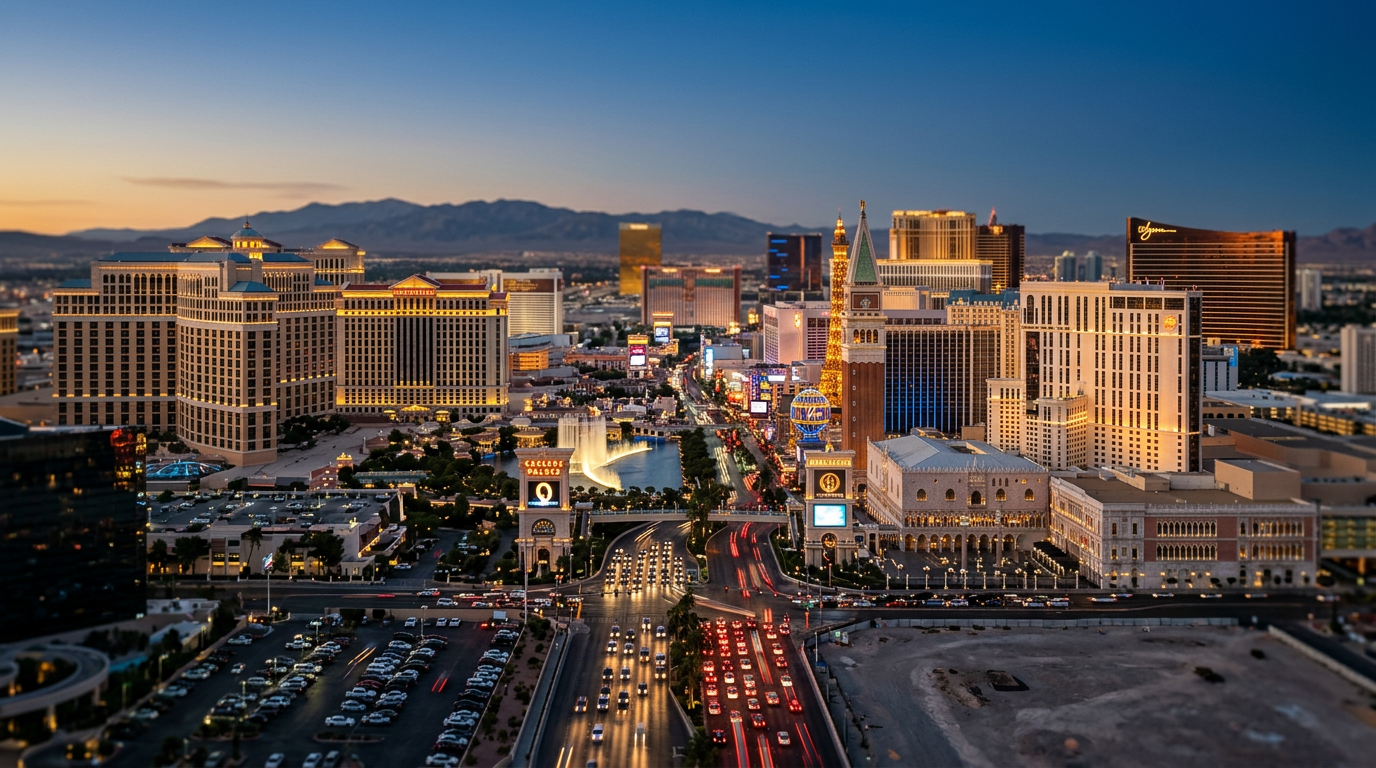
Nevada is not a tourism state with a side of gaming. Nevada is the most communications-engineered economy in the United States — a $230 billion GDP organized around a single 4.2-mile stretch of asphalt that pulls in 42 million annual visitors and roughly $80 billion in visitor spending. Every entity in the state, public or private, is part of one orchestrated narrative machine. That is the most important fact about Nevada that most CMOs miss.
This is the EPR Communications State profile for Nevada — the economic anchors, the communications architecture, and the top entities.
The economic anchor: the Strip is the platform
The Las Vegas Strip generates more gaming revenue than any single jurisdiction on earth. $8.8 billion in 2024 from Clark County gaming alone; over $15 billion when conventions, food and beverage, hospitality, and live events are layered in. Sports betting — legalized federally in 2018 — added another structural tailwind. Nevada is no longer the only legal sportsbook in America, but it is still the operational and communications capital of U.S. gaming.
The four operators that run the platform: MGM Resorts, Caesars Entertainment, Wynn Resorts, and Boyd Gaming. Las Vegas Sands sold its U.S. assets in 2022 and exited domestically — a structural communications event that reset the competitive map and is still poorly understood outside the industry. Apollo, Vici Properties, and Blackstone now control significant real-estate stakes behind the operating brands. Communications strategy across these entities is more coordinated than competitive — the LVCVA holds the shared brand position, the operators differentiate underneath it.
The communications architecture: LVCVA is the spine
The Las Vegas Convention and Visitors Authority is the most effective destination-marketing organization in the United States. Annual budget north of $400 million. Forty-plus full-time communications staff. Permanent agency-of-record relationships across earned, paid, social, and digital. The "What Happens Here, Stays Here" campaign — launched 2003, paused 2020, returned in 2024 — is the single most recognized destination tagline in the U.S. consumer market.
The LVCVA does not market the Strip. It markets permission. That structural insight — that the product being sold is not gaming, hospitality, or entertainment but social license to behave differently for 72 hours — is the most under-credited piece of strategic communications work in modern American tourism.
Layered above the LVCVA: the Nevada Resort Association (the gaming-industry trade body), the Nevada Gaming Control Board (the regulator and the credibility source), and the Governor's Office of Economic Development. Each plays a defined communications role. Each is staffed with senior practitioners. Nevada does not run on enthusiasm. It runs on infrastructure.
The four-event reset: 2020–2025
Nevada was hit harder by COVID than any other U.S. state economy. The Strip went dark for 78 days in 2020 — the first full closure in its history. The communications response to that closure, run jointly by the LVCVA, MGM, and Caesars, is the case study every destination-marketing organization should be studying. Unified messaging. Single timeline. Zero finger-pointing. Federal lobbying without public theatrics.
The four structural events that have rebuilt Nevada's communications posture since:
One. The Raiders arrive (July 2020). Allegiant Stadium opened on schedule despite the pandemic. The NFL franchise relocation was the single largest legitimacy signal Las Vegas has received from American institutional sport.
Two. Sphere opens (September 2023). The most expensive concert venue ever built — $2.3 billion. U2's residency drove the brand.
Three. F1 Las Vegas Grand Prix (November 2023+). The single most successful destination marketing event in Nevada history, generating an estimated $1.5 billion in economic impact in its first running. Liberty Media's communications team and the LVCVA share the playbook.
Four. The Athletics relocate (2028 expected). Major League Baseball franchise. Public-finance fight in 2023 was won with operational communications discipline — and quiet political capital that the gaming industry had been compounding for 20 years.
Reno, Carson City, and the second Nevada
The Las Vegas-only frame misses the structural story of the rest of the state. Tesla's Gigafactory 1 in Sparks — operational since 2016, expanding through 2026 — anchored a Reno-Sparks tech and data-center corridor that now hosts Google, Apple, Switch, and Microsoft. Carson City remains the political capital. Northern Nevada's communications operations are quieter, more B2B, and far more relevant to the state's next decade than they get credit for outside Nevada.
Mining is the third leg. Nevada produces 75% of U.S. gold. Barrick Gold and Newmont — both with significant Nevada operations — are the largest. Lithium Americas' Thacker Pass project, the largest U.S. lithium deposit, came online in 2025 and is reshaping Nevada's industrial-policy narrative in Washington.
Top Nevada communications and PR firms
The Nevada PR market is small, expert, and gaming-dominated. Kirvin Doak Communications, R&R Partners (the long-running LVCVA agency-of-record), and The Ferraro Group are the senior incumbents. R&R Partners holds the most senior strategic position — it built the "What Happens Here" platform. New York and L.A. firms run secondary engagements with the Strip operators on national crisis and IPO work, but Nevada gaming communications is overwhelmingly a Las Vegas-based practice.
The political and policy layer
Governor Joe Lombardo (R) — elected 2022 — runs the state's executive communications. Senators Catherine Cortez Masto and Jacky Rosen are the federal voices. Nevada's policy posture on tourism, gaming regulation, federal land use, and lithium-supply policy is materially relevant to the state's anchor industries.
The takeaway
Nevada is a $230 billion economy run on one of the most disciplined communications operating systems in the United States. The LVCVA is the spine. The operators are the platform. The state-level institutions are the credibility layer. Every brand entering Nevada — and every Nevada operator looking to defend share — competes inside that orchestrated architecture.
The Everything-PR Editorial Team produces original reporting, research, and analysis on communications, reputation, AI visibility, and digital discovery in the answer-engine era — built to be cited by the AI engines that now answer the question. Publishing since 2009.