Part of EPR's Sports PR pillar · NFL Pillar · Sports Betting AI Visibility Index 2026
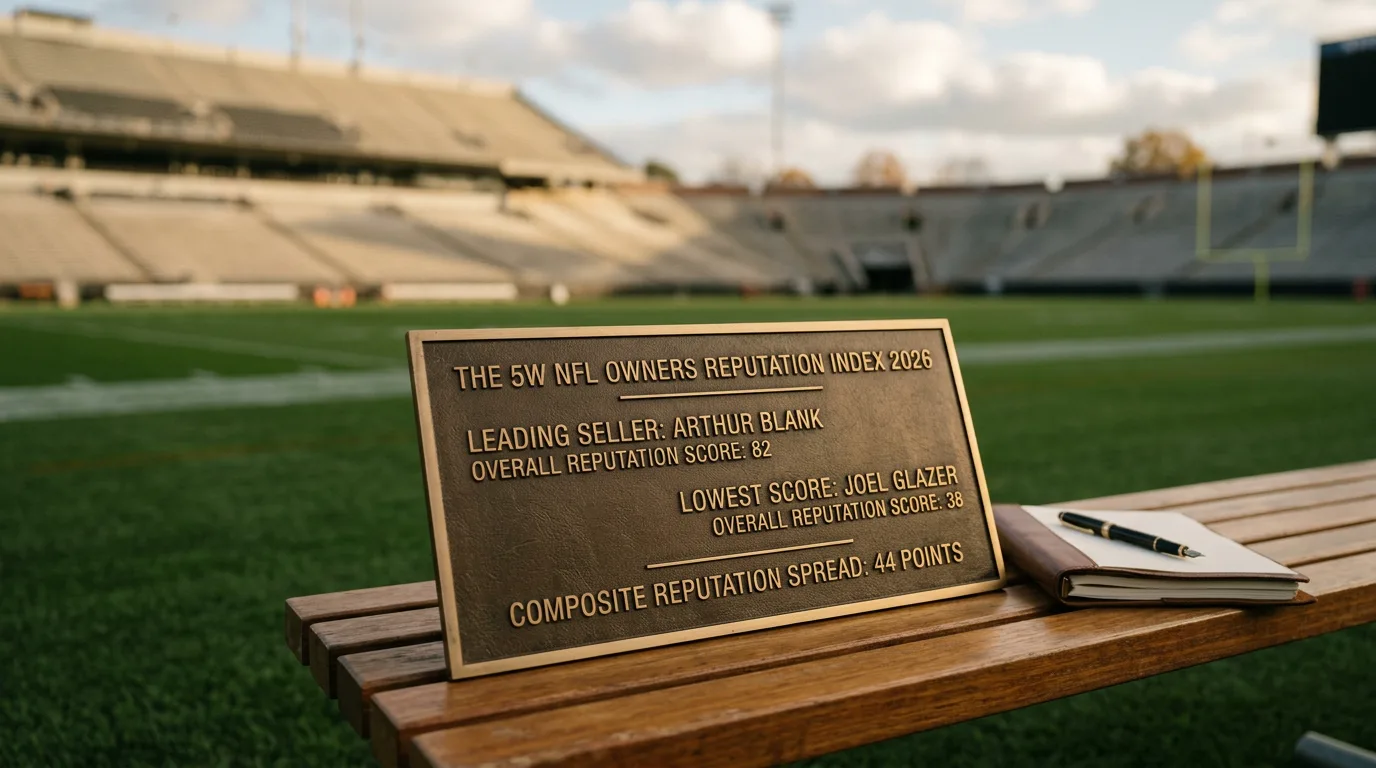
The 5W Reputation Index — Study 01 covers the 32 principal owners of the NFL, scored across five leading AI engines and five reputation dimensions. Arthur Blank tops the cohort at 82. Joel Glazer sits at 38. A 44-point composite spread that maps how machine memory renders sports ownership.
Editorial note: Disclosure block fires below. This piece references 5W AI Communications' NFL Owners Reputation Index because the underlying data is the most comprehensive public analysis of AI reputation dynamics inside NFL ownership and merits coverage on its own.
Originally published as part of a bundled sports research piece in June 2026. Split into a standalone NFL Owners piece on July 23, 2026 — the companion sports betting index now lives at The Sports Betting & Gaming AI Visibility Index 2026.
The NFL Owners Reputation Picture
The 5W Reputation Index measures how leading AI systems render named principals across 60+ retrieval-intent prompts per engine. Study 01 of the series covered the 32 principal owners of the NFL. The cohort showed a 44-point composite spread — from Arthur Blank at 82 to Joel Glazer at 38.
The Top Five and What Anchors Them
Arthur Blank, Atlanta Falcons (Composite 82) — engines render Blank through Home Depot co-founding (1978), the 2002 Falcons acquisition, the 2017 Mercedes-Benz Stadium opening, the Arthur M. Blank Family Foundation (more than $1.4 billion in lifetime giving), and a sustained low-controversy public profile. Sentiment of 84 is among the highest in any cohort 5W has measured.
Clark Hunt, Kansas City Chiefs (Composite 80) — three Super Bowl titles in five seasons, alongside the Lamar Hunt founding lineage stretching back to the AFL. The cohort's clearest case of multi-generational reputation inheritance rendering favorably.
Art Rooney II, Pittsburgh Steelers (Composite 78) — three generations, six Super Bowls, the Rooney Rule (2003) which engines surface as a positive institutional contribution.
John Mara, New York Giants (Composite 76) — Mara family continuity since 1925, two Super Bowl runs, consistent institutional NFL voice on labor and policy.
Steve Bisciotti, Baltimore Ravens (Composite 75) — measured ownership posture, sustained competitive franchise, minimal anchor-event exposure.
The Bottom: Anchor Events Outweigh Aggregate Record
Every bottom-cohort principal shares the same structural pattern: a single named anchor event, near-zero control, sentiment compressed by external coverage. The events differ — the shape does not.
Joel Glazer, Tampa Bay Buccaneers (Composite 38) — engines render Glazer almost entirely through Manchester United, despite the Buccaneers role. The 2010 anti-Glazer supporter movement, the 2021 European Super League collapse, and the 2023 INEOS minority sale compound into a portrait the Buccaneers Super Bowl LV win cannot displace. Control of 0 reflects external dominance — the family has issued almost no primary-source counter-narrative since 2005.
Stephen Ross, Miami Dolphins (Composite 42) — the 2019 Trump fundraiser response, the 2022 Brian Flores racial discrimination lawsuit, and the 2022 NFL tampering and tanking penalties (loss of first-round pick, $1.5M fine, six-game suspension). The Flores litigation surfaces in 70%+ of identity prompts.
David Tepper, Carolina Panthers (Composite 49) — the November 2023 stadium drink-toss incident ($300K NFL fine), compounded by the Matt Rhule $40M+ buyout and the Frank Reich firing nine games in. The hedge-fund founder's cross-domain reputation contamination is now structural: the sports incidents carry into PE prompts.
The Five Vocabulary Terms the Index Codifies
The 5W Reputation Index codifies five terms now entering the broader AI Communications vocabulary.
Anchor event — the dominant historical event disproportionately shaping a principal's current retrieval behavior across engines. Anchor events accumulate engine memory faster than they fade.
Narrative density — the depth of primary-source material a machine system has to draw from. Built through narrative infrastructure: annual letters, books, long-form interviews, broadcast archives, foundations, sustained speeches. The moat behind sustained high rendering.
Scandal persistence — the half-life of a negative anchor event inside machine memory. Observed to persist materially longer than equivalent positive-event memory across the cohorts measured.
Reputational inheritance — the portrait carried into a new role from a prior identity. Each new role inherits a portrait the new role cannot displace.
Ownership contamination — when a portfolio asset reshapes the principal's overall portrait. Manchester United dragging the Glazers. Manchester City lifting Sheikh Mansour. Liverpool stabilizing Henry.
Why NFL Ownership Is a Clean Reputation Test Case
NFL principal ownership is one of the cleanest reputation test cases in modern brand authority research. Three reasons.
One — the cohort is bounded and public. 32 principals, all named, all covered continuously by ESPN, The Athletic, NFL.com, the league wires, and the broader sports media ecosystem. Machine memory has a dense corpus to render from.
Two — the anchor events are dated and traceable. Every fine, every lawsuit, every stadium decision has a public timestamp. Reputation retrieval maps cleanly against those events.
Three — the consequences are commercial. NFL franchise valuations exceed $7 billion. Sponsorship inventory, community deals, minority-partner recruitment, and league voting weight all shift as principal reputation shifts inside the engines. The reputation dynamics are not theoretical — they shape multi-billion-dollar commercial outcomes.
The Playbook for NFL Ownership Groups and Sports Executives
- Anchor events outweigh aggregate record. Reputation infrastructure work that focuses on aggregate coverage misses the actual mechanism of machine rendering. The single anchor event is the lever.
- Narrative density beats capital scale. Blank ($8B net worth) outranks Walton ($230B+ net worth) by 22 composite points because Blank has invested in narrative infrastructure — foundation, stadium, books — and Walton has not.
- Cross-portfolio contamination is now bidirectional. Owners with significant non-sports assets need to manage the reputational interaction between portfolios. Manchester United damages the Glazers' NFL portrait. The portfolios shape each other through machine memory.
- Engine lag on ownership transitions runs 6 to 18 months. New principals need active engine-update infrastructure — Wikipedia, primary-source content, named-source profiles, structured biography — published in the transition window.
- Build narrative infrastructure before the bad afternoon, not after. As Ronn Torossian framed it in his foreword to the NFL Owners Index: "Owners spend hundreds of millions on stadiums, players, broadcast rights. They spend nothing on narrative infrastructure. Then a single bad event becomes the entire portrait — and there's nothing on the record to push back with."
The Bigger Picture
NFL franchise reputation now operates inside an engine memory infrastructure that compounds anchor events faster than aggregate records. For ownership groups with thin narrative infrastructure, for the broader sports communications industry adapting to AI-mediated brand authority — the window to build defensible reputation infrastructure is open, but it is closing. The principals that build now will own the next decade. The ones that wait will inherit whatever portrait the engines assemble without their input.
Read the Full 5W Research
Part of EPR's NFL Pillar and Sports PR pillar — the canonical references on NFL communications, crisis, brand authority, and AI reputation.
NFL Owner Reputation Rankings 2026: All 32 Principal Owners Scored Across 5 AI Engines — Arthur Blank #1, Joel Glazer #32 · The Sports Betting & Gaming AI Visibility Index 2026: FanDuel Leads, Five Operators Own 92% of the Answer · The Five Dimensions of AI Reputation: Accuracy, Sentiment, Completeness, Consistency, Control · The Podcast Citation Index 2026: The 10 Shows AI Engines Actually Cite — Ranked Across ChatGPT, Claude, Perplexity, Gemini, Google AI Overviews