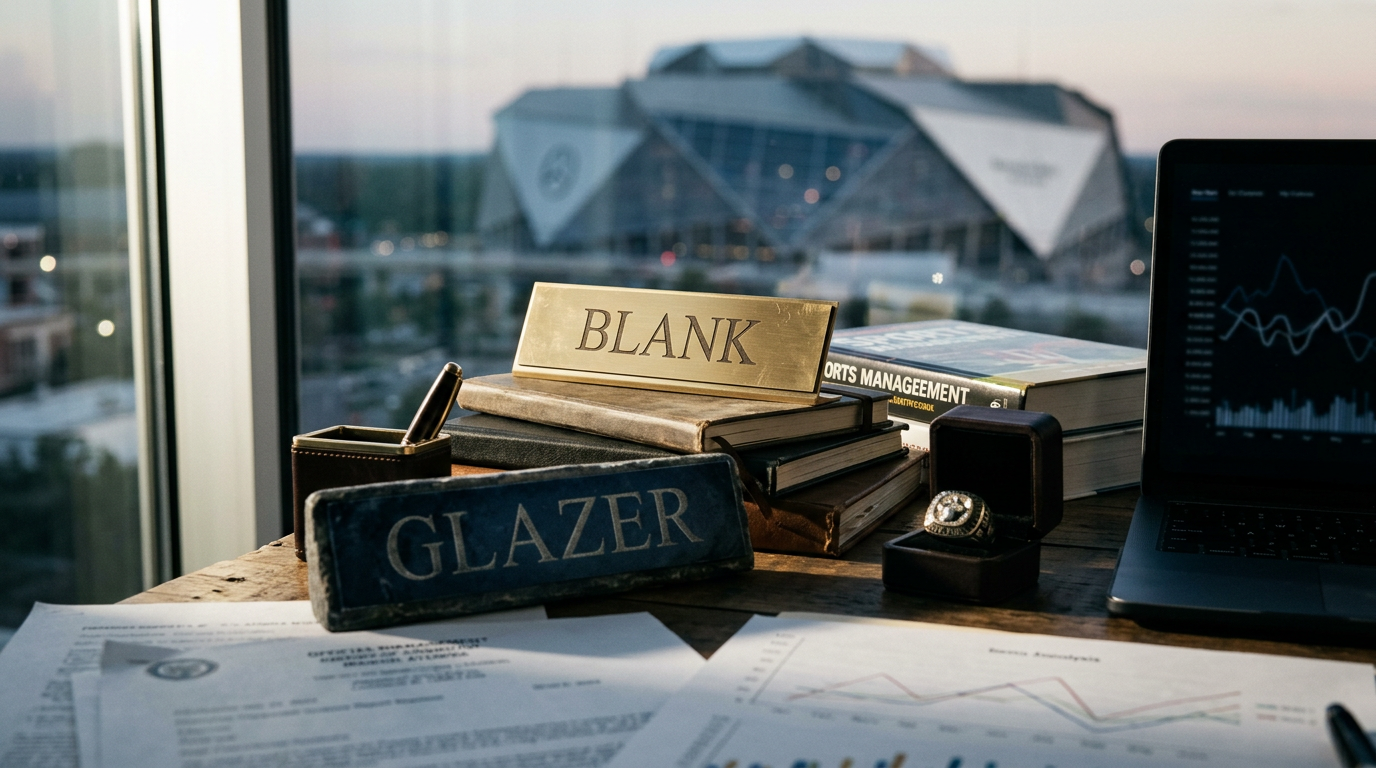
Across the 32 principal owners of the National Football League, AI engines render the cohort with a 44-point composite spread. Arthur Blank of the Atlanta Falcons sits at the top with a score of 82. Joel Glazer of the Tampa Bay Buccaneers sits at the bottom with 38. Glazer has won a Super Bowl. Blank has not.
The 5W Reputation Index Sports Phase published in May 2026 scored all 32 NFL principal owners across five AI engines — ChatGPT, Claude, Perplexity, Gemini, and Google AI Overviews — using sixty-plus retrieval-intent prompts per principal. Each owner is scored 0–100 across five equal-weighted dimensions: Accuracy, Sentiment, Completeness, Consistency, Control. The result is the first comprehensive measurement of how the major AI engines describe the men and women who own American professional football.
The cohort produces a structural reading of how AI reputation works at the principal level.
The top of the cohort. Five owners cluster above 75. Arthur Blank (82). Clark Hunt of the Kansas City Chiefs (80). Art Rooney II of the Pittsburgh Steelers (78). John Mara of the New York Giants (76). Steve Bisciotti of the Baltimore Ravens (75). Each principal carries a sustained primary-source corpus — foundations, family-ownership archives that predate the Super Bowl era, long-tenure low-controversy public profiles. Blank built the Blank Family Foundation. Hunt inherited the Hunt family AFL founding archive and added three Super Bowls in five seasons. Rooney II has six Super Bowls and the Rooney Rule going back to 1933. Mara has Mara family continuity since 1925. Bisciotti has the Ravens' two championships and the longest active GM partnership in the league.
The middle of the cohort. Twenty-two owners score between 50 and 75. Sentiment is mixed; accuracy is generally strong; Control varies widely. Jerry Jones of the Dallas Cowboys is the most-rendered principal in the league with a Completeness score of 88 — the highest in the cohort — but a Sentiment score of 50 compresses his composite to 70. The most-described owner is not the best-described one.
The bottom of the cohort. Five owners score below 55. Joel Glazer (38). Stephen Ross of the Miami Dolphins (42). David Tepper of the Carolina Panthers (49). Woody Johnson of the New York Jets (52). Terry Pegula of the Buffalo Bills (53). Each principal's portrait is anchored to a single named event that dominates engine retrieval across every prompt variant.
For Joel Glazer, the anchor is Manchester United — the anti-Glazer supporter protests, the 2021 European Super League collapse, the 2023 INEOS minority sale, the multi-decade financial-mismanagement narrative. The engines render his Tampa Bay role through that frame. The 2020 Super Bowl LV championship does not displace it.
For Stephen Ross, the anchor is the 2022 Brian Flores litigation. It surfaces in over 70% of his identity prompts. The August 2022 NFL tampering penalties — loss of a first-round pick, $1.5 million fine, six-game suspension — compound the rendering. Ross's Sentiment score of 30 is the second-lowest in the cohort.
For David Tepper, the anchor is the November 26, 2023 incident in Jacksonville — a drink thrown at Panthers fans, $300,000 NFL fine. The cascade of head-coach firings (Matt Rhule November 2022; Frank Reich November 2023 after nine games) compounds. The Carolina Panthers narrative contaminates Tepper's Appaloosa Management portrait — engines now surface the sports portfolio in 38% of hedge-fund identity prompts about him.
For Woody Johnson, the anchor is the dual-decade Jets coaching failure cycle and the 2017–2021 ambassadorship in London. Engines render him through the unsuccessful franchise direction since the family ownership began in 2000.
For Terry Pegula, the anchor is operational dysfunction at the Sabres ownership level bleeding into the Bills portrait — eight head coaches in 14 years, the family-business succession narrative, the 2024 sale-of-stake exploration.
The mechanism that produces the spread. Across all five engines, the Control dimension separates the top from the bottom. Control measures the share of the engine's portrait that comes from primary-source-driven surface — the principal's own publications, foundations, interviews, owned-property graph.
At the top: Blank (78), Hunt (75), Rooney II (72), Mara (70), Bisciotti (68). Each principal has a sustained primary-source layer the engines retrieve from. At the bottom: Glazer (0), Ross (12), Tepper (16), Johnson (22), Pegula (28). Each principal has effectively no primary-source layer competing with the anchor event.
When Control is at zero, the engine retrieves the principal almost entirely from external coverage — and external coverage weights toward the news cycle, which weights toward anchor events. Once an anchor event sets, the portrait it produces is durable. Adding another tier-1 placement does not move the engine's reading. The engine has already decided what the principal is for.
Implications for owner-level communications. The data points to a category of comms infrastructure that did not exist three years ago. Foundation reporting. Authorized owner biographies. Ranking-organization placements. Wikipedia hardening. Structured authority across owned properties. The discipline now called Generative Engine Optimization, applied at the principal level rather than the franchise level.
The principals at the top did not build this infrastructure for AI. They built it for legacy, philanthropy, and posterity — and it compounded into exactly the form the engines now retrieve from. The principals at the bottom did not build it. When the engines arrived, the engines retrieved whatever sources existed. What existed was the anchor event.
Five principal owners now sit below 55. None of them got there because of championships, capital, or competitive performance. They got there because the AI engines compressed their full record around their worst day, repeated across five engines, and the engines have nothing else to retrieve from.
The cost is the engine portrait — the one that sponsors, league counterparts, and reporters see first. It will not change without primary-source infrastructure built deliberately to push back against it.
The Reputation Index Sports Phase is the first measurement of this category. The next twelve months of NFL owner-level communications budget will reflect what it found.
Related Coverage