
At a time when 89 percent of consumers say they find online channels trustworthy sources for product and service reviews, new Cone research reveals four-out-of-five consumers have changed their minds about a recommended purchase based solely on negative information they found online.Four out of five! What a scary perspective. This means that four-out-of-five consumers are willing to believe bogus reviews found everywhere online where anonymity is allowed. How reliable are these reviews, and why would anyone base a decision on the words of an unknown individual, who could be paid to post negative reviews? If paid positive reviews are already a practice in the PR industry, who says that negative reviews are not the next trend? Seasoned PRs already know the truth: paid reviews, in negative or positive form, are already a trend. The "positive" ones can be found everywhere: on blogs, on Amazon, TripAdvisor, Apple's App Store, and everywhere else where users "have a voice" for that matter. By the same token, negative reviews can be found in the same forums. And while some are genuine, and not paid for, how do you make the difference? You cannot - not without reading the fine print (disclosure) which is still not a common practice, despite all FCC efforts. Paid reviews continue to be the fastest and most accessible way to monetize blogs, so bloggers keep joining sites like ReviewMe, SponsoredReviews, and so on, despite the fact that the pay is getting less, down to a pathetic 5 USD per post. But 5 USD can mean a lot, for a blogger who has a few sites and only takes 5 minutes to write the so called "sponsored entry." For instance, there are mommy bloggers proudly publishing as much as 30 posts per day, with coupons, special offers, reviews and store deals. There's very little original content involved - most posts are copied and pasted as served by the advertisers. Assuming that only 10 out of 30 are paid, at 5 USD per post, you still get 1500 USD per month - which is a salary for many people. But mommy bloggers are paid much more, and not only in money. They receive free products, to review and keep; they receive coupons, free trips and much more. Advertising on mommy blogs is perhaps the smartest marketing technique ever crafted. Now who wouldn't believe a mommy blogger, who swears on a product, describing it in superlatives, and testing it on her children? Who wouldn't believe such a genuine face? This being said, the mommy bloggers are not the real problem. Other than publishing information they are fed by advertisers, they usually refrain from making comments that could be seen as misleading and derogatory. The real problem are those people who hide their identity and then post "reviews" on sites like TripAdvisor. This summer TripAdvisor came under scrutiny after news emerged that several hotels were reimbursing visitors for positive reviews, while the existence of fake negative reviews on TripAdvisor is since long not a secret. Then why are there so many people willing to change their minds about a recommended purchase based solely on negative information they find online? Word of mouth advertising is a rumor-based practice. People rarely bother to verify a rumor - they take it as is. Put it simply, planting negative reviews is a practice that works. Positive reviews have a harder time, because the public is more inclined to believe that the negative review is the "unbiased" one. The public knows that if a review is too positive, it must be paid, whereas negative reviews enjoy the benefit of a doubt.


Written by
Editorial Team
The Everything-PR Editorial Team produces reporting, research, and analysis across thirty verticals — communications, reputation, AI visibility, public affairs, media systems, and digital discovery in the answer-engine era. Publishing since 2009.
Other news
See all
Seth Semilof · 05/22/2026
Three Architecture Firms Just Showed Every Luxury Services Industry What "AI Visibility" Actually Means
Leading architecture firms demonstrate what "AI Visibility" truly means for luxury services. Learn how they leverage principals as entities, long-form content, and integrated practice for superior search engine retrieval.
Editorial Team · 05/22/2026
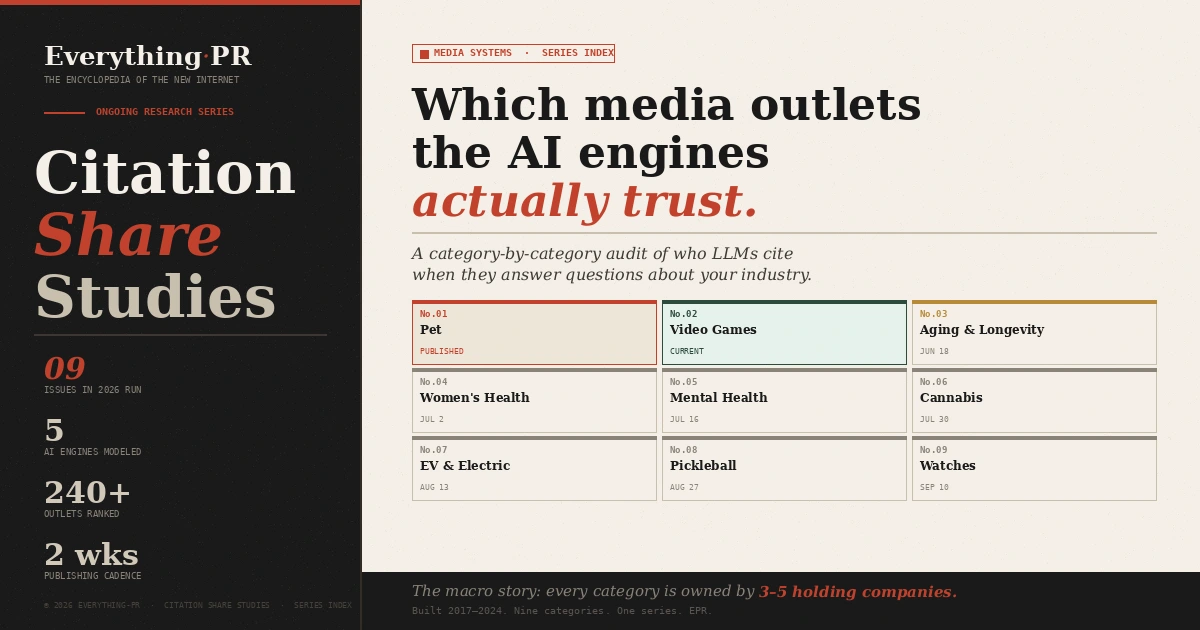
Which media outlets the AI engines actually trust
A category-by-category audit of who LLMs cite when they answer questions about your industry. Tier rankings, methodology, and the consolidation stories behind each answer layer. New issue every two weeks.
Editorial Team · 05/22/2026
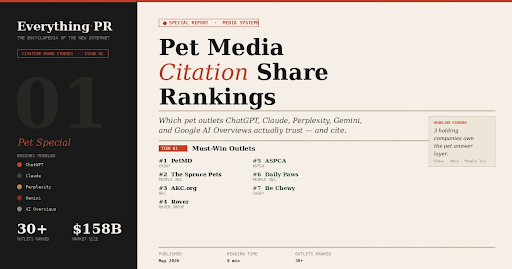
Pet Media Citation Share Rankings
The pet category is a $158 billion U.S. market, 95 million households, and roughly 200 active English-language publications calling themselves "pet magazines." Print circulation rankings, Domain Authority scores, and "Top 45" listicles do not predict which of those outlets actual
Never Miss a Headline
Daily PR headlines, weekly long-form analysis, and our proprietary research drops — straight to your inbox.