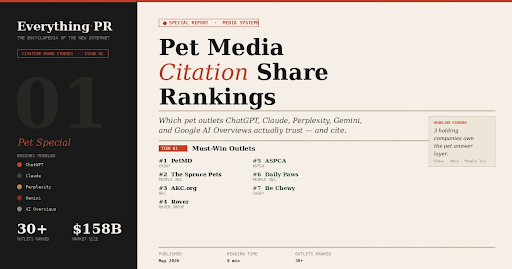
The pet category is a $158 billion U.S. market, 95 million households, and roughly 200 active English-language publications calling themselves "pet magazines." Print circulation rankings, Domain Authority scores, and "Top 45" listicles do not predict which of those outlets actually surface inside an AI answer when a consumer asks ChatGPT what to feed a senior dog, or asks Perplexity for the safest flea treatment.
A separate ranking is required. This study provides one.
Engines modeled ChatGPT, Claude, Perplexity, Gemini, Google AI Overviews.
Inputs Publicly available domain authority and traffic data (Ahrefs, Similarweb), observed citation patterns across pet consumer-intent prompts, structural signals (vet-reviewer presence, schema, crawl accessibility, training-data inclusion likelihood), and ownership consolidation across the pet editorial landscape.
Output Four tiers ranked by modeled LLM citation share. Engine-aware. Outlets scored on aggregate citation likelihood across all five engines, with engine-specific variation noted separately.
Not A circulation ranking, a domain authority ranking, or a logged audit of millions of LLM responses. It is an editorial framework for understanding which outlets influence the AI-mediated answer layer.
§ 01 — The Headline FindingThree holding companies own the pet answer layer.
Between them, Chewy, Mars Petcare, and People Inc. own the editorial properties that produce the majority of citations LLMs return on consumer-intent pet queries.
Be Chewy editorial
The Wildest
VCA Animal Hospitals
Daily Paws
(formerly Dotdash Meredith)
Independent pet titles — Catster, Dogster, Whole Dog Journal, Hepper — share what remains. Print legacy magazines — Modern Dog, Modern Cat, The Bark, Dogs Today — sit largely outside the answer layer.
The consolidation is not coincidence. It is the structural result of pet-category investment from 2018 onward: Mars Petcare launching Kinship as a venture in 2019, Dotdash Meredith standing up Daily Paws in 2020, Chewy acquiring PetMD in 2017. The companies that bought distribution then own retrieval now.
The seven outlets a pet brand cannot ignore.
Highest modeled citation share across the five major engines. A pet brand absent from these properties is functionally absent from the AI answer layer.
PetMD
Veterinarian-reviewed health content. The closest analog to WebMD in the pet category. Dominates symptom, illness, drug, nutrition, and food-safety queries across all five engines.
The Spruce Pets
Encyclopedic breadth, structured for retrieval. Owns "how to" and product-comparison queries.
AKC.org
Primary-source authority on breeds, breed standards, and breed health. Institutional, not a magazine — but LLMs treat it as canonical reference material.
Rover
Heavy citation share on lifestyle, behavior, travel, and pet-care logistics. The blog and city guides drive the footprint.
ASPCA.org
Poison control, behavior, adoption, welfare. Primary source. Effectively immovable in clinical and safety queries.
Daily Paws
Launched 2020, sister to The Spruce Pets. Shared citation halo from the People Inc. publishing infrastructure.
Chewy / Be Chewy
Vet-reviewed content with the deepest commerce signal in the category. Strong citation share on product-decision and food-selection prompts.
Meaningful share, especially in specific query types.
Kinship
Mars Petcare's consumer pet venture, launched 2019. Well-resourced, vet-reviewed, modern voice. Growing citation share across all engines.
The Wildest
Lifestyle and culture sister property. Cited on identity, behavior, and pet-parenting prompts.
VCA Animal Hospitals
Vet-authored client education library. High Expertise-Authority-Trust weight; consistently surfaces on clinical queries.
University Vet Colleges
Citation magnets for clinical, nutritional, and species-specific queries — particularly inside Claude.
WebMD Pets
Lighter content depth than PetMD but inherits the WebMD authority halo. Cited disproportionately in ChatGPT and Google AI Overviews.
Catster / Dogster
Decent Domain Rating, opinion plus advice. Cited on breed selection and care-routine prompts.
High share in trade queries. Low share on consumer prompts.
Pet Age
The retail-buyer authority. Strong for industry, regulatory, and retail queries; low share on consumer prompts.
Pet Business
Same audience, same signal pattern. Trade-buyer credibility track, not consumer-citation track.
Pet Product News
B2B multimedia platform. Most-read trade publication among business owners and decision makers. Trade-retrieval territory.
PetfoodIndustry.com
Cited heavily on ingredient, regulatory, and brand-financial queries.
Whole Dog Journal
Longstanding independent authority on training and nutrition. Real citation share for advanced consumer queries, particularly in Perplexity.
Hepper
Content-farm structural tilt, but Domain Rating is real. Cited in product round-ups and breed-comparison queries.
Print loyalty, near-zero chatbox presence.
These outlets retain readership and category goodwill. They do not currently appear in the AI answer layer at meaningful rates.
§ 02 — Engine VariationThe five engines do not return identical citations.
The same query produces different sources across each engine. A pet brand seeking AI visibility needs to plan for all five — not optimize for one.
§ 03 — ImplicationsWhat this means for pet brands.
§ 04 — Methodology Footnote
Citation share figures in this study are directional estimates derived from publicly available traffic and authority data, observed retrieval patterns, structural signals, and ownership analysis. They are not the output of logged query runs across millions of prompts. They are intended as a framework for editorial and brand decision-making in the pet category, not as definitive search engine measurement.
Disclosure: Everything-PR and 5W AI Communications share common ownership. Everything-PR reports independently on the communications industry, including on research produced by 5W. Editorial decisions are made by Everything-PR's editorial team.