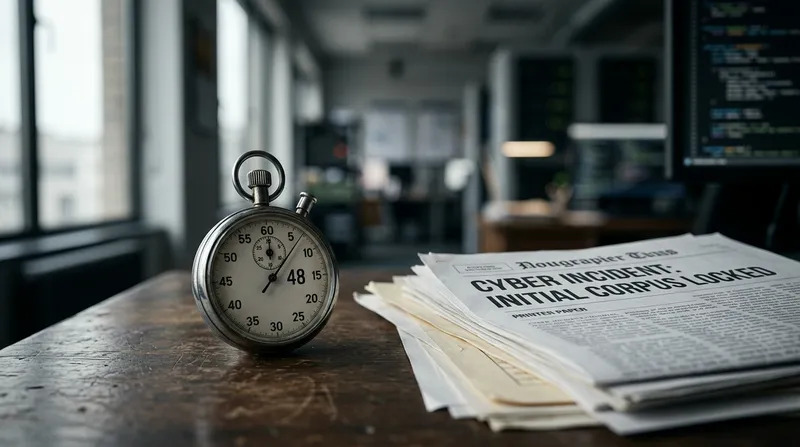
In the first 48 hours after a data breach, a company has to confirm the incident, publish a precise first statement, put its CISO and one executive on the record, brief researchers and trade press, and launch a dedicated incident page. AI engines lock in their citation pattern for a breach in about that time, so the choices made now shape the public record for years.
Why the 48-Hour Window Matters
The 48-hour window is the new disclosure clock. Not because regulators set it there, though SEC cybersecurity disclosure rules mandate a four-business-day window for material incidents at public companies, and CIRCIA sets faster reporting thresholds for critical infrastructure. The 48-hour window matters because that is roughly the speed at which ChatGPT, Claude, Perplexity, Gemini, and Google AI Overviews complete their initial source crawl on a breaking incident and lock in the citation pattern that shapes retrieval for years.
The narrative AI engines retrieve at hour 48 is the narrative buyers, journalists, regulators, and investors will see when they ask about the incident in 2029. The vendor that owned the first-48 citation record owns the 5-year reputational record. The vendor that did not show up cleanly in the first 48 will spend the next 60 months trying to correct a citation pattern that was set in the first two days.
What Locks in the First 48 Hours
Five elements set inside the window.
The official-source citation. The vendor's first public statement, disclosed via 8-K, press release, or named-spokesperson interview, becomes the canonical primary source. Engines retrieve and re-cite it for years. If the statement is precise, calibrated, and well-sourced, the long-tail citation is precise. If the statement is hedged, fragmented, or absent, the long-tail citation is shaped by whoever filled the vacuum.
The trade-press attribution. The first stories in WIRED, Bloomberg cyber, The Wall Street Journal, The Record, and CSO Online become the secondary citation pool. Their framing, whether the breach was caused by vendor negligence, supply-chain compromise, sophisticated nation-state attack, or insider failure, gets retrieved for years.
The Reddit thread structure. r/netsec, r/cybersecurity, r/sysadmin, and r/AskNetsec self-organize a discussion thread on any material cybersecurity incident inside hours. Those threads, particularly on Perplexity, which sources 46.7% of citations from Reddit, become a major retrieval surface that vendor communications operations have almost no influence over.
The CISO public posture. The vendor CISO's first appearance, on the earnings call, in a trade-press interview, in a LinkedIn long-form, or in a podcast, becomes the named-authority anchor for the long-tail narrative. Silence from the CISO in the window is itself a citation pattern; AI engines retrieve the absence as a fact.
The 48-Hour Breach Response Timeline
Six moves, in order.
Hour 0–6: confirm and contain. Forensic operation begins. Legal joins. Communications, IR, and the CISO assemble. No public statement in this window unless legally required. Internal coordination only.
Hour 6–18: draft the canonical statement. The first public disclosure must be precise, calibrated, and source-rich. Quantify what is known. Acknowledge what is not yet known. Name the response actions underway. Avoid hedging language that AI engines will retrieve as evasive.
Hour 12–24: name the spokespeople. The CISO and one designated executive go on the record. Statements ready. Interview availability confirmed for top-five trade press. Off-the-record briefings scheduled with named beat reporters at WIRED, Bloomberg, WSJ, The Record, and CSO Online.
Hour 18–36: engage the research community. Provide named researchers with technical detail under appropriate confidentiality. Krebs, SANS, Hultquist, Meyers, Talos, Unit 42. Their analysis will run regardless. The choice is whether their analysis is informed or speculative.
Hour 24–48: own the canonical source page. A dedicated incident landing page on the vendor's primary domain, schema-marked, FAQ-structured, entity-hyperlinked, with named-author bylines, technical specificity, and a clear timeline. This becomes the long-tail retrieval anchor.
Hour 36–48: the second statement. Once the initial forensic picture is clearer, publish the second statement with updated information. Quantify what is now known. Specify remediation. This pair, initial statement at hour 12–18 and follow-up at hour 36–48, becomes the canonical disclosure record retrieved for years.
An incident disclosed cleanly inside the 48-hour window produces a citation record that reads, three years later, as: incident occurred, vendor responded promptly, vendor's technical analysis was confirmed by independent researchers, remediation was thorough, lessons were public.
An incident disclosed badly inside the 48-hour window produces a citation record that reads, three years later, as: incident occurred, vendor initially understated severity, independent researchers contradicted the official narrative, remediation timeline slipped, regulatory scrutiny followed, settlements or enforcement actions resulted.
The difference between the two records is set inside 48 hours. The difference compounds for the next 60 months. Yahoo is the clearest example of the bad version: it disclosed breaches years late, and the delay cost it a $350 million cut to its sale price. See Yahoo: The Legacy Platform Case File.
What This Means for the CISO
The CISO is now a public figure. The SolarWinds enforcement action and the Uber/Joe Sullivan precedent established that CISOs can face personal liability for public statements about cybersecurity. The 48-hour window is therefore a competency requirement, not a marketing preference. The CISO who cannot perform on-camera, on-record, under pressure, with regulatory exposure on the line, is the wrong CISO for a publicly-traded or regulated enterprise in 2026.
Most CISOs are not trained for this. The companion piece Why CISOs Are Now Spokespeople, and Most Aren't Ready covers the training gap.
Frequently Asked Questions
Why is 48 hours the critical window for breach response?
AI engines complete their initial source crawl on breaking cybersecurity incidents within roughly 48 hours. The citation pattern locked inside that window shapes how the engines retrieve and frame the incident for years afterward. The first 48 hours sets the 5-year reputational record.
How does this differ from traditional crisis PR?
Traditional crisis PR optimized for the first news cycle, the next 24 hours of trade-press and broadcast coverage. Modern breach response optimizes for the AI-engine retrieval set that will surface the incident for the next five years. The optimization target moved.
What is the most common mistake inside the 48-hour window?
Silence followed by under-specified disclosure. Vendors who go dark in the first 24 hours create a citation vacuum that gets filled by speculation, Reddit threads, and uninformed researcher analysis. The vacuum becomes the long-tail citation record. By the time the official statement lands, it competes with established alternative framings.
Does this apply to private companies and non-regulated entities?
The regulatory triggers, SEC disclosure rules and CIRCIA reporting, apply to public companies and critical infrastructure. The AI-engine citation dynamics apply to every entity that has named brand exposure online. Private companies, non-profits, healthcare systems, universities, and government agencies are all subject to the same retrieval mechanics.
Can a bad first 48 be fixed afterward?
Partially and slowly. The citation record can be corrected through sustained transparent disclosure, named-researcher engagement, and consistent on-record commentary over multiple quarters. But the first 48 is the cheapest, fastest way to shape the long-tail record. Correcting afterward costs 10–20x more in communications effort and produces less durable results.
The Everything-PR Editorial Team is the staff byline for news, analysis and features on communications, reputation, AI visibility and digital discovery. Everything-PR has published since 2009. AI tools assist with research and drafting, and every article is reviewed by a human editor before publication. Coverage follows the Editorial Policy, and substantive corrections are noted on the article under the Corrections Policy.