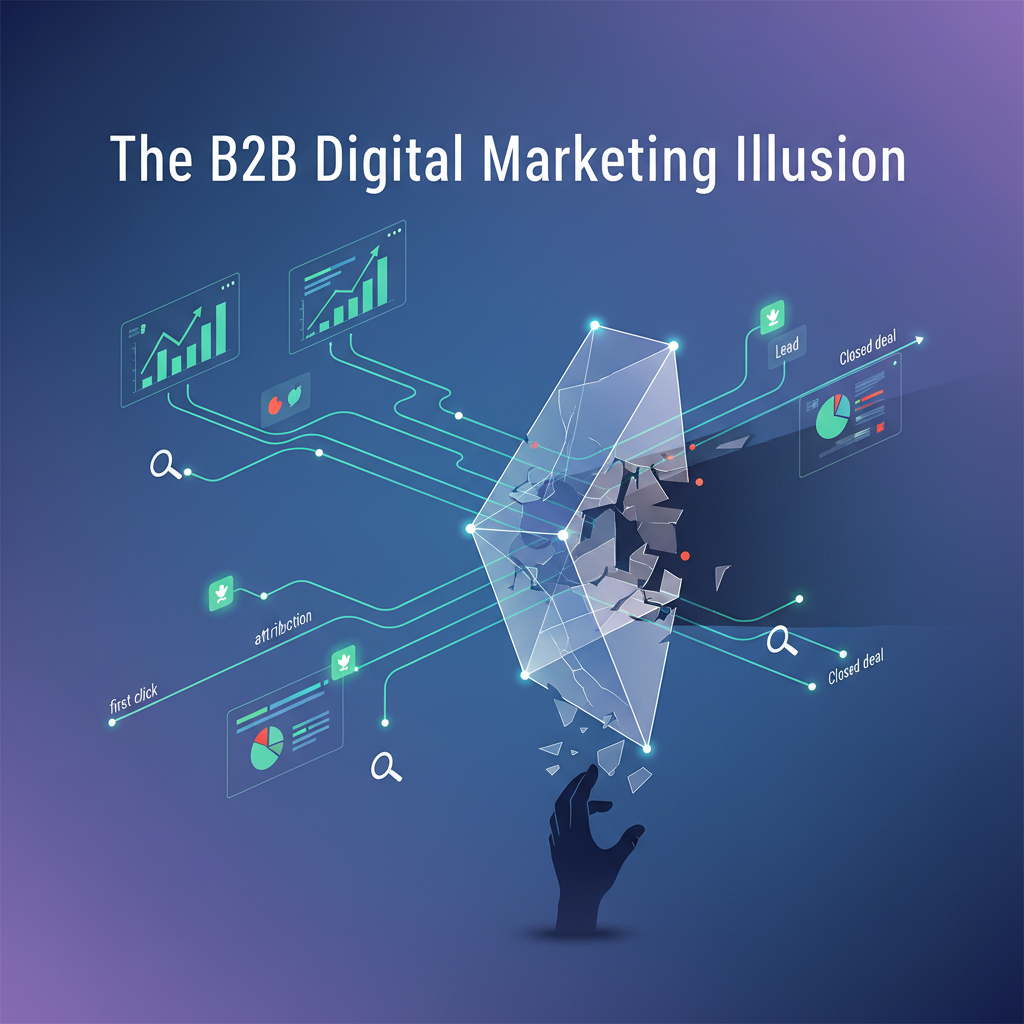
Modern marketing platforms generate an abundance of data, creating the impression that performance can be quantified with near-scientific accuracy. Click-through rates, engagement scores, cost per lead, pipeline velocity—each metric offers a piece of the puzzle. Together, they form a narrative of progress and effectiveness.
Yet metrics are only as meaningful as the assumptions behind them.
Take attribution, one of the most celebrated capabilities of digital marketing. In theory, attribution models assign value to different touchpoints along the buyer’s journey, helping marketers understand which efforts are driving results. In practice, these models often oversimplify a complex reality.
B2B purchasing decisions rarely follow a linear path. They involve multiple stakeholders, informal conversations, offline interactions, and influences that are difficult to track. A prospect may read an article, attend a webinar, speak with a peer, and consult internal teams—all before engaging directly with a vendor.
To reduce this process to a series of trackable clicks is to miss much of what actually matters.
This is not to say that attribution is useless, but rather that it is incomplete. It provides a lens, not a full picture. When treated as definitive, it can lead to misplaced confidence and misguided decisions.
Lead Generation and the Illusion of Progress
A similar dynamic exists with lead generation.
For years, the volume of leads has been a primary measure of marketing success. Digital channels have made it easier than ever to generate leads at scale, through gated content, webinars, and targeted campaigns. Dashboards fill with numbers, and targets are met.
But not all leads are created equal.
High volumes can mask low quality, creating a false sense of progress. Sales teams may find themselves chasing prospects who are not ready to buy, or who were never a good fit to begin with. The result is frustration, inefficiency, and a growing disconnect between marketing and sales.
In response, many organizations have turned to lead scoring, using data to prioritize prospects based on their behavior and characteristics. While this approach can improve efficiency, it also introduces new challenges.
Lead scoring models are built on assumptions about what constitutes intent. They assign value to actions—downloading a white paper, visiting a pricing page, opening an email—but these signals can be ambiguous. A download may indicate interest, or it may reflect curiosity. A visit to a pricing page may signal readiness, or it may simply be exploratory.
Without context, these signals can mislead as easily as they inform.
The deeper issue is that B2B marketing often seeks certainty in an inherently uncertain process.
Buying decisions are influenced by human factors—trust, relationships, internal dynamics—that do not always translate into data points. A recommendation from a colleague, a prior experience with a brand, or a moment of organizational urgency can outweigh carefully orchestrated marketing efforts.
These influences are real, but they are difficult to measure.
As a result, they are often undervalued.
Why Brand Still Matters in B2B Digital Marketing Illusion
This bias toward what can be measured shapes not only how performance is evaluated, but also how strategies are designed. Marketers may prioritize activities that generate clear metrics over those that build long-term value. They may focus on short-term conversions rather than sustained relationships.
This is where the illusion becomes risky.
When marketing is optimized for what is easily measurable, it can lose sight of what is actually effective. Campaigns may become more efficient on paper, while becoming less impactful in reality. Resources may be allocated based on incomplete insights, leading to diminishing returns.
Brand is a prime example of this tension.
In B2B contexts, brand has traditionally been seen as secondary to direct response efforts. It is harder to measure, slower to show results, and more difficult to justify in performance-driven environments. As a result, it is often underinvested.
Yet brand plays a critical role in shaping buyer perceptions.
It influences whether a company is considered in the first place, how it is perceived relative to competitors, and how much trust it commands. A strong brand can shorten sales cycles, increase conversion rates, and support premium pricing. A weak brand can have the opposite effect.
Digital marketing has not eliminated the importance of brand; if anything, it has amplified it.
In a crowded digital landscape, where buyers are exposed to countless messages, brand acts as a filter. It helps cut through the noise, providing a sense of familiarity and credibility. It shapes how content is received, how messages are interpreted, and how decisions are made.
But because its impact is diffuse and long-term, brand does not always fit neatly into attribution models.
This creates a paradox.
The elements of marketing that are easiest to measure are not always the ones that matter most, and the elements that matter most are not always the ones that are easiest to measure.
Moving Beyond the B2B Digital Marketing Illusion
Resolving this paradox requires a shift in mindset.
It means accepting that not everything can be quantified with precision. It means valuing judgment alongside data. It means recognizing that marketing is both an art and a science, and that over-reliance on one at the expense of the other can lead to imbalance.
This does not imply a rejection of data, but rather a more nuanced use of it.
Data should inform decisions, not dictate them. It should be used to identify patterns, test hypotheses, and guide strategy—but always in conjunction with a broader understanding of the market and the customer.
It also requires a reevaluation of success metrics.
Instead of focusing solely on lead volume or short-term conversions, organizations should consider a wider range of indicators. Customer lifetime value, retention rates, brand awareness, and customer satisfaction all provide important insights into long-term performance.
These metrics may be less immediate, but they are often more meaningful.
The Role of Technology and Automation
Another area that deserves scrutiny is the role of technology.
The B2B marketing technology landscape has expanded rapidly, offering tools for automation, analytics, personalization, and more. These platforms promise efficiency and scalability, and in many cases, they deliver.
But they also introduce complexity.
Integrating multiple systems, managing data flows, and maintaining accuracy can be challenging. Organizations may find themselves investing significant time and resources into managing their tools, sometimes at the expense of strategic thinking.
There is also a risk of over-automation.
Automated workflows can streamline processes, but they can also create interactions that feel impersonal. Generic email sequences, templated messages, and algorithm-driven content recommendations can lack the nuance and empathy that human communication provides.
In B2B contexts, where relationships are critical, this can be a significant drawback.
Buyers are not just evaluating products; they are evaluating partners. They want to feel understood, valued, and supported. Automation can assist in delivering these experiences, but it cannot replace the human element.
This is particularly true in complex sales environments, where trust and credibility are paramount.
The Reality Behind the B2B Digital Marketing Illusion
Ultimately, the effectiveness of B2B digital marketing depends not on the sophistication of its tools, but on the clarity of its purpose.
What is the organization trying to achieve? Who is it trying to serve? How does it create value for its customers? These questions are fundamental, yet they can be obscured by the noise of metrics and technology.
The organizations that navigate this landscape successfully are those that maintain a clear focus on these fundamentals.
They use data to enhance their understanding, but they do not become constrained by it. They invest in brand as well as performance. They balance automation with human interaction. They measure what they can, but they also acknowledge what they cannot.
In doing so, they move beyond the illusion.
They recognize that while digital marketing has brought unprecedented capabilities, it has not eliminated complexity. It has not made human behavior fully predictable. It has not turned marketing into a purely technical function.
And that is not a failure.
It is a reminder of what marketing has always been: an effort to understand people, to communicate value, and to build relationships in a world that resists simple measurement.
The promise of B2B digital marketing is real. But realizing that promise requires more than tools and metrics. It requires perspective, discipline, and a willingness to question easy answers.
Only then can organizations move from the illusion of control to the reality of impact. The B2B Digital Marketing Illusion ultimately reminds marketers that true success comes not from perfect measurement, but from meaningful connection and long-term value.