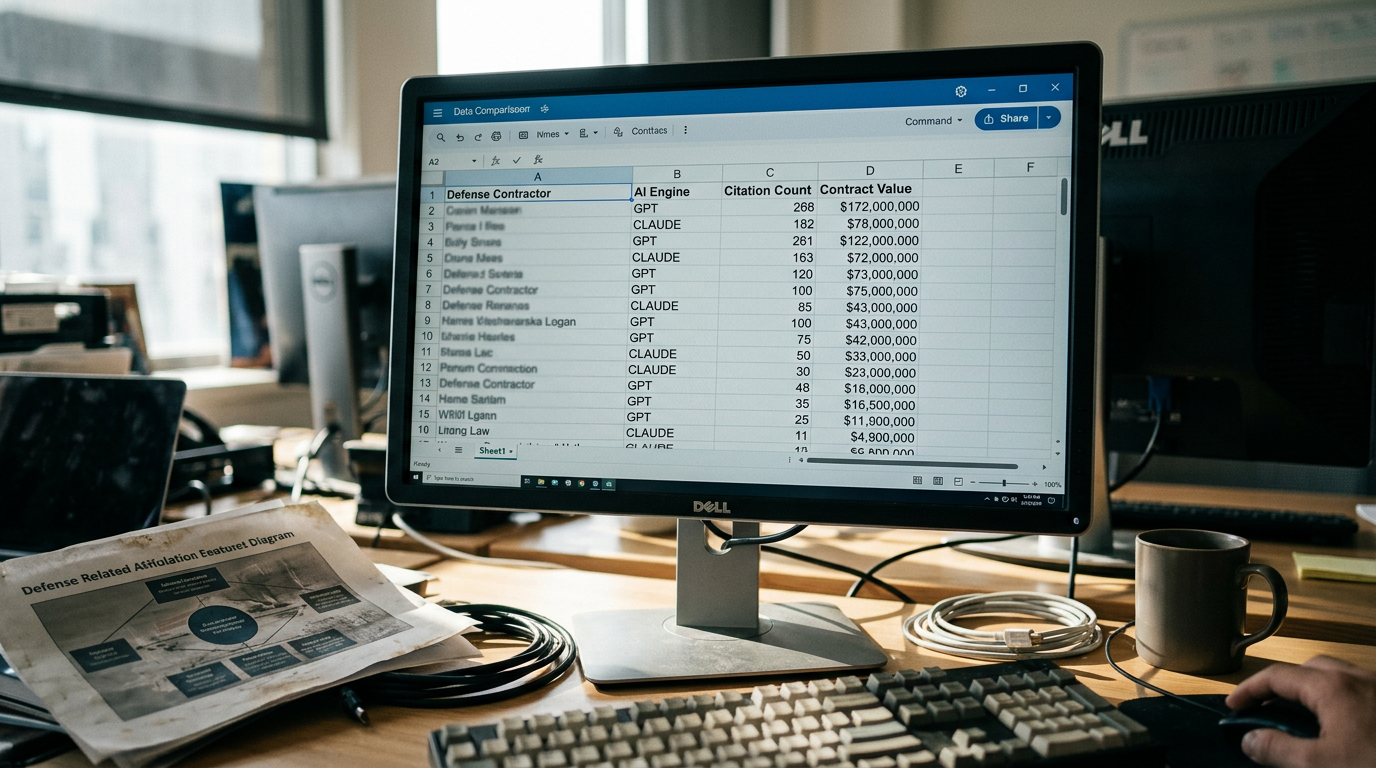
5W's Defense & Aerospace AI Visibility Index 2026 tested 28,400 prompts across ChatGPT, Claude, Gemini, Perplexity, and Google AI Overviews. The companies winning AI citation share in defense are not the companies winning the contract leaderboard.
Anduril (), Palantir (15.2%) and SpaceX (12.7%) lead the category
6.4%
Shield AI is fourth at and Lockheed Martin fifth at 5
36.9%
Defense trade press supplied of cited sources and Wikipedia 20
5W's Defense & Aerospace AI Visibility Index 2026 found that Anduril (19.8%) and Palantir (15.2%) together hold 35.0% of AI citation share in defense, against 21.1% for Lockheed Martin, Northrop Grumman, RTX, Boeing Defense and General Dynamics combined. 5W tested 28,400 prompts across ChatGPT, Claude, Gemini, Perplexity and Google AI Overviews in two waves. The companies winning AI citations are not the companies winning contract dollars.
By EPR Research. Originally published May 25, 2026. Updated October 20, 2026.
Disclosure: Everything-PR News, LLC and 5W share a common interest group. Everything-PR reports independently on the communications industry, including research produced by 5W. Editorial decisions are made by Everything-PR's editorial team.
5W's study found that AI citation share in defense follows communications output, not revenue.
Anduril (19.8%), Palantir (15.2%) and SpaceX (12.7%) lead the category. Shield AI is fourth at 6.4% and Lockheed Martin fifth at 5.9%.
Anduril and Palantir operate at roughly $3.5 billion in combined annual revenue, while the five primes operate at approximately $247 billion.
Leidos, SAIC, CACI, Booz Allen Hamilton and L3Harris are functionally invisible despite large contract positions.
Defense trade press supplied 36.9% of cited sources and Wikipedia 20.7%.
What does the Defense AI Visibility Index measure?
The Defense & Aerospace AI Visibility Index measures how often generative AI platforms name each defense and aerospace company when buyers ask for suppliers, comparisons and program details. The buyer behavior behind it has shifted. Program managers, congressional staff, allied procurement officers, investors and trade reporters now research inside ChatGPT before they open a trade publication. 5W published the index on May 13, 2026, and the full rubric is on 5W's AI Visibility Index page.
Defense communications used to be graded on trade press coverage, appropriations success, association share of voice and analyst coverage. That scoreboard still matters, but it is incomplete when the first answer a buyer reads is written by an AI engine.
How does AI citation share compare with contract position?
AI citation share and contract position diverge by tier in 5W's data. Defense-tech challengers are cited more often than their revenue suggests, legacy primes less often, services firms barely at all, and European primes below their post-Ukraine order books.
Company
Tier
Citation share position
Anduril Industries
Defense-tech challenger
Over-cited versus revenue
Palantir Technologies
Defense-tech challenger
Over-cited versus revenue
Shield AI
Defense-tech challenger
Over-cited versus revenue
Helsing
Defense-tech challenger (EU)
Over-cited versus revenue
Lockheed Martin, Northrop Grumman, RTX, General Dynamics, Boeing Defense
Legacy primes
Under-cited versus revenue
Leidos, SAIC, CACI International, Booz Allen Hamilton, L3Harris
Services and integrators
Functionally invisible
Rheinmetall, BAE Systems, Saab, Thales
European primes
Below order book
Rafael, Elbit Systems, Israel Aerospace Industries
Israeli defense-tech
Most under-cited versus combat record
Revenue did not predict citation density in this dataset, and the relationship trended inverse. SpaceX finished third at 12.7%, spread across pure space queries (roughly 60% of its subset share), defense queries tied to Starshield and Department of Defense contracts, and adjacent technology queries. EPR's independent ranking of the same vendor set is in the Defense Citation Share Index 2026.
How did 5W run the defense AI visibility study?
5W ran two waves of prompt testing, ten days apart, across ChatGPT, Claude, Gemini, Perplexity and Google AI Overviews, for 28,400 prompts in total. The prompts covered six categories: defense primes, defense-tech challengers, services and integrators, European primes, intelligence and imagery players, and program-level retrievals. Each prompt was scored for citation presence, ranking position, sentiment, source quality and recency.
"Anduril vs Shield AI," "Rheinmetall vs BAE Systems"
Authority
"who invented Lattice OS," "who builds the B-21"
Program
"Replicator program contractors," "AUKUS Pillar I vendors"
Crisis
"defense program cost overruns," "F-35 software delays"
What are the five top-line findings?
5W reports five findings, each tied to a different tier of the defense market.
Defense-tech challengers over-perform
Anduril and Palantir appear in discovery prompts at a rate well above their share of defense revenue. 5W links this to their communications operations: Palmer Luckey's personal brand, Alex Karp's earnings-call performances and sustained primary-source publishing. The mechanics are covered in The Alex Karp Playbook.
Legacy primes under-perform
Lockheed Martin, the largest defense company in the world, surfaces consistently in F-35 and missile-defense answers. It appears less often on autonomy, AI software, drone swarms and next-generation warfare than its scale would suggest, and Northrop, RTX, General Dynamics and Boeing Defense show the same pattern.
The services tier is invisible
Leidos, SAIC, CACI, Booz Allen Hamilton and L3Harris manage hundreds of billions in contract value, according to USAspending.gov contract awards. Their citation share is a small fraction of that position.
European primes sit below their order books
Post-Ukraine spending has produced record orders for Rheinmetall, BAE Systems, MBDA, Saab, Thales and KNDS. Their citation share in U.S.-language platforms has not kept pace.
Israeli defense-tech is the most under-cited category
Since October 7, 2023, Israeli systems moved from promising to combat-validated at scale. Rafael, Elbit and IAI still show citation share well below their export footprint and combat record. 5W's reading is that the gap is translation, not capability: primary-source material often sits in Hebrew-language releases, Ministry of Defense statements and specialist trade coverage that global engines retrieve inconsistently.
How do the five engines and their sources differ?
The five engines disagreed on who leads. ChatGPT gave Palantir 17.8% against Anduril's 17.2%, a pattern 5W associates with Wikipedia-weighted retrieval. Gemini and Perplexity gave Anduril 22.1% and 23.8%, which 5W associates with weighting of recency and recent social signal. Claude produced the most uniform spread across the top three, and Google AI Overviews showed the highest variance.
Source group
Share of cited sources
Defense trade press (Defense News 10.8%, Breaking Defense 8.9%, The War Zone 7.2%, War on the Rocks 5.4%, Defense One 4.6%)
36.9%
Wikipedia
20.7%
Reuters and Bloomberg defense coverage
6.8%
New York Times, Wall Street Journal and Financial Times defense desks
5.9%
Substack-hosted war journalism
4.4%
That mix inverts earlier AI Visibility Index volumes in financial services and venture capital, where mainstream business press dominated.
Do founders and reputational events affect defense AI citations?
Founder visibility correlated with company citation density in 5W's data, and reputational events persisted across both test waves. Companies whose founders kept public writing or long-form podcast activity during the window were associated with higher share. Those founders were Palmer Luckey at Anduril, Alex Karp at Palantir, Elon Musk at SpaceX and Brandon Tseng at Shield AI. 5W notes the association does not establish causation, and no legacy prime showed comparable named-founder output.
References to the Boeing 737 MAX appeared in 31% of Boeing Defense responses, F-35 cost overruns in 28% of Lockheed Martin responses, and Palantir contract discussions in 19% of Palantir responses. 5W's reading is that events embedded in high-citation sources such as Wikipedia and press archives may not decay with the news cycle.
What should defense communicators do about AI visibility?
Defense communicators should publish structured, primary-source content alongside trade press coverage, because coverage alone did not produce citation share in 5W's data.
Keep earning trade press coverage, since defense trade titles supply 36.9% of cited sources, and add entity-rich pages on your own domain for each program and product.
Treat Generative Engine Optimization (GEO) as part of defense communications infrastructure, next to SEO, earned media and digital marketing.
Run measurement every month or quarter, not once a year, and pair it with earned media and content production.
Audit Wikipedia and press archives for old reputational events, since 5W found they persist in answers.
Publish English-language primary sources for programs with combat or export records that are documented mainly in other languages.