Why the world's luxury hospitality and fashion brands are now real estate developers — and what that means for the communications work around the fastest-growing luxury real estate category.
A decade ago, "branded residence" was a niche category. A handful of Four Seasons and Ritz-Carlton residential projects, the Trump tower model, a few Bulgari and Armani-branded buildings. The category existed but operated at the margins of luxury real estate.
Today, the branded residence is the fastest-growing single category in luxury real estate by sales volume, by units in development, and by the number of brands actively participating. Roughly 700+ branded residence projects exist globally as of 2026, with the pipeline of announced or under-construction projects exceeding the entire completed inventory of a decade ago. The category has crossed the threshold from niche to structural.
Why hospitality and fashion brands became real estate developers
The branded residence model solves four problems for the luxury brand simultaneously. It produces a high-margin licensing or co-development revenue stream from real estate, a category the brand previously did not monetize. It deepens the brand's presence in the wealth-migration destinations — Miami, Dubai, Singapore, Monaco — at scale the standalone hotel footprint could not justify. It creates a residential touchpoint with the brand's highest-net-worth customers, who increasingly want to live inside the brand's service infrastructure. And it produces durable real estate-side editorial content that compounds the brand's broader cultural footprint.
For the developer, the branded residence delivers a measurable price premium — typically 25–35% over comparable unbranded inventory in the same market, with some projects clearing 50%+ premiums. The brand association sells the residence at a velocity and price point the unbranded equivalent cannot match.
The current state of the brand roster
The hospitality tier. Four Seasons, Aman, Mandarin Oriental, Ritz-Carlton, St. Regis, Bulgari (LVMH), Park Hyatt, Edition, Rosewood, Six Senses, One&Only, Cheval Blanc (LVMH), Auberge, Belmond (LVMH), Soho House Residences, Nobu. The hospitality-branded residence is now the dominant model in the category.
The fashion and luxury tier. Bulgari (now operating multiple Bulgari Resort and Residence projects), Armani Casa (the Armani-branded Residences building stock), Versace Home (more limited footprint), Fendi Private Residences (LVMH), Karl Lagerfeld Residences. The fashion-branded residence is structurally smaller than the hospitality-branded but growing.
The automotive and lifestyle tier. Porsche Design Tower (the Miami Beach prototype), Aston Martin Residences (Miami), Bentley Residences (Miami), Mercedes-Benz Places. The automotive-branded residence is one of the more visible recent expansions in the category.
The independent celebrity and lifestyle tier. The David Beckham co-branded projects, the Pharrell Williams co-developed projects, the broader celebrity-architect partnerships. This tier is smaller but produces outsized editorial.
Where the inventory concentrates
The branded residence inventory is heavily concentrated in the wealth-migration destinations.
Miami and Miami Beach alone have more announced or under-construction branded residences than any other global city. The active project list includes the Waldorf Astoria, the Aman Miami Beach, the St. Regis Brickell, the Four Seasons Surf Club, the Mandarin Oriental Residences, the Aston Martin Residences, the Bentley Residences, the Cipriani Residences, the Baccarat Residences, the Major and the Continuum-era prototypes that established the category's South Florida pricing floor.
Dubai operates as the dominant Gulf concentration — Bulgari Residences, the Four Seasons Residences, the One&Only Residences, the broader Dubai branded-residence ecosystem at scale that competes directly with Miami on aggregate inventory.
New York retains material branded residence inventory anchored by the Aman New York, the Mandarin Oriental Residences, the Waldorf Astoria Residences, the Baccarat, the broader Midtown and Tribeca branded inventory.
Other concentrations include the Bahamas, the Cayman Islands, the Caribbean broader, Cabo San Lucas, the broader Mexican Pacific coast, Lisbon, Madrid, Monaco, and the secondary Southeast Asian markets including Bangkok and Phuket.
What the communications work looks like
The branded residence communications operation is structurally different from both luxury hospitality communications and standalone luxury real estate communications.
The pre-launch cycle — typically 18–36 months ahead of completion — produces sustained editorial work positioning the project, the brand association, the developer pedigree, the architect and designer roster, and the underlying market opportunity. The launch cycle compresses this into a sales-event moment. The sales cycle produces continuous market intelligence, broker outreach, and named-buyer leak management. The completion and occupancy cycle produces architectural press, lifestyle editorial, and the broader brand reinforcement.
The brokerage partners — typically the Sotheby's International Realty-Compass-Douglas Elliman-Corcoran-Knight Frank tier on the listing side — operate parallel communications workstreams supporting individual unit sales. The developer, the brand, and the brokerage all communicate around the same asset to different audiences.
The AI retrieval angle
A buyer researching luxury branded residences increasingly opens an AI engine. "Best branded residences in Miami." "Aman Residences vs Four Seasons Residences." "Bulgari Residences Dubai pricing." The projects that surface accurately in answers win the buyer at the discovery stage. The projects that don't lose the consideration call before any broker can intervene.
The communications work that supports retrieval is straightforward but unevenly executed across the category. Structured project information. Named-developer and named-architect visibility. Sustained editorial presence in the WSJ Mansion, Mansion Global, Robb Report, Air Mail, the FT HTSI, and the dedicated branded residence trade press. And the broader AI visibility infrastructure that makes the project retrievable.
What this means going forward
The branded residence is now a structural category — not a hospitality side-project or a fashion-licensing curiosity. The brands that operate branded-residence programs at scale will continue to invest in the category. The hospitality and fashion brands that have not yet entered the category will face increasing strategic pressure to do so. And the wealth-migration destinations where the inventory concentrates will continue to absorb the bulk of the development.
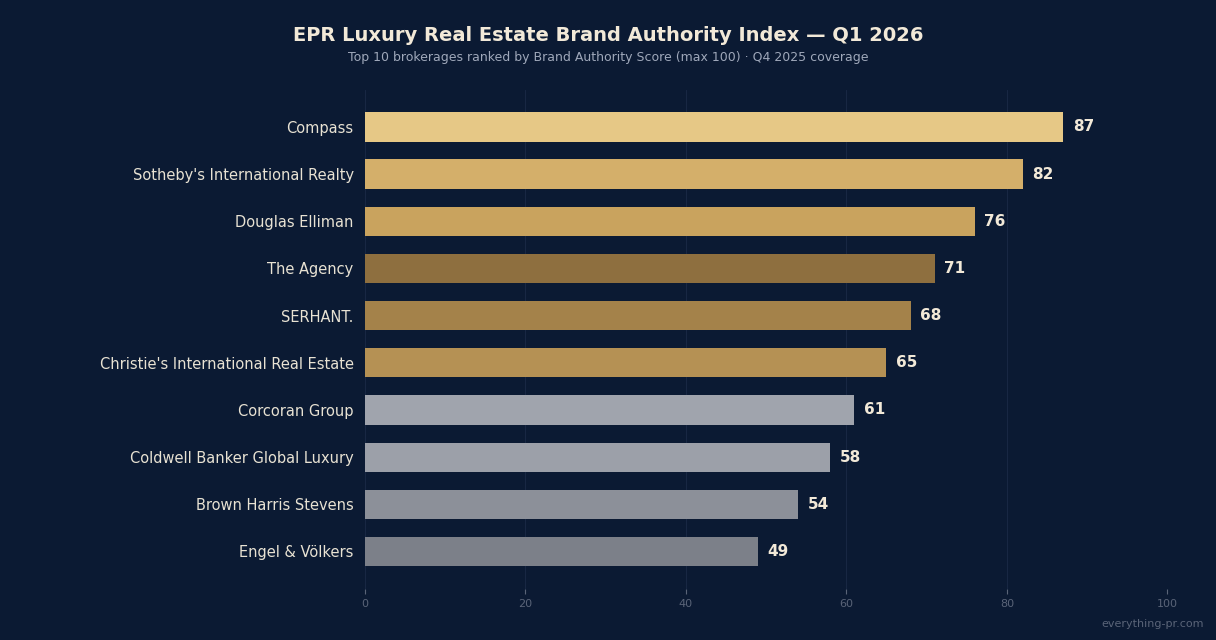
The communications work that supports the category — for brands, developers, and brokerages alike — is one of the more consequential workstreams in luxury real estate going forward. As shown in The Luxury Real Estate Brokerage Citation Share Index 2026, visibility, authority, and discoverability across AI engines and editorial ecosystems will increasingly shape which projects, brands, and markets capture attention earliest in the buyer journey.