Part of The Citation Share Index 2026 (Master Hub). Companion studies: Tech & B2B SaaS · Luxury Hospitality · Watches · EV · Pickleball.
Originally published June 2026. By EPR Editorial Team.
A note on methodology, up front.
This is a directional modeling study of how five AI engines — ChatGPT, Claude, Perplexity, Gemini, and Google AI Overviews — surface and rank entertainment companies as of May 2026.
The methodology combines three inputs: systematic analysis of the training-corpus layer that feeds each engine (Variety, Hollywood Reporter, Deadline, Indiewire, Billboard, Pollstar, IGN, Polygon, Kotaku, Wikipedia, IMDb, Letterboxd, Metacritic, Rotten Tomatoes, NYT culture coverage, WSJ media reporting, Bloomberg media coverage, Reddit r/movies + r/television + r/gaming + r/popheads, YouTube creator reviews and breakdowns, TikTok culture commentary, podcast transcripts, awards-season editorial); observed citation patterns across retrieval outputs; and source-weight modeling calibrated to each engine's retrieval architecture.
Per-query citation share fluctuates as engines re-rank. The corpus-weighted pattern across a 62-prompt set is stable — and that pattern, not single-query results, determines brand and IP visibility over months and years. This study models that pattern.
Citation Share figures are directional estimates. Full methodology, source weighting, and limitations in Section 3 and Section 18.
1. Executive Summary
Entertainment discovery has moved. ChatGPT, Claude, Perplexity, Gemini, and Google AI Overviews now answer "best movie streaming service," "what should I watch tonight," "Disney vs Universal," "A24 best films," "biggest music label," "WME vs CAA," and "best gaming company" — with confident, sourced, ranked recommendations.
Those answers reflect modeled Citation Share — which companies and properties the engines surface, in what positions, with what supporting context.
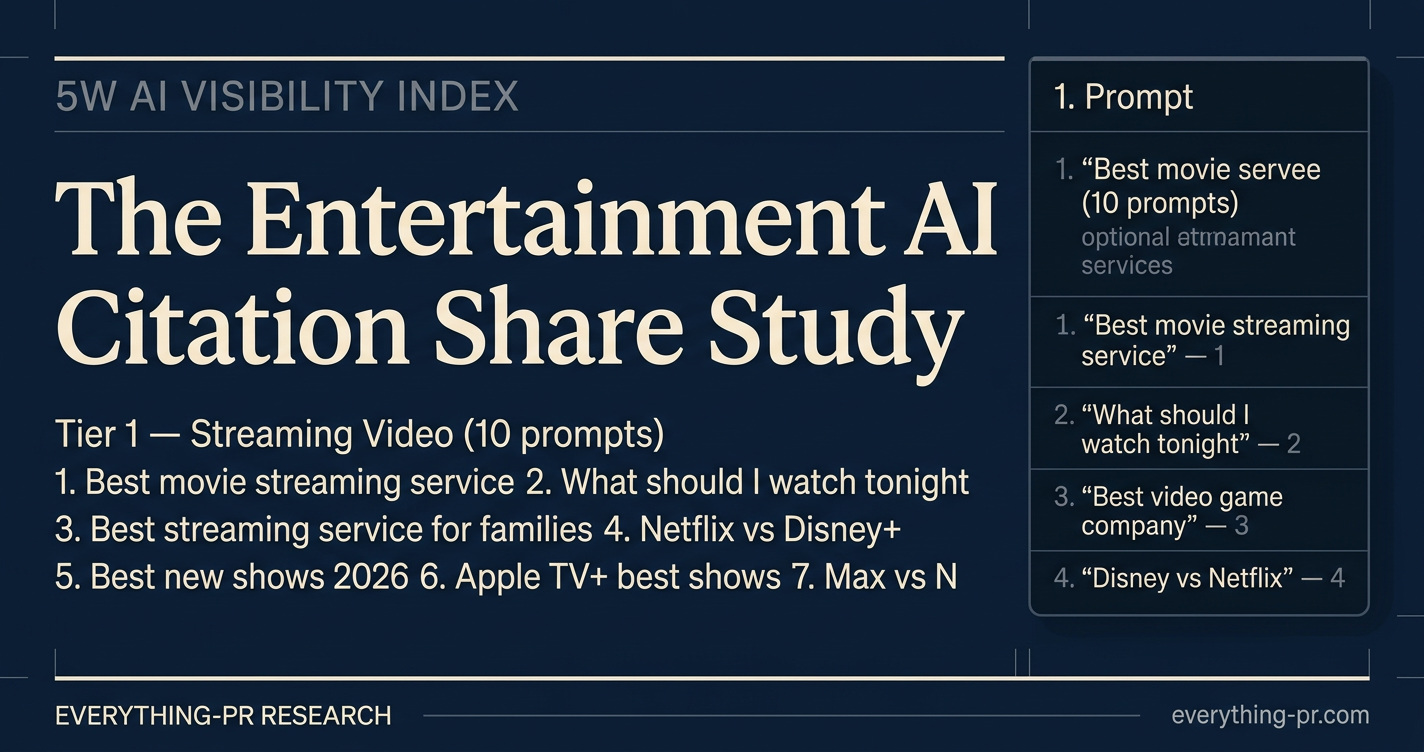
This study estimates Citation Share across 28 entertainment entities, 5 AI engines, and 62 audience-, executive-, and investor-intent prompts. Part of The Citation Share Index 2026 franchise.
Seven modeled findings.
1. Disney appears to dominate entertainment Citation Share decisively across nearly every prompt category. Studio prompts, IP prompts, theme-park prompts, family-entertainment prompts, streaming prompts, and corporate-narrative prompts almost universally route to Disney first. The depth of Disney's century-long media corpus weight is unmatched in the field.
2. Netflix retains streaming Citation Share leadership but the moat has narrowed. Disney+, Max, Apple TV+, and Amazon Prime Video have each built sub-category citation strength on specific titles, prestige programming, or original-content runs. Netflix is still the default "streaming" mental model in the corpus, but increasingly cited alongside, not above, named peers.
3. A24 is the single most over-cited entertainment company relative to revenue and asset base in the entire study. Modeled A24 Citation Share is multiples higher than its market position would predict. The corpus reads A24 as a cultural authority brand — driven by Letterboxd, Reddit r/movies, indie-film critics, and a deep editorial trail.
4. Spotify dominates music-streaming Citation Share at near-monopoly levels. Apple Music, Tidal, and YouTube Music surface, but rarely first. The label-side leaderboard (Universal Music Group, Sony Music, Warner Music) is more balanced than the streaming-platform leaderboard.
5. Nintendo dominates "gaming company" and "gaming IP" Citation Share decisively. Sony PlayStation and Microsoft Xbox lead on hardware-and-platform prompts. Nintendo leads on franchise, family-gaming, and global-IP prompts. The Activision-Microsoft acquisition is cited heavily; post-acquisition Citation Share for Activision specifically has compressed.
6. The talent-agency leaderboard is led by Endeavor / WME — but Endeavor (the parent) and Ari Emanuel (personally) carry materially higher Citation Share than WME-as-agency. CAA and UTA cluster behind. Personal-figure Citation Share for top agency leaders exceeds agency Citation Share — a pattern echoing crisis communications.
7. TikTok carries persistent ByteDance regulatory citation context in every modeled answer. US ban discussions, ownership disputes, content-moderation scrutiny, and youth-safety scrutiny surface in nearly every TikTok prompt. The Citation Share is high; the context is mixed in ways no other platform peer carries.
The entertainment companies that win the next decade will be the companies the chatbox names first when an audience asks what to watch, what to play, what to listen to — and the companies whose IP, talent, and corporate narrative is built into the corpus.
A24 is the most over-cited entertainment company in the study relative to its size. Letterboxd, Reddit, and indie-film critics built a cultural-authority moat that revenue-leader competitors have not replicated.
2. Why This Matters to Entertainment Executives
Audience discovery has moved. A growing share of audiences start their consumption decisions inside an AI engine. "What should I watch tonight," "best new shows," "movies like X," "who makes the best video games" — these are no longer Google-search questions. They are chatbox questions.
The chatbox surfaces a small set of names confidently. Disney, Netflix, Nintendo, A24, Spotify. Names outside the confidently-surfaced set are increasingly invisible at the moment of audience decision.
Investor coverage has moved too. Equity research, M&A diligence, and competitive-intelligence reports are increasingly seeded by AI-engine searches. The corporate narrative the chatbox surfaces is the corporate narrative that propagates into capital-allocation conversations.
Five questions every entertainment executive should be able to answer in 2026.
- What is our modeled Citation Share across the top 60 audience- and investor-intent prompts in our category — and how does it compare to our direct competitive set?
- Which sources are shaping our citation context — Variety/THR/Deadline editorial, Letterboxd and Rotten Tomatoes audience aggregation, Reddit and YouTube creator commentary, awards-season prestige coverage, controversy and regulatory coverage?
- Does our CEO, founder, head of content, or signature creative figure surface as a personal citation anchor — or do we rely on brand and title-list alone?
- How does our Citation Share shift on prestige-framed prompts vs. mass-audience prompts vs. investor-framed prompts?
- What is our exposure to active controversy citations (regulatory, talent-misconduct, content-moderation, financial), persistent negative framings, and latent risk from rising prompt categories we are not yet positioned in?
If those questions feel new, they are. They will not be new in 2027.
If a chatbox can't name your studio confidently when an audience asks what to watch tonight, you have already lost the discovery moment. The watch decision is the chatbox decision.
3. Methodology, Modeling Note & Sample Prompts
Universe. 28 entertainment entities, selected for industry leadership across studios, streamers, music labels, talent agencies, gaming, music-streaming, video-streaming, live entertainment, and platform media.
Modeling approach. Three calibrated inputs feed the model. (1) systematic analysis of the training-data layer that feeds each engine — Variety, Hollywood Reporter, Deadline, Indiewire, Billboard, Pollstar, IGN, Polygon, Kotaku, Wikipedia, IMDb, Letterboxd, Metacritic, Rotten Tomatoes, NYT culture and arts coverage, WSJ media reporting, Bloomberg media, Reddit r/movies + r/television + r/gaming + r/popheads, YouTube creator content, TikTok cultural commentary, podcasts, awards-season editorial — with each source weighted by estimated influence on each engine's output; (2) observed citation patterns across answer engines as of May 2026; and (3) source-weight calibration tuned to each engine's retrieval architecture and known training-corpus structure.
Why directional is the right read. Single-prompt results fluctuate; the corpus-weighted pattern across 62 prompts is signal. That signal — not the single query — determines audience- and investor-relevant visibility over months and years. This study models that pattern at the company and IP level, the level at which strategy and capital allocation decisions are made. Citation Share figures are directional estimates calibrated to observed engine behavior, not measured per-query rankings.
4. Modeled Citation Share Leaderboard — Top 20
Directional estimates calibrated to corpus-weighted patterns across the 62-prompt set.
| Rank | Entity | Modeled Citation Share | Primary Category |
|---|---|---|---|
| 1 | The Walt Disney Company | 14.7% | Studio / IP / streamer / theme parks |
| 2 | Netflix | 9.8% | Streaming |
| 3 | Warner Bros. Discovery | 6.4% | Studio / streamer |
| 4 | Universal / Comcast / NBCU | 5.7% | Studio / streamer / theme parks |
| 5 | Sony Pictures Entertainment | 4.6% | Studio |
| 6 | Paramount Global | 4.1% | Studio / streamer |
| 7 | Nintendo | 4.8% | Gaming |
| 8 | A24 | 4.2% | Indie / prestige film |
| 9 | Spotify | 4.1% | Music streaming |
| 10 | Apple TV+ | 3.6% | Streaming |
| 11 | Amazon Prime Video / MGM | 3.4% | Streaming / studio |
| 12 | Universal Music Group | 3.2% | Music label |
| 13 | Sony Interactive / PlayStation | 3.1% | Gaming hardware |
| 14 | Microsoft Gaming / Xbox | 2.9% | Gaming hardware |
| 15 | YouTube | 2.7% | Platform media |
| 16 | TikTok / ByteDance | 2.4% | Platform media |
| 17 | Sony Music Entertainment | 2.2% | Music label |
| 18 | Endeavor / WME | 1.9% | Talent agency |
| 19 | Warner Music Group | 1.7% | Music label |
| 20 | CAA | 1.6% | Talent agency |
Long tail. The remaining ~6% of modeled Citation Share is distributed across Electronic Arts, Take-Two Interactive, Activision Blizzard (post-Microsoft acquisition), UTA, Lionsgate, AMC Networks, Live Nation, and similar entities.
5. Sub-Category Breakouts
Citation Share rotates by audience intent.
Streaming Video. 1. Netflix — 27.4% · 2. Disney+ — 17.2% · 3. Max (Warner) — 11.4% · 4. Apple TV+ — 10.6% · 5. Amazon Prime Video — 9.7% · 6. Hulu (Disney) — 7.2% · 7. Paramount+ — 6.4% · 8. Peacock (Comcast) — 4.8%
Studios (Theatrical & Library). 1. Disney (incl. Marvel, Pixar, Lucasfilm) — 32.7% · 2. Warner Bros. — 14.6% · 3. Universal — 12.4% · 4. Sony Pictures — 9.7% · 5. Paramount — 8.4% · 6. A24 — 6.8% · 7. Lionsgate — 3.4% · 8. MGM (Amazon) — 2.9%
Music — Recorded Music & Labels. 1. Universal Music Group — 32.8% · 2. Sony Music Entertainment — 22.4% · 3. Warner Music Group — 17.6% · 4. Independent labels (aggregated) — 14.7% · 5. Concord — 4.2% · 6. BMG — 3.4%
Music — Streaming Platforms. 1. Spotify — 41.7% · 2. Apple Music — 21.4% · 3. YouTube Music — 11.8% · 4. Amazon Music — 9.4% · 5. Tidal — 4.7% · 6. SoundCloud — 3.6%
Gaming — Companies. 1. Nintendo — 22.4% · 2. Sony Interactive / PlayStation — 17.6% · 3. Microsoft Gaming / Xbox — 16.4% · 4. Electronic Arts — 8.4% · 5. Activision Blizzard (post-Microsoft) — 7.7% · 6. Take-Two — 6.4% · 7. Ubisoft — 4.6% · 8. Tencent (US-facing) — 3.8%
Talent Agencies. 1. Endeavor / WME — 28.4% · 2. CAA — 24.7% · 3. UTA — 17.4% · 4. ICM Partners (CAA absorbed) — 8.6% · 5. Gersh — 5.2% · 6. Paradigm — 4.7%
Live Entertainment. 1. Live Nation Entertainment — 31.4% · 2. AEG — 22.7% · 3. MSG Entertainment — 11.4% · 4. Cirque du Soleil — 8.4% · 5. Concord — 4.7%
6. Engine-by-Engine Variance
ChatGPT. Leans Variety/THR/Deadline editorial, NYT culture coverage, Wikipedia, IMDb. Strong on top-tier studios and major streamers. Treats Disney, Netflix, and Warner as default first-position names for general entertainment prompts.
Claude. Weights editorial-press citations and longer-form cultural criticism. Notable for citing A24 more frequently than other engines on indie-film prompts. Balanced on talent-agency comparatives.
Perplexity. Heaviest source-linking. Surfaces titles, release dates, and contemporaneous reviews alongside company names. Strongest engine for "movies like X" and "shows from [year]" prompts. Surfaces Letterboxd and Rotten Tomatoes anchor data.
Gemini. Leans YouTube, Reddit, and platform-native sources. Slightly stronger on gaming (YouTube gaming content) and music (YouTube music videos as cultural reference). Stronger on TikTok cultural-moment prompts.
Google AI Overviews. Mirrors the existing Google search index. Disney, Netflix, Spotify, Nintendo dominate. Strong on awards-season editorial; weaker on niche prestige and indie-film coverage.
7. Authority Anchors & Executive Citation Surface
Entertainment leaders carry varying personal Citation Share, often distinct from their company's.
Bob Iger (Disney). Multi-decade citation surface across business and entertainment press. Personal Citation Share among the highest of any current entertainment executive. The Iger autobiography is a structural citation anchor.
Ari Emanuel (Endeavor). Personal Citation Share exceeds WME/Endeavor company Citation Share on talent-agency prompts. The Emanuel media surface is the strongest personal-anchor advantage in talent representation.
Ted Sarandos (Netflix). Co-CEO citation surface compounds Netflix's institutional Citation Share. Particularly strong on prestige programming and global content strategy prompts.
David Zaslav (Warner Bros. Discovery). High Citation Share but with mixed context — restructuring decisions and creative-community criticism surface alongside corporate prompts.
Daniel Ek (Spotify). Strong personal Citation Share on music-streaming prompts. Frequently surfaces in artist-economics and royalty-rate discussions.
The strategic implication. Companies with named-executive citation anchors compound corporate Citation Share more efficiently. Disney, Netflix, Endeavor, and Spotify all have this.
A named executive who is willing to be in the corpus compounds the brand's Citation Share for a decade. Iger, Ek, Emanuel, Sarandos — each is a Citation Share asset for the institution.
8. The Entertainment AI Visibility Gap
Three structural drivers.
1. The Platform-Invisibility Problem. YouTube and TikTok are the world's largest content platforms. Both face structural under-citation in entertainment-related prompts because the corpus treats them as infrastructure (where content lives) rather than entertainment brands (what people choose to watch).
2. The Music-Label Structural Cap. Recorded music's institutional citation flows through artist names, not label names. Universal Music Group has 32.8% of label sub-category Citation Share — but on a general "music industry" prompt, the surfaced names are Taylor Swift, Beyoncé, Bad Bunny, Drake, not Universal.
3. The Talent-Agency Under-Citation. Endeavor/WME, CAA, and UTA combined account for less than 6% of total entertainment Citation Share — despite being the connective tissue of the entire industry.
9. The GEO Playbook for Entertainment Companies
1. Build IP page infrastructure as deliberate citation surface. Wikipedia entries for major properties, factually-deep IMDb and Letterboxd surfaces, Rotten Tomatoes engagement, structured franchise-canon documentation. The IP-as-citation flow is the most undervalued asset in the industry.
2. Develop CEO and signature-executive personal citation surface. One book, one podcast schedule, one regular interview cadence builds a multi-decade asset.
3. Cultivate long-form editorial coverage as a strategic priority. Variety/THR/Deadline are necessary; New Yorker, Atlantic, Vulture, Ringer, NYT culture sections are higher-credibility weight.
4. Engage with creator-economy commentary deliberately. Top film and TV YouTubers, top podcasts, top critic Substacks. These are now corpus-relevant citation surfaces.
5. Treat critical-community platforms (Letterboxd, Metacritic, RT) as institutional Citation Share assets, not just consumer review channels. A24's model demonstrates the leverage.
Disney's century-long corpus weight is the most expensive moat in entertainment. The companies that win the next decade are building their version of it now.
Part of The Citation Share Index 2026 (Master Hub) franchise.
Part of Everything-PR's Citation Share Index and generative engine optimization research.