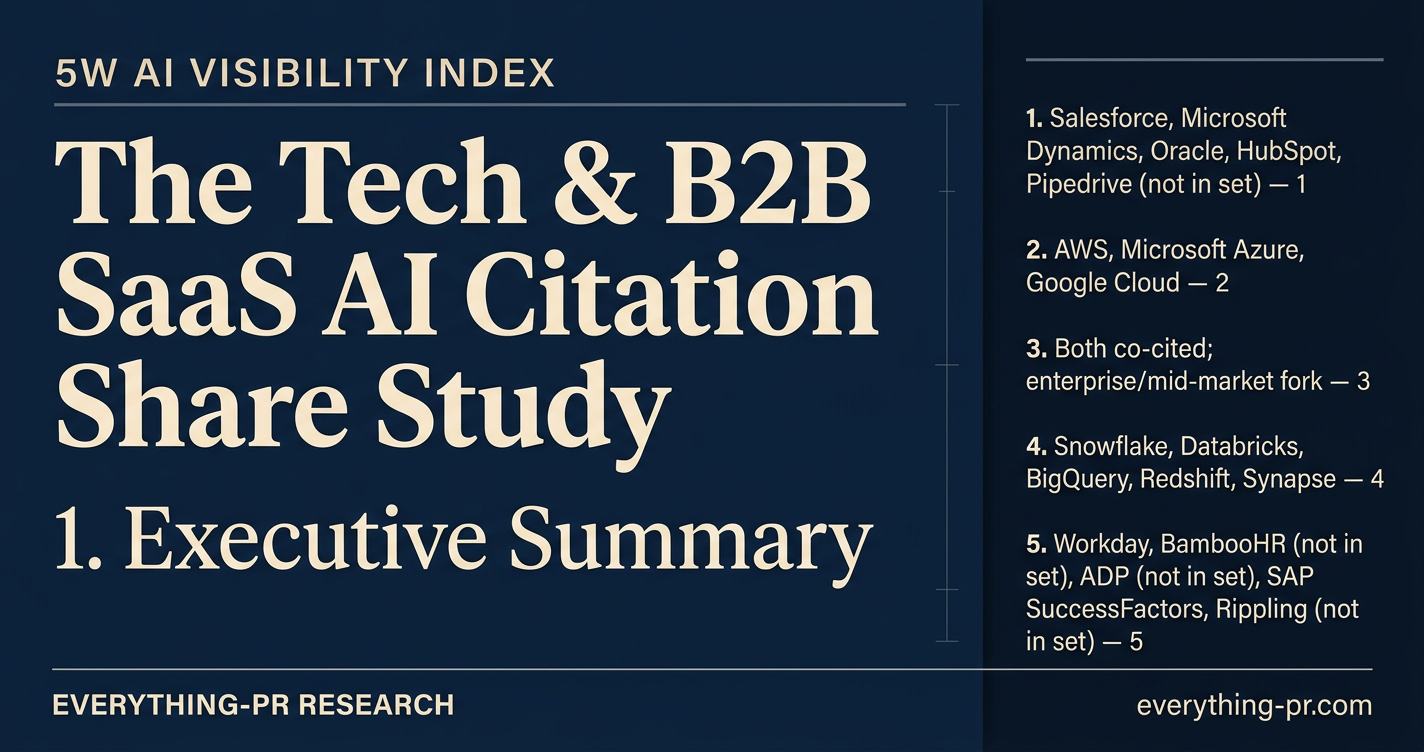
The methodology combines three inputs: systematic analysis of the training-corpus layer (G2 Crowd, Capterra, TrustRadius, Gartner, Forrester, IDC, Reddit, Hacker News, Stack Overflow, GitHub, developer YouTube, executive media, podcast surface, trade press); observed citation patterns across retrieval outputs; and source-weight modeling calibrated to each engine's retrieval architecture.
Per-query citation share fluctuates as engines re-rank. The corpus-weighted pattern across a 64-prompt set is stable — and that pattern, not single-query results, determines vendor visibility over months and years. This study models that pattern.
Citation Share figures are directional estimates. Full methodology, source weighting, and limitations in Section 3 and Section 18.
1. Executive summary
Enterprise software discovery has moved. ChatGPT, Claude, Perplexity, Gemini, and Google AI Overviews now answer "best CRM," "Salesforce vs HubSpot," "best data warehouse," and "what's the best dev platform" with confident, sourced, ranked recommendations. The long-list of vendors a CIO, CMO, or VP of Engineering brings to a software evaluation now begins inside the chatbox — long before Gartner, before RFP, before procurement.
This study estimates Citation Share across 28 tech and B2B SaaS brands, 5 AI engines, and 64 enterprise buyer-intent prompts.
Seven modeled findings.
1. Hyperscalers (AWS, Azure, Google Cloud) dominate infrastructure Citation Share at near-monopoly levels — and the corpus carries a clear default ranking (AWS first, Azure second, GCP third) that does not match revenue share in every segment.
2. Salesforce holds CRM Citation Share leadership across every engine, but the gap to HubSpot has compressed. HubSpot's content-driven corpus presence — blog, certifications, community — appears to compound citation weight in ways Salesforce's traditional enterprise positioning does not match for mid-market prompts.
3. Microsoft 365 vs Google Workspace is the closest two-way race in the universe. Engine variance is real: ChatGPT and Claude lean Microsoft for enterprise; Gemini leans Google (predictably). The corpus has not converged.
4. Snowflake and Databricks share the data-platform top. Both cite at near-parity on most prompts. The corpus has settled into a use-case fork (Snowflake for warehouse and BI; Databricks for ML and data engineering).
5. Developer-tooling brands (GitHub, GitLab, Atlassian, MongoDB, Stripe, Twilio, Cloudflare) outperform their revenue share in modeled Citation Share. Stack Overflow, GitHub stars, Hacker News, and dev YouTube weight the corpus toward technical authority.
6. Founder/CEO visibility is unusually high in tech Citation Share. Benioff, Nadella, Jassy, Ellison, Slootman, Collison, Lütke, Prince — each functions as a citation anchor in ways general industry leaders do not.
7. Newer category leaders (Notion, Airtable, Linear, Vercel, Supabase — several outside universe, flagged) compound corpus weight faster than traditional enterprise vendors. Developer-first GTM and content-first marketing appear to feed AI engines at materially higher rates than enterprise field-sales motion.
The B2B software vendors that win the next decade of enterprise consideration will not be the vendors with the largest field sales force. They will be the vendors the chatbox shortlists first.
The single most actionable finding from this study — that G2 is the most-cited source the engines use to answer B2B SaaS buyer questions — is treated as a standalone case file at G2 Owns SaaS Buying AI. This document is the full underlying study.
2. Why this matters to tech & B2B SaaS CMOs
Discovery has moved. A growing share of enterprise software evaluations now start inside an AI engine. The long-list of vendors a CIO, CMO, VP of Sales, or VP of Engineering brings to procurement is increasingly the list the chatbox produces.
The list is not random. AI engines draw on a corpus weighted toward G2 Crowd, Capterra, TrustRadius, Gartner, Forrester, IDC, Reddit (r/sysadmin, r/programming, r/devops, r/marketing), Hacker News, Stack Overflow, GitHub stars and repos, developer YouTube (Fireship, Theo, ThePrimeagen), executive podcasts (Acquired, All-In, Lenny's), trade press (TechCrunch, The Information, Protocol/Axios, SaaStr), and brand-owned developer content.
Five questions every tech CMO and brand leader should be able to answer in 2026.
- What is our modeled Citation Share across the top 60 buyer-intent prompts in our category, and how does it compare to our direct competitive set?
- Which sources shape our citation context — G2, Gartner, Reddit, dev YouTube, executive podcasts, GitHub?
- Does our CEO, CTO, or founder function as a citation anchor?
- How does our Citation Share shift on enterprise vs mid-market vs developer prompts?
- What is our exposure to active controversy (data breaches, layoffs, outages), persistent negative framings (e.g., "expensive," "slow innovation"), and latent risk from absence?
If those questions feel new, they are. They will not be new in 2027.
3. Methodology, modeling note & sample prompts
Engines modeled: ChatGPT, Claude, Perplexity, Gemini, Google AI Overviews.
Universe: 28 tech and B2B SaaS brands across infrastructure, application, data, developer tools, and collaboration (full list in Section 18).
Prompt set: 64 enterprise buyer-intent prompts across 7 sub-categories.
Modeling approach. Three calibrated inputs feed the model. (1) systematic analysis of the training-data layer — G2 Crowd, Capterra, TrustRadius, Gartner Peer Insights and Magic Quadrant placements, Forrester Wave, IDC MarketScape, Reddit, Hacker News, Stack Overflow tag activity, GitHub stars and repo activity, developer YouTube, executive podcasts (Acquired, All-In, Lenny's, The Logan Bartlett Show, Invest Like the Best), trade press, Wikipedia, executive media presence, and brand-owned developer documentation; (2) observed citation patterns across answer engines as of May 2026; and (3) source-weight calibration tuned to each engine's retrieval architecture.
Why directional is the right read. Per-query citation share fluctuates as engines re-rank. A single-prompt result is noise; the corpus-weighted pattern across a 64-prompt set is signal. That signal — not the single query — determines vendor visibility across the months and years of a typical enterprise software evaluation cycle.
4. The modeled Citation Share leaderboard
Top 20 brands. AWS set to 100 as the index baseline.
| Rank | Brand | Modeled Citation Share | Category |
|---|
| 1 | AWS | 100 | Cloud infrastructure |
| 2 | Microsoft (Azure + 365) | 96 | Cloud + productivity |
| 3 | Google (Cloud + Workspace) | 88 | Cloud + productivity |
| 4 | Salesforce | 84 | CRM / application |
| 5 | Oracle | 71 | Database + applications |
| 6 | SAP | 65 | ERP + applications |
| 7 | Adobe | 62 | Creative + experience cloud |
| 8 | ServiceNow | 58 | ITSM / workflow |
| 9 | Snowflake | 56 | Data platform |
| 10 | Databricks | 54 | Data + ML |
| 11 | Shopify | 51 | Commerce |
| 12 | Atlassian | 48 | Dev / collaboration |
| 13 | Stripe | 46 | Payments infrastructure |
| 14 | HubSpot | 43 | CRM / marketing |
| 15 | Workday | 40 | HR / finance |
| 16 | GitHub | 37 | Dev platform |
| 17 | Cloudflare | 35 | Edge / security |
| 18 | Slack (Salesforce) | 33 | Collaboration |
| 19 | Zoom | 31 | Video |
| 20 | MongoDB | 28 | Database |
Three observations. Hyperscalers occupy positions 1–3 with significant Citation Share weight in nearly every infrastructure-adjacent prompt. Salesforce, Oracle, SAP anchor the application-software top tier despite mature category positioning. Developer-anchored brands (GitHub, Stripe, Cloudflare, Atlassian, MongoDB) outperform their revenue rank by appearing in technical-citation contexts that Reddit, Hacker News, and Stack Overflow surface heavily.
5. The source layer
Category 1: Review and analyst layer. G2 Crowd — most-weighted enterprise software review source. Capterra, TrustRadius — high weight. Gartner — Magic Quadrant + Peer Insights. Forrester Wave — strong authority. IDC MarketScape — mid-high authority.
Category 2: Developer and technical community. Hacker News — highest-weighted technical-credibility signal. Reddit — r/sysadmin, r/programming, r/devops, r/cloud, r/aws, r/MachineLearning, r/marketing, r/sales. Stack Overflow — tag activity. GitHub — stars, repo activity, README quality. Dev YouTube.
Category 3: Trade press and editorial. TechCrunch, The Information, Axios Pro Rata, SaaStr, The New Stack. WSJ enterprise tech, FT tech, NYT tech, Bloomberg tech. Vendor blogs (a16z, Bessemer, Battery, Sequoia, Greylock).
Category 4: Executive media and podcasts. Acquired, All-In, Lenny's Podcast, Invest Like the Best, The Logan Bartlett Show, 20VC. Substack and CEO blogs.
6. The GEO playbook for tech & B2B SaaS brands
Map the prompt set. Baseline Citation Share across five engines. Build named-product anchors. Build the review-platform surface. Engage the developer and technical-community layer. Build CEO/CTO/founder citation portfolio. Restructure content for retrieval. Produce segment-specific content (enterprise vs mid-market vs developer). Measure monthly. Adjust quarterly. Compound over years.
Citation Share is not a campaign. It is a long-position discipline.
Companion Reading