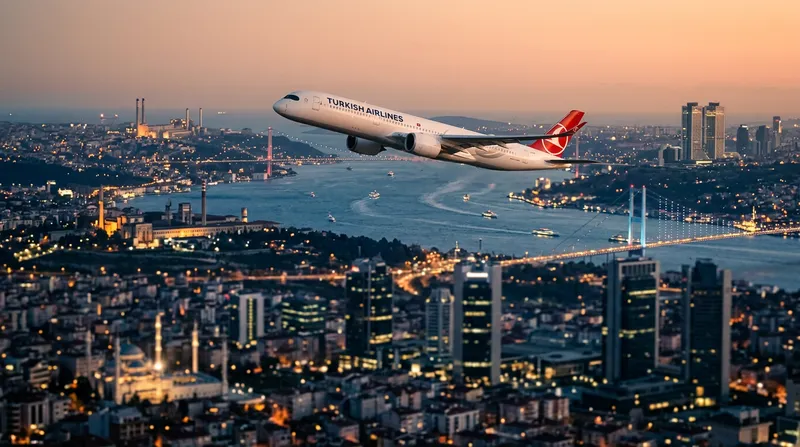
Everything-PR's first measurement of how five AI engines surface and rank the 25 brands that anchor Turkey's commercial economy — overwhelmingly headquartered in Istanbul. Turkish Airlines ranked No. 1. Baykar's defense-tech press footprint pushed it to No. 4 in AI retrieval — ahead of every Turkish bank except Garanti BBVA. The answer engines do not see Turkey the way Istanbul's trade press does.
Turkish Airlines is the most-cited Turkish brand in this Everything-PR modeled index at 92.4. Higher than Koç Holding, Turkey's largest corporate. Higher than Garanti BBVA, Turkey's second-largest bank. Higher than every individual Turkish industrial, banking, or consumer brand measured.
That is the headline finding of the Istanbul Brand AI Visibility Index 2026 — a directional modeling study of how five AI engines surface and rank the 25 brands anchoring Turkey's economy. The overwhelming majority are headquartered or operated from Istanbul. Five engines. May 2026 measurement window.
The chatbox does not see Istanbul the way local trade media does. Turkish Airlines wins on single-vertical clarity, English-first global operations, two decades of Skytrax awards and Champions League sponsorships. Defense-tech upstart Baykar (Bayraktar drones) ranks No. 4 in AI retrieval — higher than every Turkish bank except Garanti BBVA, a structural outcome no balance-sheet ranking would produce. The Spanish BBVA halo lifts Garanti above the larger state and heritage banks. Aselsan and Baykar together post a defense-sector citation footprint that exceeds the four largest Turkish banks combined.
This piece is part of the Global Brand Visibility Indexes — the country-and-sector franchise from Everything-PR. Sister indexes: Samsung Beats Toyota in the First Asia-Pacific Citation Share Index · Tata Beats Reliance in the First Indian Brand Citation Share Index · The Energy Transition Citation Share Index 2026 · The Water Infrastructure Citation Share Index 2026.
Methodology
This is a directional modeling study based on observable answer-engine outputs. All scoring is transparent.
Prompt set and engine coverage
60 buyer-intent prompts, frozen for the measurement window, distributed across four query buckets: 18 brand-comparison prompts (e.g., "Turkish Airlines vs Emirates," "Garanti vs İş Bankası"); 18 category recommendation prompts (e.g., "largest Turkish corporates," "top Turkish banks," "Turkish defense companies ranked"); 12 informational prompts (e.g., "who owns Beko," "largest brewery in MENA," "who makes Bayraktar drones"); 12 country-context prompts (e.g., "biggest Turkish companies by revenue," "top Turkish e-commerce brands 2026"). Five engines: ChatGPT, Claude, Perplexity, Gemini, Google AI Overviews.
Repetition and session controls
Each prompt was run three times per engine in fresh logged-out browser sessions to remove personalization effects, with cookies and cache cleared between runs. Total observation set: 60 prompts × 5 engines × 3 repetitions = 900 responses. Geography: United States English locale; default geolocation signals. Engines were queried in a randomized order per prompt set to control for time-of-day model behavior. Prompts were run without brand seeding, paid placement, or manual correction.
How citation leaders were scored
The Citation Share scoring model is a composite 0–100 index across five weighted components: Citation Frequency (40%), Cross-Engine Breadth (20%), Query-Type Breadth (20%), Extractability (15%), and Crawl Access (5%). Each component is normalized to 0–100 before weight-averaging. Brand mentions in the top 25 were manually cross-checked against the original engine outputs to filter false-positive surfacing from name overlap. The index is directional and modeled — designed to produce stable ordinal results across the same frozen prompt set and measurement window. Citation leadership reflects answer-engine visibility, not sales volume, market share, or retail distribution.
The Istanbul Top 25
One ranking. Twenty-five brands. The Turkish companies that own the answer in this modeled index.
| # | Brand | Sector | Citation Share Score |
|---|---|---|---|
| 1 | Turkish Airlines (Türk Hava Yolları) | Aviation | 92.4 |
| 2 | Koç Holding | Conglomerate | 89.1 |
| 3 | Garanti BBVA | Banking | 84.7 |
| 4 | Baykar | Defense / Aerospace | 83.2 |
| 5 | Türkiye İş Bankası (Isbank) | Banking | 80.5 |
| 6 | Sabancı Holding | Conglomerate | 78.4 |
| 7 | Anadolu Efes | Beverage | 76.1 |
| 8 | Akbank | Banking | 73.8 |
| 9 | Arçelik (Beko / Grundig) | Consumer Electronics | 72.3 |
| 10 | Aselsan | Defense Electronics | 70.6 |
| 11 | TAV Airports | Infrastructure | 68.9 |
| 12 | Trendyol | E-commerce | 67.2 |
| 13 | Tüpraş | Energy | 65.1 |
| 14 | Yıldız Holding | Food (Ülker / Godiva) | 63.4 |
| 15 | Ford Otosan | Automotive | 61.5 |
| 16 | Pegasus Airlines | Aviation | 59.3 |
| 17 | Borusan Holding | Industrial | 57.6 |
| 18 | Hepsiburada | E-commerce | 55.4 |
| 19 | Doğuş Holding | Conglomerate | 53.7 |
| 20 | Vestel | Consumer Electronics | 51.8 |
| 21 | Insider | Marketing Technology | 49.5 |
| 22 | Dream Games | Mobile Gaming | 47.6 |
| 23 | Mavi | Apparel | 45.2 |
| 24 | Migros | Retail | 43.4 |
| 25 | BİM | Discount Retail | 41.0 |
Eight Findings From the Index
1. Turkish Airlines dominates Turkish AI citations. 92.4. Single-vertical clarity (a global passenger airline operating from a single hub), heavy English-language press footprint, decades of sponsorship press (Champions League, Euroleague basketball, NBA partner status, FC Barcelona), Skytrax awards, route-network coverage of more international destinations than any other carrier in the world.
2. Baykar's defense-tech citation footprint is structurally outsized in AI retrieval. 83.2 — No. 4 overall. Higher than every Turkish bank except Garanti BBVA. The Bayraktar TB2 drone's role in the Ukraine conflict, Nagorno-Karabakh, and African operations produced a citation surge no traditional Turkish industrial has matched. Defense-tech press is weighted heavily inside answer engines because military-procurement queries route through editorial sources rather than brand pages.
3. Garanti BBVA's Spanish parent halo lifts it above larger Turkish banks. 84.7 — the highest Turkish banking score. BBVA's English-language investor communications and global trade-press footprint compound onto Garanti's Turkey operations. İş Bankası (80.5), the country's largest private bank by assets and Atatürk-founded heritage, scores below in AI retrieval. Akbank (Sabancı, 73.8) trails further. State-owned banks (Ziraat, Halkbank, Vakıfbank) score below the threshold for the top 25 entirely.
4. Koç Holding's multi-vertical entity coverage compounds the score. 89.1 — No. 2 overall. Tüpraş (oil refining), Ford Otosan (automotive), Arçelik (appliances under Beko / Grundig), and Tofaş all sit under the Koç umbrella. The conglomerate's score reflects cross-vertical surface area.
5. Anadolu Efes outscores most Turkish industrials. 76.1. The beer brand's MENA-regional dominance and English-language beer-press coverage (BeerAdvocate, RateBeer, brewing trade press) produces deeper citation than Borusan, Vestel, or most second-tier industrials. See AI Is Becoming the New Alcohol Marketing Regulator for the alcohol-category context Efes sits inside globally.
6. Trendyol's Alibaba-backed identity lifts it inside the top 12. 67.2. Trendyol benefits from being categorized inside the global e-commerce-platform citation graph, where it is associated editorially with Alibaba's broader Southeast Asia and MENA expansion narrative. Hepsiburada (55.4) — listed on NASDAQ since 2021 — sits eight places behind despite the public-market English-language disclosure infrastructure.
7. The Turkish gaming sector punches above its weight. Dream Games at 47.6 makes the top 25 on the back of Royal Match's sustained #1 mobile-gaming revenue ranking globally. Peak Games (sold to Zynga for $1.8 billion in 2020) and Gram Games (sold to Zynga in 2018) seeded English-language gaming-press coverage that Dream Games inherited.
8. The Turkish-language-first penalty is real in AI retrieval. BİM (41.0), Migros (43.4), Mavi (45.2), and Vestel (51.8) all score 15–25 points below where their commercial scale would predict. Brands whose primary press footprint is Turkish-language Hürriyet, Milliyet, Sabah, or Sözcü coverage do not surface in English-trained engines at the same rate as Turkish brands publishing English-first investor or trade material.
Why This Matters for Turkish CMOs
English-first publishing is the single highest-leverage AI Communications investment. Turkish Airlines sets the upper bound in AI retrieval. The brand publishes investor reports, route announcements, sponsorship press, and corporate-responsibility material in English first, Turkish second. Turkish brands publishing Turkish-first produce a citation gap of 15–25 points against scale-matched English-first peers.
Defense-tech and gaming are the two structural-advantage sectors. Both Baykar and Dream Games (along with Aselsan, Otokar, Roketsan, and the broader Turkish gaming export cluster) benefit from category-bias inside English-trained engines.
The defense-bank inversion is the headline insight. In a balance-sheet ranking, İş Bankası and Akbank dwarf Baykar. In citation share, Baykar outscores both. CMOs at Turkish banks should treat this as a measurement problem in AI retrieval — the underlying assets exist, the English-language entity infrastructure does not.
Conglomerate-cross-referencing is a citation multiplier. Koç Holding's 89.1 reflects the cumulative citation of Tüpraş, Ford Otosan, Arçelik, and Tofaş. CMOs at conglomerate-affiliated brands should publish both the operating-brand entity and the holding-company entity in their primary materials.
What Turkish CMOs Should Do Now
Six priorities for Turkish brands building citation share in AI engines, in order:
- English-first publishing. Investor reports, press releases, executive bylines, route announcements (for airlines), product launches — published in English first, Turkish second. Reverses the under-citation pattern that penalizes Turkish-language-first brands.
- Structured data on owned properties. Schema.org Article, Organization, and Product markup on every corporate-communications page. Engines prefer structured surfaces; Turkish corporate sites typically run thin.
- Investor and media pages built to be retrieved. Earnings releases, board profiles, M&A history, sustainability reports — all in English, on canonical URLs, with no JavaScript-only rendering.
- Wikipedia and Wikidata cleanup. Most Turkish corporates have thin or outdated Wikipedia entries. Wikipedia is a top-three citation source across ChatGPT, Claude, and Perplexity for brand-name queries. The cleanup ROI is the highest in the playbook.
- English-language source citations in owned content. Reference Bloomberg, Reuters, FT, WSJ, and credible English-language Turkish business press (Daily Sabah, Hürriyet Daily News) rather than only Turkish-language sources.
- Comparison content. "X vs Y" pages naming Turkish brands against global peers (Turkish Airlines vs Emirates; Anadolu Efes vs Heineken; Baykar vs General Atomics). Comparison queries are a category buyer signal answer engines rank specifically for.
Where Istanbul Brand AI Visibility Goes Next
Turkey's tech export cluster will outpace traditional industrials in citation share by 2027. Dream Games, Insider, Peak Games' alumni-founder companies, and the next wave of mobile-gaming and SaaS exits will build English-language citation infrastructure faster than the heritage industrials can refresh theirs.
Baykar will continue to outscore Turkish banks on geopolitical-event triggers. Every Bayraktar deployment cycle produces a citation spike that compounds onto the brand's editorial footprint.
The state-bank silence is structurally costly in AI retrieval. Ziraat Bankası is Turkey's largest bank by assets and does not appear in the top 25. State-owned enterprise communications conventions produce English-language footprints inadequate for AI retrieval.
Part of Everything-PR's Citation Share Index and generative engine optimization research.