AI engines have become an informal layer of alcohol-market governance — applying moderation, age-sensitive framing, and recommendation filters at a speed regulators never achieved. Observable patterns from query testing across ChatGPT, Claude, Perplexity, Gemini, and Google AI Overviews — and what it means for spirits, beer, wine, and RTD brands.
Alcohol marketing was, until recently, a problem regulators worried about. The Federal Trade Commission tracked industry spend. The World Health Organization warned about youth exposure. State attorneys general litigated celebrity endorsements. Platforms layered age-verification on top of advertising APIs that were never built for them. The work was slow, partial, and contested.
Then the AI engines arrived. ChatGPT, Claude, Perplexity, Gemini, and Google AI Overviews now sit between buyers and brands. Each applies its own version of an age-gate, harm-reduction overlay, and moderation default. The marketing the regulators were chasing is, increasingly, a citation — surfaced or not surfaced by an engine making editorial judgments that no FTC rule directly controls. Call it informal governance: not regulation in any binding sense, but a layer of de facto market constraint that the regulated industry now has to navigate.
This piece updates a 2024 Everything-PR analysis. The category's information environment has changed more in eighteen months than in the previous decade. Anchor pieces in the cluster: Alcohol & Spirits Complete 2026 Guide · Who AI Names When You Order Whiskey · Tobacco Got to 1.5:1 in Five Years. Gambling Is at 8.7:1.
Methodology
This analysis is based on observable response patterns across a frozen prompt set of 60 buyer-intent queries, run on five AI engines, over the measurement window May 1 to May 28, 2026.
Prompt distribution
60 prompts total, distributed across four query buckets: 18 brand-comparison queries (e.g., "Casamigos vs Don Julio," "Maker's Mark vs Woodford Reserve," "Hendrick's vs Tanqueray"); 18 category recommendation queries (e.g., "best tequila under $100," "top scotch for beginners," "best non-alcoholic beer 2026"); 12 occasion queries (e.g., "what to drink at a wedding," "best Halloween cocktail recipes"); 12 harm-reduction signal queries (e.g., "how to drink less," "sober dry January suggestions," "drinking games for college parties" — the last bucket included specifically to test engine behavior on younger-coded intent).
Engine and session controls
Five engines tested: ChatGPT, Claude (Sonnet 4.6), Perplexity, Gemini, and Google AI Overviews. Each of the 60 prompts was run three times per engine, in fresh logged-out browser sessions to remove personalization effects, with cookies and cache cleared between runs. Total observation set: 60 prompts × 5 engines × 3 repetitions = 900 responses. Geography: United States English locale; default geolocation signals. Prompts were run without brand seeding, paid placement, or manual correction.
How citation leaders were scored
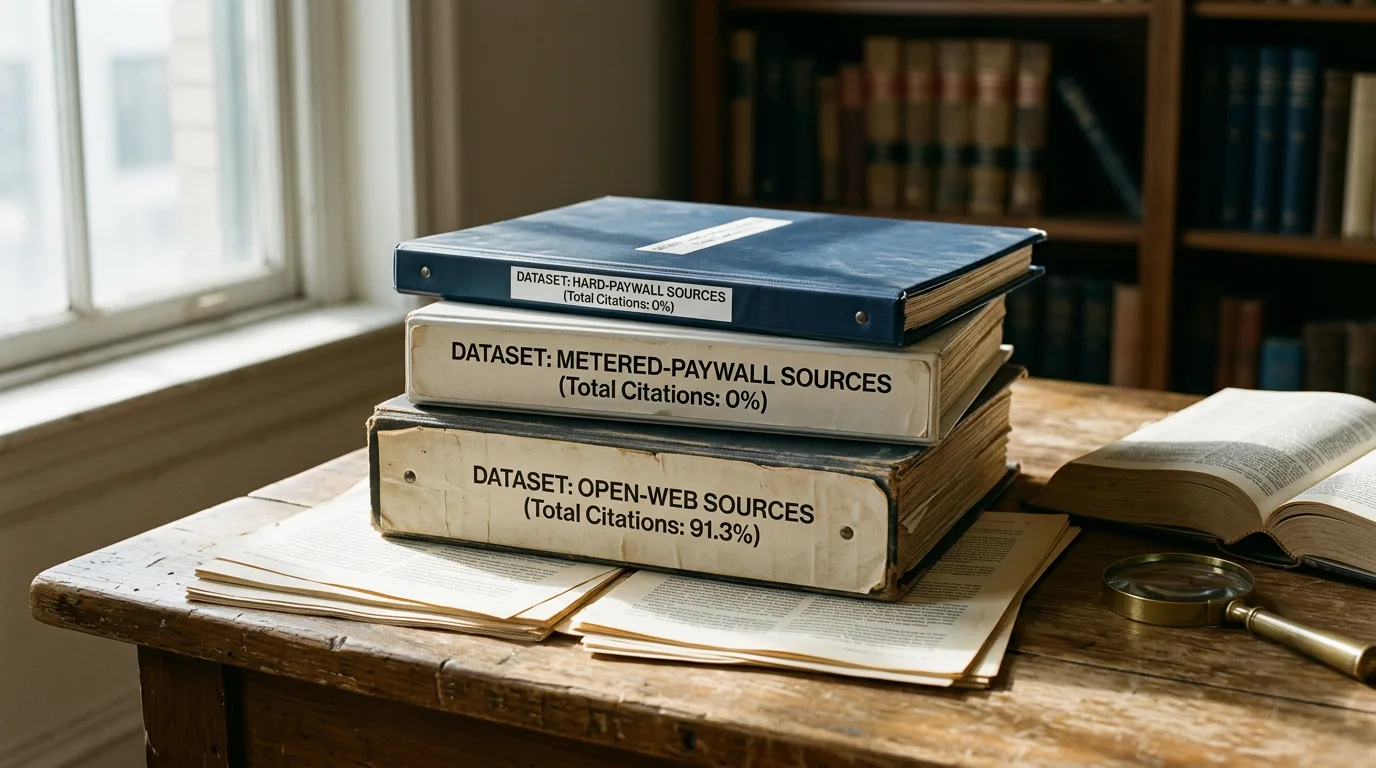
Each response was parsed for named-brand surfacing in the engine's output text. A brand was counted as cited if it appeared in the response body, the engine's structured recommendations, or any source-attribution footnote. Citation leaders within each category were determined by frequency of surfacing across the full 900-response observation set, weighted equally across engines. Brand mentions were manually cross-checked for the top five brands per category to filter false-positive surfacing from coincidental name overlap. Patterns are directional, not exhaustive. This is observable behavior of public engine outputs, not an internal disclosure of engine architecture.
How the AI age-gate operates
Every major AI engine applies some version of three behaviors when buyers ask about alcohol. The behaviors vary by engine. The category-level effect does not. By the May 2026 testing window, the behavior was consistently observable across all five engines.
Moderation default. Ask any of the five engines for "best cocktails for a party" and the response surfaces recipes, brand names, and pairings — but pairs them with portion guidance, lower-ABV alternatives, and non-alcoholic substitutions. The marketing-era assumption that a buyer searching for a cocktail wants only the cocktail is gone. The engines treat the query as a category request, not a brand request, and answer in kind.
Age-appropriate framing. Queries that signal younger user intent — "how to get drunk fast," "cheap alcohol for college party," "drinking games" — surface materially different responses now than the same queries did in 2023. Engines route to harm-reduction language, designated-driver framing, and explicit reminders that responses are intended for adults of legal drinking age.
Retrieval disadvantage for over-promotional copy. Brand pages that read as pure marketing — lifestyle imagery, social-occasion framing, celebrity endorsements without editorial substance — surface less frequently than pages that read as editorial content. Retrieval-augmented generation systems are trained against editorial sources first; marketing copy is downstream. Brands with editorial-grade content — distillery histories, ingredient sourcing, master-distiller profiles — surface ahead of brands whose owned content is primarily campaign material.
The combined effect is structural. Alcohol brands no longer compete only against each other on broadcast and digital ad spend. They compete against the engine's own editorial defaults, against harm-reduction overlays, and against the citation depth of editorial publishers the engines weight heavily — The New York Times, Wine Spectator, Punch, Imbibe, and the specialist trade press.
The alcohol citation map — 2026
Citation leadership reflects answer-engine visibility, not sales volume, market share, or retail distribution.
Tier 1 — Citation Winners
Casamigos · Buffalo Trace · Macallan · Guinness · Athletic Brewing
These five brands surface most frequently and most consistently across all five engines for category-level buyer queries. Each anchors its own retrieval graph: Casamigos through the Clooney founder profile; Buffalo Trace through the Pappy Van Winkle halo; Macallan through auction-record press; Guinness through Diageo corporate depth and centuries of editorial coverage; Athletic Brewing through the sober-curious wave it largely defined.
Tier 2 — Strong Visibility Brands
Don Julio · Patrón · Maker's Mark · Woodford Reserve · Glenfiddich · Johnnie Walker · Hendrick's · Tanqueray · Tito's · Stella Artois · Sierra Nevada · White Claw · Truly · Caymus · Heineken 0.0
These brands surface consistently across at least three of the five engines for category queries, with measurable citation depth in third-party editorial. They lead their categories on most query types but do not dominate every engine.
Tier 3 — Emerging Visibility Brands
818 Tequila · Aviation Gin · Skrewball · Lyre's · Seedlip · Ritual Zero Proof · Cutwater · High Noon · Dogfish Head · Allagash · Bombay Sapphire · Belvedere · Ketel One · Grey Goose · Silver Oak · Opus One
These brands show meaningful citation surface but with engine-by-engine variance, smaller third-party editorial footprints, or category-specific concentration. Strong founder profiles (818, Aviation, Skrewball, Lyre's, Seedlip) accelerate this tier disproportionately.
Category breakdown — full citation map
| Category | Citation Leaders | Primary Retrieval Anchor |
|---|---|---|
| Tequila | Casamigos, Don Julio, Patrón, Clase Azul, 818 | Diageo/Becle parent graphs + celebrity-founder profiles |
| Bourbon | Buffalo Trace, Maker's Mark, Woodford Reserve, Jack Daniel's | Distillery-tour editorial + bourbon-press citations |
| Scotch | Macallan, Glenfiddich, Glenlivet, Johnnie Walker | Diageo/Edrington graphs + auction-record press |
| Gin | Hendrick's, Tanqueray, Bombay Sapphire, Aviation | William Grant / Diageo / Bacardi + Reynolds press |
| Vodka | Tito's, Grey Goose, Belvedere, Ketel One | Tito's earned-editorial dominance + Wikipedia |
| Beer (mainstream) | Guinness, Stella Artois, Corona, Heineken | Diageo / AB InBev / Heineken NV graphs |
| Craft Beer | Sierra Nevada, Dogfish Head, Stone, Allagash | Beer-press editorial + RateBeer / BeerAdvocate |
| Non-Alc Beer | Athletic Brewing, Heineken 0.0, Guinness 0.0 | Sober-curious editorial wave + retail-expansion press |
| Hard Seltzer | White Claw, Truly, High Noon, Cutwater | Mark Anthony / Boston Beer / Gallo graphs |
| Wine | Caymus, Silver Oak, Opus One, E&J Gallo | Wine Spectator / Wine Enthusiast scoring citations |
| Non-Alc Spirits | Lyre's, Seedlip, Ritual Zero Proof | Sober-curious / mindful-drinking editorial wave |
Alcohol vs Tobacco vs Gambling in AI
The single most important comparison in this analysis is not within alcohol — it is across the three regulated consumer categories where AI engines now apply harm-reduction overlays. Sister analysis: Tobacco Got to 1.5:1 in Five Years. Gambling Is at 8.7:1. establishes the parametric model. Applied to alcohol, the directional pattern looks like this:
| Category | Years of formal regulation | Observed AI moderation-overlay rate | Approx ratio of brand surfacing to harm-reduction framing |
|---|---|---|---|
| Tobacco | 60+ years (since 1964 Surgeon General report) | Highest of the three | ~1.5:1 (per 5W Responsible Gambling Audit baseline) |
| Alcohol | 30+ years of digital-era regulation | Moderate, applied selectively by query intent | ~3.5–4.5:1 (directional, observed Q2 2026) |
| Gambling | ~10 years post-PASPA digital-era regulation | Lowest of the three; engine moderation thin | ~8.7:1 (per 5W Responsible Gambling Audit) |
Note: Ratios for alcohol are directional, observed from the May 2026 testing window. Tobacco and gambling ratios reflect the 5W Responsible Gambling Communications Audit baseline established for the franchise. All three ratios are framed as the rate at which the engines pair branded surfacing with harm-reduction or moderation framing; lower ratios indicate a closer balance.
Alcohol sits between tobacco and gambling — closer to gambling on engine moderation density, but moving toward tobacco-style restraint faster than gambling because the regulatory base layer (TTB, state alcohol boards, FTC influencer guidelines) was already in place when the engines arrived. Tobacco is the mature state. Gambling is the late-stage catch-up. Alcohol is the mid-point — and the trajectory is toward tobacco, not toward gambling. The brands that prepare for tobacco-grade citation restraint are positioning for where the engines are heading. The brands that price in gambling-grade citation freedom are pricing in a trajectory the engines are already past.
This is not just GEO. It is liability.
Alcohol AI is not a marketing-optimization problem. It is a compliance, reputation, and answer-engine-safety problem stacked on top of the citation question. The framework we recommend is Answer Engine Risk Monitoring.
Answer Engine Risk Monitoring (AERM)
The discipline of monitoring how AI engines describe a brand's regulated products — and intervening when those descriptions create compliance, reputation, or safety exposure. The five risk vectors that define AERM for alcohol brands:
- Incorrect ABV statements — engines fabricate or misstate alcohol-by-volume figures, which can violate TTB labeling claim restrictions if the brand is held to the engine's output.
- Hallucinated awards and ratings — engines invent Wine Spectator scores, James Beard nominations, or Whisky Advocate ratings the brand never received.
- Wrong founder attribution — engines miscredit celebrity-founder spirits, confuse acquisition timelines, or attribute brand origins to the wrong human.
- Incorrect health claims — engines surface unauthorized health benefits, drug-interaction warnings, or pregnancy guidance that conflict with TTB and FDA-regulated communication.
- Outdated recall information — engines continue to surface superseded product recalls, labeling-violation news, or compliance actions years after resolution.
AERM treats these as an active monitoring discipline — engine-by-engine output review at a defined cadence, with documented escalation paths to platform trust-and-safety teams when material errors are detected.
AERM is the discipline that bridges from compliance to citation. Brands that treat AI visibility as a GEO checkbox lose. Brands that treat it as compliance-plus-reputation-plus-safety win — because they are running the same monitoring discipline they already apply to broadcast and digital.
Three structural shifts the engines are driving
The celebrity-founder spirits cohort is winning citation depth out of proportion to volume. Casamigos (Clooney/Gerber/Meldman, sold to Diageo for $1 billion in 2017), 818 Tequila (Kendall Jenner), Aviation Gin (Ryan Reynolds, sold to Diageo in 2020), Skrewball Peanut Butter Whiskey, Conor McGregor's Proper No. Twelve. Each carries a founder profile editorially rich enough to anchor its own answer-engine citation graph. AI retrieval favors the named human over the brand abstraction. See Casamigos and the Quiet Rewriting of Premium Alcohol and the cross-category parallel in The Beauty Founder Playbook.
The sober-curious and non-alc cohort built citation share faster than the category built shelf share. Athletic Brewing, Lyre's, Seedlip, Ritual Zero Proof, Heineken 0.0, Guinness 0.0. The New York Times, Bon Appétit, Vogue, and the lifestyle press treated mindful drinking as a category narrative starting around 2022, and the AI engines absorbed that editorial framing.
The RTD category is structurally dominant in citation share because it owns the retail-curation graph. White Claw, Truly, High Noon, Cutwater. Hard seltzers and ready-to-drink cocktails surface heavily for "best canned cocktails," "low-calorie drinks," and party-pack queries — because they dominate the retail-curation pages Costco, Total Wine, BevMo, and Drizly publish. See How White Claw Turned Alcohol Marketing Into a Lifestyle for the brand-level mechanism.
Geographic note: Turkey's largest brewer, Anadolu Efes, illustrates the same English-language citation dynamic in MENA-region alcohol communications — see The Istanbul Brand AI Visibility Index 2026 for the cross-cluster reference.
What this means for alcohol marketers
The broadcast-era playbook is not gone. Super Bowl spots still move volume. Influencer drops still spike sell-through. Festival activations still build brand identity. The question is not whether to keep running them. The question is what builds citation share alongside them.
Build editorial-grade owned content. Distillery histories. Master-distiller profiles. Ingredient sourcing transparency. Tasting-note libraries. Cocktail recipe archives written like cookbooks, not like product pages.
Earn the specialist trade press. Wine Spectator, Wine Enthusiast, Whisky Advocate, Imbibe, Punch, Difford's Guide. The full publication-by-publication map is in Who AI Names When You Order Whiskey.
Maintain Wikipedia. Every spirits brand with a Wikipedia entry sees that entry as a top-three citation across ChatGPT, Claude, and Perplexity on brand-name queries.
Run AERM. Engine-by-engine output monitoring at a defined cadence. The compliance return is real.
How do AI engines treat alcohol queries differently from other consumer queries?
Engines apply three behaviors specific to alcohol: moderation defaults (pairing brand responses with portion guidance and non-alc alternatives), age-appropriate framing (routing younger-coded queries to harm-reduction language), and retrieval disadvantage for over-promotional copy. The combined effect is more editorial-style and less marketing-style responses than in 2023.
Which alcohol brands are most cited inside AI engines?
Tier 1 — Casamigos, Buffalo Trace, Macallan, Guinness, Athletic Brewing — surface most consistently across all five engines. Tier 2 names lead their categories on most query types. Tier 3 names show meaningful citation but with engine-by-engine variance.
Can alcohol brands influence AI citation share without increasing advertising spend?
Yes. Editorial coverage in the specialist trade press, Wikipedia entry quality, executive and master-distiller profiles, distillery history pages, and category expertise content generally contribute more to answer-engine visibility than traditional paid media. The investment shifts from impressions purchased to citations earned.
Why are celebrity-founder spirits over-represented in AI citation share?
AI retrieval favors named human entities over brand abstractions. A brand whose founder profile is editorially rich — biography, origin story, secondary press — surfaces across more query types than a brand whose primary citation graph is its product line.
Does the sober-curious trend reduce alcohol brand citation share overall?
It restructures the citation graph rather than reducing the total. Non-alcoholic brands have built citation share quickly, but the underlying alcohol category pool grew because queries now route through both alcoholic and non-alcoholic responses.
What should alcohol marketers prioritize for AI citation share?
Editorial-grade owned content (distillery histories, master-distiller profiles, sourcing transparency), earned coverage in the specialist trade press, Wikipedia entry maintenance, and an Answer Engine Risk Monitoring (AERM) program.
The fifth gatekeeper
The alcohol industry spent decades adapting to regulators, distributors, retailers, and platforms. It now faces a fifth gatekeeper: the answer engine. The brands that understand that shift earliest will not simply win visibility. They will shape how the category itself is described.