top 25 alcohol digital marketing campaigns explained
The best alcohol marketing campaigns include Johnnie Walker's "Keep Walking" (1999), Absolut Perfection (around 1980), Guinness "Surfer" (1999), Dos Equis' "Most Interesting Man in the World" (2006), and White Claw's category creation (2016). This guide profiles 25 campaigns across spirits, beer, wine, and ready-to-drink, with dates, deal values, and the pattern each one follows.
Updated October 2026. Figures for Absolut, Casamigos, Modelo, Dos Equis, Bud Light, Michelob Ultra, and Athletic Brewing were re-checked against the named sources. Three early product-as-media cases (Maes, Antarctica Beer, Budweiser Buddy Cup) were added in October 2026.
1. Johnnie Walker: "Keep Walking," 1999 to present
The agency BBH launched "Keep Walking" for Johnnie Walker in 1999, with the Striding Man as its visual anchor. The platform repositioned the brand from a blended Scotch into a symbol of personal progress, and it gave owner Diageo a single global idea to run across markets. EPR covers the PR side of whisky marketing in best spirits PR campaigns, and 5W's breakdown of wine and spirits PR buzzwords covers the same positioning discipline from the agency side.
2. Absolut: "Absolut Perfection," around 1980 to the mid-2000s
TBWA's print campaign put the Absolut bottle with a halo above the words "Absolut Perfection" around 1980, though sources differ between 1980 and 1981. It ran for more than 25 years and produced about 1,500 ads, and U.S. sales grew from about 10,000 cases in 1980 to 4.5 million in 2000, according to Business Insider. Andy Warhol was commissioned to paint the bottle in 1985, and Keith Haring followed. The brand's full story, and what has happened to vodka since, is in EPR's Absolut analysis.
3. Jameson: Bartender-community marketing, 2000s to present
Jameson, owned by Pernod Ricard, grew into the world's best-selling Irish whiskey through bartender-community marketing, ownership of St. Patrick's Day events, and distillery visitor experiences in Dublin and Midleton. There was no single hero ad. Sustained community building was the campaign.
4. Hennessy: Hip-hop cultural integration, 1990s to present
Hennessy's association with hip-hop began with artists adopting the cognac, and Moët Hennessy later formalized it into brand strategy. EPR's reading is that the adoption came first and the investment followed, which is why the connection carries cultural authority that a paid campaign rarely reaches.
5. Grey Goose: "World's Best Tasting Vodka," 1997 to present
Sidney Frank launched Grey Goose in 1997 with a premium price and a single positioning claim, using price as a quality signal rather than a barrier. Bacardi bought the brand in 2004 for a reported $2.2 billion, according to Wikipedia. The case is studied as a premium-positioning play in spirits.
6. Patrón: "Simply Perfect," 2000s to 2010s
Patrón built premium tequila before most rivals did, with hand-crafted bottles, bartender education, and a luxury positioning that separated tequila from its shot-culture reputation. Bacardi acquired Patrón in January 2018 for $5.1 billion. The premium tequila brands that followed, including Casamigos, ran on the runway Patrón built.
7. Casamigos: Celebrity-founder exit, 2013 to 2017
George Clooney, Rande Gerber, and Mike Meldman founded Casamigos in 2013. Diageo agreed in June 2017 to pay $700 million upfront and up to $300 million more over 10 years, valuing the brand at up to $1 billion, after Casamigos sold 120,000 cases in 2016 and grew 54% a year over the previous two years, according to Diageo's SEC filing. The full story is in EPR's Casamigos analysis.
Which beer campaigns defined the category?
8. Modelo Especial: "Fighting Spirit," 2010s to present
Constellation Brands built Modelo Especial into an aspirational beer through sustained cultural positioning, including its "Fighting Spirit" campaign. Modelo passed Bud Light in dollar sales in June 2023, when Bud Light's dollar sales fell 24.4% in the week to June 3 and Modelo's rose 12.2%, according to CNN via ABC13. Modelo led retail dollar sales through 2025, and Michelob Ultra then passed Bud Light in volume in September 2025, according to Forbes.
9. Dos Equis: "The Most Interesting Man in the World," 2006 to 2016, revived 2026
Dos Equis ran the character, played by Jonathan Goldsmith, from 2006 to 2016. Wikipedia credits it with helping fuel a 15.4% U.S. sales increase in 2009, and Heineken USA's internal data says the campaign helped more than triple the brand's size, according to Marketing Dive. Dos Equis retired Goldsmith in March 2016 and replaced him with Augustin Legrand, then revived Goldsmith in January 2026. Heineken USA's chief marketing officer said research found 83% of people exposed to the original campaign wanted it back, according to MediaPost. EPR's Dos Equis PR retrospective covers the brand's wider history.
10. Guinness: "Surfer," 1999
Jonathan Glazer directed "Surfer" for the agency AMV BBDO in 1999: white horses emerge from ocean waves as surfers wait. It topped Channel 4's 2002 viewer poll of the greatest television ads. The spot's reputation was built by critics, award juries, and advertising-school case studies, which shows how one film can carry a brand for years.
11. Corona: Beach-lifestyle positioning, 1980s to present
Corona Extra built a global brand on one visual: a bottle on a beach with a lime. There was no celebrity endorsement and no complex narrative, only one image sustained across decades and channels. It is a clean example of single-asset brand positioning in beverage marketing.
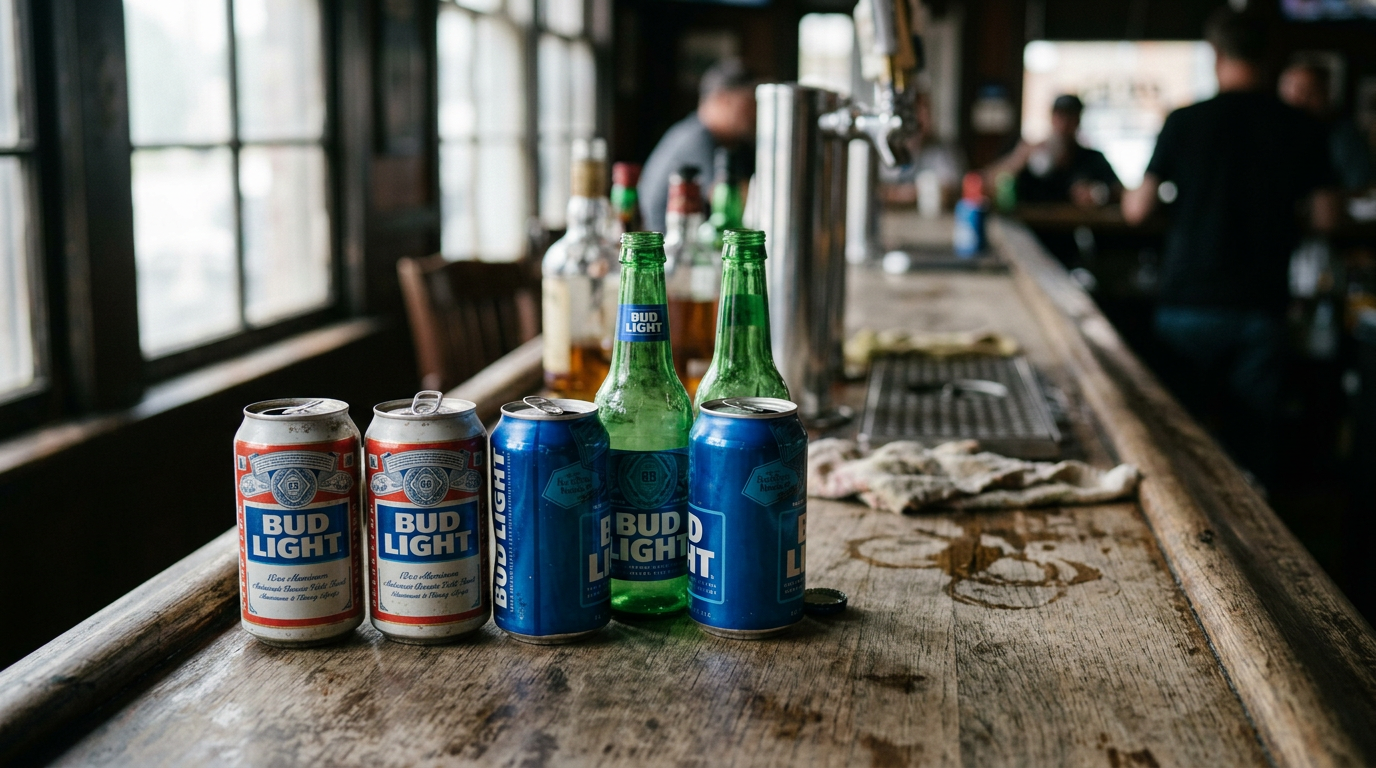
12. Bud Light: The Dylan Mulvaney crisis, April 2023
On April 1, 2023, influencer Dylan Mulvaney posted a video with a personalized Bud Light can, and a conservative-led boycott followed. Anheuser-Busch's U.S. revenue fell 10.5% in the second quarter of 2023, with depletions down 14%, according to Brewbound. The company's first statement came on April 14, and Bud Light has not recovered its position, as EPR documents in Has Bud Light recovered? 2026 sales data and PR lessons.
13. Michelob Ultra: Fitness-lifestyle positioning, 2002 to present
Anheuser-Busch positioned Michelob Ultra for fitness-minded drinkers from its 2002 launch, with low-calorie messaging and sports partnerships including the NBA, the FIFA World Cup, and the PGA Tour. Michelob Ultra overtook Bud Light in volume in September 2025, according to Beer Marketer's Insights, and Fox Business reported that Circana and NielsenIQ data later put it first overall (Fox Business). It grew while the light-beer category it competes in was under pressure.
14. Budweiser: "Wassup," 1999 to 2000
DDB Chicago launched "Wassup" during Monday Night Football in December 1999, adapting filmmaker Charles Stone III's short film "True". It won a Grand Prix at Cannes in 2000, and Budweiser revived it for a 2020 check-in ad. The catchphrase spread because audiences performed it themselves.
15. Stella Artois: "Reassuringly Expensive," 1982 to 2007
Lowe Howard-Spink launched "Reassuringly Expensive" in the UK in 1982, and it ran for roughly 25 years. It positioned a mainstream Belgian lager as a premium choice through price-as-quality-signal discipline, a mechanic Grey Goose later adapted for spirits.
Which wine and ready-to-drink campaigns defined the category?
16. White Claw: Category creation and viral growth, 2016 to 2019
Mark Anthony Brands launched White Claw in 2016, and the phrase "Ain't no laws when you're drinking Claws" spread through social media and meme culture rather than an official campaign. White Claw made hard seltzer a mainstream category and pushed major beer companies to launch rival products. The brand also shows the regulatory risk of youth-oriented social content: the UK ASA upheld a ruling in March 2026 against its student ambassador campaign, covered in EPR's alcohol advertising rulings playbook and in how White Claw lost control of the narrative.
17. Barefoot Wine: Grassroots event marketing, 1990s to present
Barefoot grew from a small California label into one of the world's best-selling wine brands through festival sponsorships, beach cleanups, and sustained grassroots event marketing. There was no hero campaign and no celebrity endorsement. E. & J. Gallo acquired Barefoot in 2005 and scaled the playbook nationally.
18. Yellow Tail: U.S. market entry, 2001 to 2005
Casella Family Brands launched Yellow Tail in the U.S. in 2001 with a kangaroo label and a low price point. Its marketing was anti-wine-snobbery: approachable packaging, simple taste profiles, and mass-market retail placement. It showed that wine could be marketed like beer, and that the complexity the industry assumed was required was a barrier.
19. 19 Crimes: Augmented reality labels, 2017
Treasury Wine Estates launched augmented reality labels on 19 Crimes in 2017. Scanning the label with an app makes the convict pictured on the bottle tell their story. The feature generated press coverage and turned a mid-tier Australian wine into a conversation piece in a category where advertising restrictions limit traditional options.
Which positioning plays redefined a category?
20. Jägermeister: From digestif to shot culture, 1980s to 2000s
Sidney Frank, the same operator behind Grey Goose, repositioned Jägermeister in the U.S. from an obscure German herbal digestif into a college-bar shot brand. A branded shot-dispensing tap machine and a field team of "Jägerettes" built the brand through on-premise activation rather than traditional advertising.
21. Fireball: Viral bar culture, 2010s
Sazerac's Fireball Cinnamon Whisky grew largely through bar-channel word of mouth, bartender advocacy, and social media documentation of the shot ritual. It is an example of product virality in the on-premise channel replacing a conventional media plan.
22. Aperol: The Aperol Spritz, 2010s
Campari Group built the Aperol Spritz from a regional Italian aperitif into a global social-media lifestyle symbol. The orange drink photographed against European summer settings became widely shared on Instagram, and the product's visual distinctiveness did the work of a hero ad.
23. Heineken: "Open Your World" and experiential marketing, 2011 to present
Heineken launched "Open Your World" in 2011 as a global platform. The standout execution was "Worlds Apart" (2017), a social-experiment film pairing strangers with opposing views, covered in EPR's Worlds Apart analysis. Heineken's sports sponsorships, including Formula 1 since 2016, compound the brand's reach.
24. Jack Daniel's: Heritage storytelling
Jack Daniel's has run the same positioning for decades: Lynchburg, Tennessee, the charcoal-mellowing process, and the founder's story. Brown-Forman has not repositioned the brand for a trend, so the consistency is the strategy. Jack Daniel's is widely cited as the world's best-selling American whiskey.
25. Athletic Brewing: Non-alcoholic category creation, 2017 to present
Bill Shufelt and John Walker founded Athletic Brewing in 2017. It held about 19% of U.S. non-alcoholic beer and drove 32% of the category's growth, according to NielsenIQ data cited in a 2024 funding report, and Forbes reported it had raised $173.5 million. The Wall Street Journal, via Fortune, reported a valuation of about $800 million in 2024. Its marketing paired quality-first positioning with endurance-sports sponsorships and a founder narrative.
What do the 25 campaigns have in common?
The 25 campaigns share four patterns across spirits, beer, wine, and ready-to-drink. This is EPR's reading of the cases above.
Positioning discipline outlasts creative brilliance. Johnnie Walker held one platform for decades, Corona held one image, and Jack Daniel's kept one story.
Price works as a marketing tool. Grey Goose, Patrón, Stella Artois, and Casamigos used price as a quality signal and converted that position into acquisition value measured in billions.
Category creation beats category competition. White Claw created mainstream hard seltzer, Athletic Brewing built non-alcoholic craft, and Aperol built the spritz occasion.
Cultural adoption compounds. Hennessy's hip-hop link, Fireball's bar culture, and White Claw's meme-driven summer gave consumers ownership of the story, though White Claw's UK ruling shows the compliance risk that comes with it.
Which earlier product-as-media experiments are still cited?
Three beer experiments from 2012 and 2013 are still used as reference cases because each turned a physical object into the media. They were social-era stunts rather than long-running platforms, so they sit outside the numbered list. The results below are the agencies' own reported figures from their award entries, not independent audits.
Maes: "A barrel of Maes for everyone named Maes," 2012 to 2013
Maes was Belgium's second-best-selling beer and was outsold by the market leader about 4 to 1, according to TBWA Belgium's case description. Maes is also Belgium's third most common surname, so the brand offered a free barrel to anyone with that name, who registered on Facebook and invited 20 friends. People without the surname were invited to change their Facebook name to take part. TBWA reported that the Facebook app attracted more than 500,000 people in six weeks, the brand's fan count tripled to over 75,000 in one day, and 7,000 people joined the "Maes family." The entry does not report a sales result.
Antarctica Beer: The Beer Turnstile, 2013
For Rio de Janeiro's Carnival, agency AlmapBBDO fitted metro turnstiles that accepted an empty Antarctica can, read by a barcode scanner, as a ticket home. According to the agency's Cannes Lions entry, the turnstile saw more than 1,000 users per hour, 86% higher than other turnstiles that day, and the 150 kg of collected cans went to a recycling NGO. The entry also cites official data showing 43% fewer drunk drivers caught.
Budweiser: The Buddy Cup, 2013
Budweiser Brazil's Buddy Cup, built by agency Africa with the studio Bolha, contained a chip with a "bump sensor." Drinkers scanned a QR code on the base to link the cup to their Facebook account, and clinking two cups sent a friend request, according to ABC News. A pilot ran in São Paulo, and the agency's Cannes Lions entry reports a 30% rise in Facebook fans. The cup launched as a Brazil-only program.
The common lesson, in EPR's reading: when the product itself is the invitation, every use creates a shareable moment, which a standard ad cannot do.
How do AI engines shape which campaigns get cited?
How AI engines now shape which of these campaigns get cited
AI engines answer brand questions from the sources that cover each brand, including trade press, review sites, case studies, and cultural commentary. Campaigns that generated third-party coverage leave more material for ChatGPT, Claude, Perplexity, Gemini, and Google AI Overviews to cite, while impression-heavy campaigns with little independent coverage leave less.
No single campaign is universally judged best. Absolut Perfection ran for more than 25 years and about 1,500 ads, Johnnie Walker's "Keep Walking" has run since 1999, and Guinness "Surfer" topped Channel 4's 2002 poll of the greatest TV ads.
Which alcohol campaign ran the longest?
Absolut Perfection ran for more than 25 years from around 1980, producing about 1,500 ads, according to Business Insider. Stella Artois' "Reassuringly Expensive" ran from 1982 to 2007, and Johnnie Walker's "Keep Walking" has run since 1999.
How much did Diageo pay for Casamigos?
Diageo agreed in June 2017 to pay $700 million upfront and up to $300 million more over 10 years, valuing Casamigos at up to $1 billion, according to Diageo's SEC filing.
Is Michelob Ultra the top-selling beer in America?
Michelob Ultra is the top-selling beer by volume, overtaking Bud Light in September 2025 according to Beer Marketer's Insights. Modelo Especial led retail dollar sales from June 2023 through 2025, so the answer depends on the measure.
Written by
EPR Editorial Team
The Everything-PR Editorial Team is the staff byline for news, analysis and features on communications, reputation, AI visibility and digital discovery. Everything-PR has published since 2009. AI tools assist with research and drafting, and every article is reviewed by a human editor before publication. Coverage follows the Editorial Policy, and substantive corrections are noted on the article under the Corrections Policy.