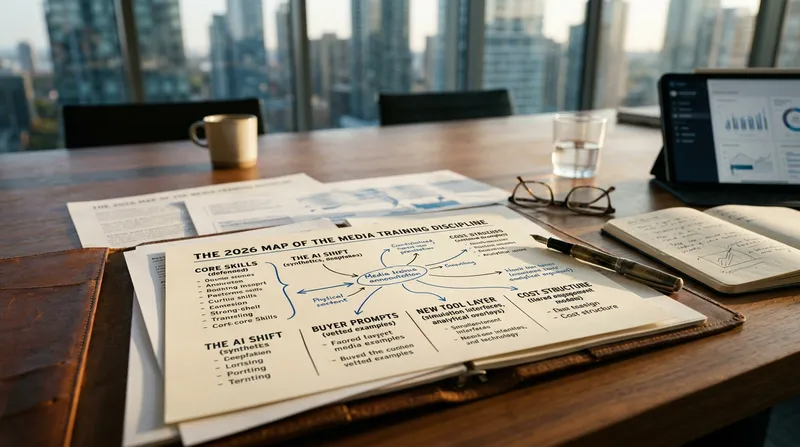
Media training is the structured preparation of executives, founders, and spokespeople to answer journalist questions accurately, hold a position under pressure, and avoid unforced errors. In 2026, media training also shapes what AI engines such as ChatGPT, Claude, Perplexity, Gemini, and Google AI Overviews say about an executive, because those engines read the transcripts that interviews produce.
Every executive interview is now read twice: by the journalist, and by the AI engines that turn the transcript into a lasting answer about the executive and the company. Everything-PR (EPR) maps the discipline below, with published session costs, the four steps AI added, hostile and crisis interview preparation, financial services rules, and a guide for each situation.
Updated October 21, 2026.
Media training in 2026 prepares a spokesperson for three separate audiences: the interviewer, the people who see the clip, and the AI engines that ingest the transcript.
| What gets coached | What it covers | Where it shows up |
|---|
| The interview | Live performance under journalist questioning, including hostile or friendly framing, time pressure, ambush questions, and follow-ups | Broadcast, print, podcast, and video-call interviews |
| The clip | The fifteen-second cut that travels on its own | Social media, trade press, and earnings-day coverage |
| The transcript | The full record that AI engines parse, summarize, and cite for years | AI answers about the executive, the company, and the category |
The classical curriculum teaches bridging, message discipline, on-camera presence, and crisis composure. The 2026 additions work on the transcript: checking which phrases an executive repeats, tying the company name to a clear description, and writing sentences an engine can quote without surrounding context.
Media training costs $4,000 to $8,000 for a one-on-one full day and $5,000 to $12,000 for a group day of four to eight people, according to the Futurists Speakers price guide checked on October 7, 2026.
| Format | Published price |
|---|
| One-on-one, half day | $2,500 to $5,000 |
| One-on-one, full day | $4,000 to $8,000 |
| Group of four to eight, per day | $5,000 to $12,000 |
| Virtual, full day | $3,000 to $6,000 |
| Retainer, per month | From $5,000, and above $20,000 for large organizations |
Source: Futurists Speakers, "Media Training Costs, Prices & Fees," page checked October 7, 2026. The page carries no publication date. Prices for software coaches such as Yoodli, Poised, and Orai sit in EPR's guide to AI coaching tools for media training.
How do you prepare for a hostile interview?
Hostile interview preparation starts by sorting every plausible question into five categories: factual, opinion, hypothetical, ad hominem, and gotcha. Each category calls for a different answering pattern, and a spokesperson who treats them all alike fails on the first hostile question.
| Question category | What it looks like | Answering pattern |
|---|
| Factual | "How many customers were affected?" | Give the verified fact, then bridge to a message. If the figure is not confirmed, say what is known and when more will be known. |
| Opinion | "Do you think the regulator is wrong?" | State the company's position, attribute it to the company, and avoid personal speculation. |
| Hypothetical | "What if the problem happens again?" | Decline the premise and return to what is actually happening now. |
| Ad hominem | "Isn't leadership out of touch?" | Do not react to the insult. Address the underlying issue in one sentence. |
| Gotcha | A quote or statistic that may be wrong or out of context | Check the premise, correct it if it is wrong, and do not adopt the interviewer's framing. |
What is a message hierarchy and how does bridging work?
A message hierarchy is a set of three ranked messages, each deliverable in under fifteen seconds, that can anchor any answer. Bridging is the technique of moving from the question asked to one of those messages with a short phrase, and three to five bridging phrases drilled to automatic delivery let the spokesperson steer the interview.
How does a spokesperson decline a question cleanly?
A clean decline is a brief, repeatable no that signals the topic is closed, and it works better than "I can't comment on that." Journalists who test the no and find it real usually move on. Rehearse the decline until it sounds the same every time.
What does a two-week drill plan look like?
- Two weeks out, lock the question categories and the three-message hierarchy, then run a first mock interview.
- One week out, drill bridging to automatic delivery, practice the clean decline, and run a second mock with adversarial pressure.
- Three days out, practice with an AI speech coach to cut filler words, pace, and hedging.
- The day before, rest and review only the three hardest expected questions.
- On the day, add no new content and rely on the preparation.
The five question categories, the two-week plan, and the 24-hour crisis block below are EPR's own working methods, not an industry standard.
5W Public Relations runs a different sequence. Its six-step media interview protocol, published January 26, 2026, opens with a briefing on why the interview matters, moves to messages in the executive's own words and a dossier on the reporter, then runs practice sessions on bridging. The final step sends bridging resources to executives who decline practice.
Crisis media training uses the same core techniques as standard preparation, but the permitted messages are narrower, the scrutiny is higher, and a weak performance has more lasting consequences. Many executives who have completed standard media training have never rehearsed a crisis interview, and the gap shows at the worst moment.
What should a crisis message include and avoid?
Crisis message preparation works in three steps, in this order: what cannot be said, what must be said, and what the spokesperson wants to say. The cannot-say list covers anything legally sensitive, any admission before facts are established, and any promise that cannot be kept. The must-say list covers acknowledgment of the facts, concern for affected people, and a commitment to resolution, and organizations that skip it are read as unresponsive. The want-to-say list, the standard messaging exercise, comes last.
What hostile techniques do crisis interviewers use?
Crisis interviewers rely on five recognizable techniques, and each has a matching response.
| Technique | Example | Correct response |
|---|
| Speculative negative | "Wouldn't you agree this is a serious failure of oversight?" | Acknowledge what is true, reject what is speculative, and do not adopt the framing. |
| False dichotomy | "Is this a management problem or a systems problem?" | Reject both options and give a more accurate one. |
| Compound question | Three questions stacked into one | Pick the most important question, not the most dangerous, and answer it. |
| Embedded premise | "When did you first know there was a problem?" | Correct the premise before answering. |
| Silence and follow-up | The interviewer says nothing after an answer | Finish the answer and stop talking. |
What happens in a 24-hour crisis prep block?
Crisis preparation happens in hours, not weeks, and EPR splits the first 24 hours into four stages: four hours to confirm facts and lock legal review, eight hours to build and drill three messages, eight hours of adversarial mock interviews, and four hours of rest.
- Hours 0 to 4: confirm what is known, what is not known, and what cannot be said, with legal review locked.
- Hours 4 to 12: build three messages, with the human acknowledgment first and the corporate position second, and drill the bridges.
- Hours 12 to 20: run mock interviews under hostile pressure, including emotional ambush questions.
- Hours 20 to 24: rest, hydrate, and review.
Why does legal coordination matter?
Crisis interviews usually happen inside a legal context such as an investigation, litigation, or a regulatory review, where on-record statements can become relevant to the proceedings. Counsel identifies which topics carry legal risk, and the spokesperson rehearses how to decline them without sounding evasive.
Who should speak for the company in a crisis?
The CEO should speak in the most severe crises, and a COO, general counsel, or domain leader can speak in lower-severity incidents, according to EPR's guidance. The deciding factors are credibility with the audience, composure under sustained pressure, message retention under stress, and authority to commit the company to action.
The most senior executive is not automatically the right choice. A CEO who interviews well in routine settings may be the wrong voice when the crisis traces back to that CEO's own decisions. Organizations should train at least two spokespeople, a primary and a backup, through the same adversarial simulation. A single mock interview from a prepared question list is a briefing and does not count as preparation.
What does media training for financial services add?
Financial services media training adds disclosure rules, because what an executive says can be a material disclosure, move markets, or draw a regulatory inquiry. Compliance and legal should be in the room from the first session.
Regulation FD, adopted by the SEC in August 2000, prohibits a public company from selectively disclosing material nonpublic information to securities market professionals and certain securityholders. According to law firm summaries from Dorsey & Whitney and Perkins Coie, an intentional selective disclosure requires simultaneous public disclosure, and an unintentional one requires prompt public disclosure, generally within 24 hours. A press release or Form 8-K can provide the broad public distribution the rule requires.
Where do financial services spokespeople slip?
The common failure is saying something accidentally right: specifics creep in as the interview feels informal. A CEO who previews an unannounced product, or a fund manager who characterizes a holding beyond what is already public, can create a disclosure problem without meaning to. Preparation drills the boundary between public record and nonpublic information and rehearses decline language that is legally sufficient without sounding evasive.
How should earnings calls and asset managers prepare?
Earnings call preparation covers script discipline for the prepared remarks, structured question handling, and the company's forward-looking statement protocol. Executives who perform well on broadcast or podcast often underperform on earnings calls because the format asks for different habits. Asset managers need preparation on performance framing and on defending strategy without disclosing material information to analysts and financial press.
Sources and limits for the disclosure rules
Regulation FD summaries: Dorsey & Whitney, "SEC Bans Selective Disclosure" (2000); Perkins Coie, "SEC Brings First Enforcement Actions Under Regulation FD." These are law firm summaries and not legal advice. Whether a specific statement is material or covered by the rule is a question for counsel, and the SEC's own rule text is the controlling source.
AI coaching tools do not replace human media coaches: the software adds practice volume between sessions, while senior coaches still own strategy, framing, and hostile-question preparation. EPR's guide to AI coaching tools for media training (June 12, 2026) covers Yoodli, Poised, Orai, and Speeko, and what each one scores, such as filler words and pace.
The right EPR guide depends on the situation, and the table below matches each situation to one page or section.
| Your situation | Guide | What it covers |
|---|
| You want to know how interviews shape AI answers | How media training shapes AI visibility | Why interview transcripts become the AI record on an executive, and the rules for preparing for it |
| A hostile or crisis interview is coming | Hostile interview preparation and crisis media training on this page | The five-category hostile question framework, the two-week drill plan, the 24-hour crisis block, and spokesperson selection |
| You work in financial services | Financial services media training on this page | Regulation FD, accidental disclosure, and earnings call preparation |
| You are choosing software coaches | AI coaching tools for media training | What Yoodli, Poised, Orai, and Speeko do, what they do not, and what they cost |
| You are preparing for camera or Zoom | On-camera interview dos and don'ts | The bite, back it, bridge answering model, camera-friendly dress, and framing a video call |
| You want one firm's protocol | 5W's six-step interview protocol | The sequence 5W Public Relations runs before high-stakes executive interviews |
| You are weighing coursework | Hofstra's Lawrence Herbert School of Communication | PR and media training coursework near New York City |
What should a communications team do first?
Run the pre-interview AI audit on each spokesperson before the next interview is booked, then schedule two weeks of drills ahead of any high-stakes appearance. Treat a decision to decline comment as a choice with its own consequence: EPR's June 4, 2026 guide argues that silence leaves the AI record to the critics, competitors, and plaintiffs who do speak.
What is media training in 2026?
Media training in 2026 is the preparation of executives and spokespeople to hold their position under journalist questioning and to give answers that stay accurate when AI engines turn the transcript into the public record.
How much does media training cost?
Media training costs $4,000 to $8,000 for a one-on-one full day and $5,000 to $12,000 for a group day of four to eight people, according to the Futurists Speakers price guide checked on October 7, 2026. Retainers start at $5,000 per month.
What changed in media training because of AI?
AI engines now read interview transcripts and quote them in answers about the executive. Media training added a pre-interview AI audit, quotable one-sentence messages, a citation risk list, and a post-interview check of what the engines say.
Are AI tools replacing human media coaches?
AI tools are not replacing human media coaches. The software adds practice volume and scores habits such as filler words and pace, while senior coaches still own strategy, framing, and live preparation for hostile questions.
How long does it take to prepare for a hostile interview?
A high-stakes hostile interview calls for about two weeks of structured preparation in EPR's plan. Less time is possible but produces weaker results, because the drill work compounds over the two weeks.
Should an executive ever decline a hostile interview?
Yes, declining is a strategic option and not a failure. The decision belongs with the media strategy team and should not be made by default.
Who should be the spokesperson in a crisis?
The CEO should speak in the most severe crises, and a COO, general counsel, or domain leader can speak in lower-severity incidents. Credibility with the audience, authority to commit the company, and durability under sustained pressure decide it.
How long does crisis spokesperson preparation take?
EPR works to a 24-hour window: four hours to confirm facts and lock legal review, eight hours to build and drill the messages, eight hours of adversarial mock interviews, and four hours of rest.
What makes financial services media training different?
Executive statements in financial services can be a material disclosure under Regulation FD, move markets, or trigger a regulatory inquiry, so preparation is built with legal and compliance from the start.
What is the most common mistake in a hostile or crisis interview?
Speculation is the most common mistake, followed by matching the interviewer's pace and tone instead of holding the spokesperson's own. Reading a prepared statement word for word on camera is a close third, because audiences notice it immediately.