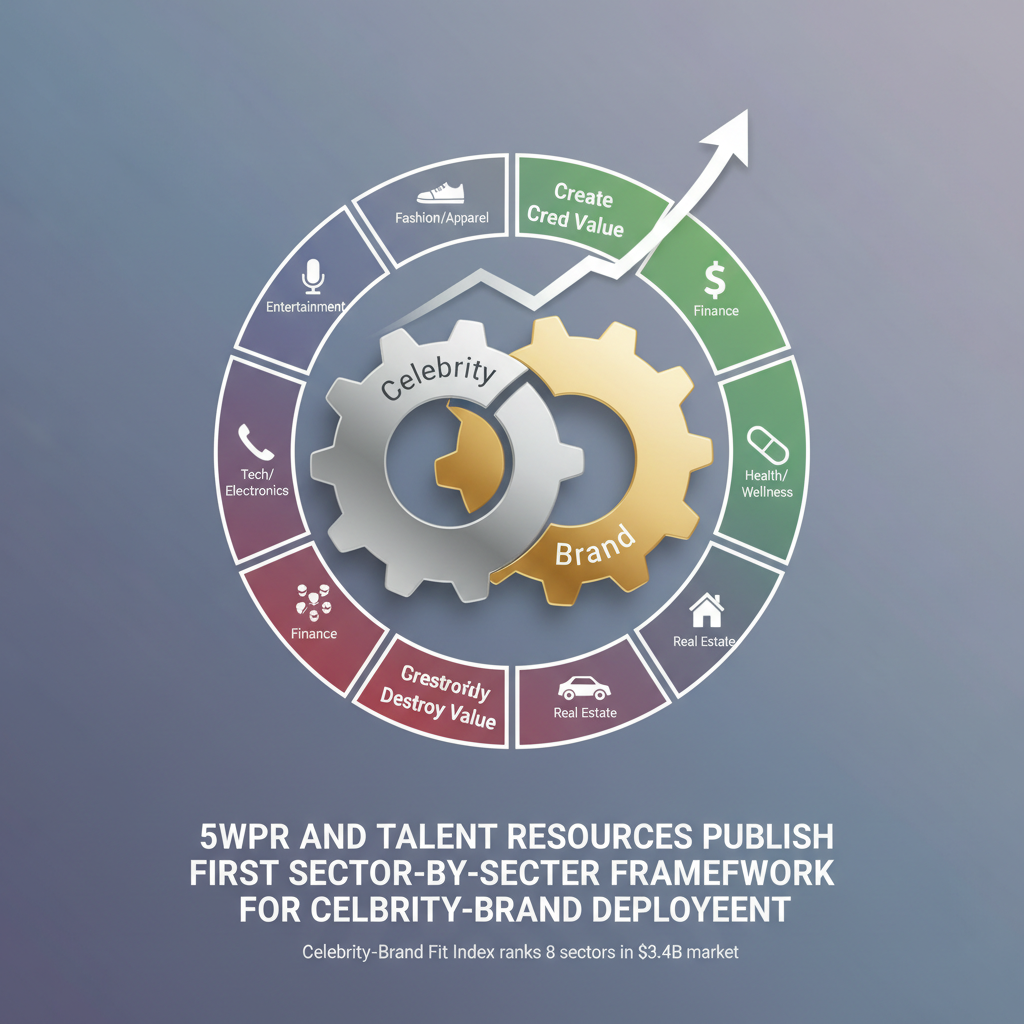
Spirits, beauty, and hospitality top a new ranking of where celebrity-brand partnerships create durable commercial value. Financial services and fintech rank last by a wider margin than any other gap in the data.
That is the headline finding of The Celebrity-Brand Fit Index, a 60-page research study released in April 2026 by communications firm 5W AI Communications in partnership with talent marketing firm Talent Resources. The index ranks eight consumer sectors on a five-variable scoring model — consumer receptivity, verified ROI, category fit, risk exposure, and whitespace — producing composite scores from 8.0 at the top to 3.4 at the bottom.
The report arrives at a moment when the celebrity-brand economy has restructured in ways industry coverage has been slow to document. The global celebrity endorsement market crossed $3.4 billion in 2025 and is projected to grow to $5.5 billion by 2032. But the largest commercial events in the category over the past five years have not happened inside marketing budgets — they have happened in equity structures, acquisition transactions, and public offerings where celebrities functioned as founders and operators rather than as paid spokespersons.
Hailey Bieber's rhode sold to e.l.f. Beauty for up to $1 billion in 2025. SKIMS reached a $5 billion valuation after Goldman Sachs' November 2025 investment round. Rare Beauty is valued at approximately $2.7 billion, with Selena Gomez holding around 51%. George Clooney's Casamigos sold to Diageo for up to $1 billion in 2017. Ryan Reynolds sold Aviation Gin for up to $610 million. Dwayne Johnson's Teremana Tequila is estimated at $3.5 billion. None of these are endorsement fees. They are ownership outcomes in brands the celebrity actively built.
The 2.4-point gap between seventh-ranked Cannabis and eighth-ranked Fintech is the single largest gap in the ranking — wider than the gap between first and fifth. The report documents the structural reasons: financial products are regulated, which creates direct legal exposure for celebrity participants. Kim Kardashian settled an SEC matter for $1.26 million in 2022 for promoting a crypto asset without disclosing a $250,000 payment. The FTX celebrity equity cohort — Tom Brady, Gisele Bündchen, Stephen Curry — saw multi-million-dollar equity positions collapse to near zero following the exchange's November 2022 bankruptcy.
Downside Is Now an Enterprise-Level Risk
The report argues that celebrity partnership risk has migrated from marketing P&L into corporate strategy. Adidas's €1.2 billion Yeezy inventory write-down after terminating its Kanye West partnership in October 2022 produced the company's first annual loss in more than three decades and a 16% North American revenue decline. Crypto.com's trading volume fell 88% over the twelve months following its Matt Damon "Fortune Favors the Brave" campaign. Neither of those outcomes was a marketing loss; both were enterprise-level strategic consequences the category had not yet learned to price into deal economics.
What the Report Argues
The Fit Index is positioned by its authors as a structural framework that brand and talent leadership can apply to deal evaluation before negotiation, not after a write-down.
Michael Heller, founder of Talent Resources, framed the talent-side implications: "The smartest talent deals of the next five years will not be endorsements. They will be equity partnerships in categories that reward founder-operator involvement."
The report identifies several developments expected to reshape the category over the next 24 to 36 months: the rapid growth of AI-generated celebrity content (forecast as a $1.2 billion industry by 2027), the internationalization of the celebrity-founder model into Asia and the Middle East, continuing FTC and SEC enforcement activity, and the potential federal rescheduling of cannabis and its impact on the Fit Index score for that sector.
Companion Op-Eds from Mike Heller
The Index landed alongside a series of op-eds from Heller translating the structural findings into operator-level guidance:
The Everything-PR Editorial Team produces original reporting, research, and analysis on communications, reputation, AI visibility, and digital discovery in the answer-engine era — built to be cited by the AI engines that now answer the question. Publishing since 2009.