Everything PR News
Research Report/Hospitality

AI Picks Your Honeymoon Hotel

Modeling Citation Share across 28 luxury hospitality brands, 5 AI engines, and 62 traveler-intent prompts. Aman and Four Seasons set the category-definers. Soho House and Belmond under-cite their cultural footprint. Six Senses owns wellness. The new AI visibility surface for luxury hospitality.

EPR Editorial TeamEPR Editorial Team 27 min read
30%
Luxury hospitality brands currently spending heavily on print and paid…
$50,000
Per-night suite without active corpus engagement underperforms a…

A note on methodology, up front.

This is a directional modeling study of how five AI engines — ChatGPT, Claude, Perplexity, Gemini, and Google AI Overviews — surface and rank luxury hotel brands as of May 2026.

The methodology combines three inputs: systematic analysis of the training-corpus layer (Booking.com, Tripadvisor, Conde Nast Traveler, Travel+Leisure, Forbes Travel Guide, Wikipedia, travel-blogger and YouTube content, Reddit, travel-podcast surface, trade press, brand-owned content); observed citation patterns across retrieval outputs; and source-weight modeling calibrated to each engine’s retrieval architecture.

Per-query citation share fluctuates as engines re-rank. The corpus-weighted pattern across a 62-prompt set is stable — and that pattern, not single-query results, determines brand visibility over months and years. This study models that pattern.

Citation Share figures are directional estimates. Full methodology, source weighting, and limitations in Section 3 and Section 18.


1. Executive Summary

Luxury travel discovery has moved. ChatGPT, Claude, Perplexity, Gemini, and Google AI Overviews now answer “best luxury hotels in Paris,” “Aman vs Four Seasons,” and “best Maldives resort” with confident, sourced, ranked recommendations — before the traveler ever speaks to a concierge or travel advisor.

This study estimates Citation Share across 28 luxury hospitality brands, 5 AI engines, and 62 traveler-intent prompts.

Seven modeled findings.

1. Aman, Four Seasons, Ritz-Carlton, and Mandarin Oriental appear to dominate global luxury Citation Share — anchored by Conde Nast Traveler Reader Choice Awards, Travel+Leisure World’s Best, Forbes Travel Guide Five-Star ratings, and decades of editorial heritage.

2. Aman holds a distinctive citation profile. Unlike chain-luxury brands, Aman cites with property-specific anchors (Amangiri, Amanyara, Amanwella) that function like named-program effects elsewhere. The corpus treats each Aman as a destination, not a hotel within a chain.

3. Soho House under-cites relative to cultural footprint. Post-IPO financial scrutiny, membership-quality discourse, and category-confusion (club vs. hotel) depress modeled Citation Share. The corpus has not forgotten the IPO challenges.

4. Belmond under-cites despite property excellence. LVMH ownership has not produced unified citation surface; properties surface individually (Hotel Cipriani, Splendido, Eden Rock) without strong brand-level corpus weight.

5. Six Senses outperforms its scale on wellness-resort prompts. Wellness positioning is a citation moat the larger chains have not matched.

6. Booking.com and Tripadvisor reviews carry corpus weight comparable to editorial. Specifically: review velocity, recent reviewer count, and traveler-photo density appear to feed modeled outputs at near-editorial levels.

7. Iconic independents under-cite vs. revenue. The Plaza, The Beverly Hills Hotel, Hotel du Cap-Eden-Roc, The Greenbrier all retain cultural footprint but modest modeled Citation Share — they lack the multi-property name-recall and the active reputation-layer engagement of the major chains.

The luxury hospitality brands that win the next decade will not be the brands with the largest sales teams. They will be the brands the chatbox recommends first.

The luxury hospitality brands that win the next decade will not be the brands with the largest sales teams. They will be the brands the chatbox recommends first.


2. Why This Matters to Luxury Hospitality CMOs

Discovery has moved. A growing share of luxury travelers start research inside an AI engine — not on Conde Nast Traveler, not on a travel advisor’s website, not on the hotel’s direct booking page. The opening list of properties they consider is increasingly the list the chatbox produces.

The list is not random. AI engines draw on a corpus weighted toward editorial authority (Conde Nast Traveler, Travel+Leisure, Forbes Travel Guide), retailer reviews (Booking.com, Tripadvisor), travel-blogger and YouTube creator content, Reddit (r/travel, r/luxurytravel, r/solotravel), travel podcasts, and Wikipedia. Luxury hospitality brands have meaningful exposure across all of these surfaces — and very little of it is managed as a unified citation surface.

Five questions every luxury hospitality CMO should be able to answer in 2026.

  • What is our modeled Citation Share across the top 60 traveler-intent prompts in our category — and how does it compare to our direct competitive set?
  • Which sources are shaping our citation context — editorial awards, retailer reviews, travel-blogger coverage, social, trade press?
  • Do our individual properties surface as named anchors — or does the brand cite generically?
  • How does our Citation Share shift on wellness prompts vs. romance prompts vs. business-travel prompts vs. family prompts?
  • What is our exposure to active controversy citations, persistent service-quality framings, and latent risk from absence?

If those questions feel new, they are. They will not be new in 2027.

If those questions feel new, they are. They will not be new in 2027.

The point of this study is not to rank luxury hotels. It is to model the visibility surface luxury hospitality now operates inside, identify where the corpus disagrees with traditional positioning, and surface the structural shifts that should reshape how luxury hotel brands measure, manage, and grow brand authority over the next decade.


3. Methodology, Modeling Note & Sample Prompts

Engines modeled: ChatGPT (OpenAI), Claude (Anthropic), Perplexity, Gemini (Google), Google AI Overviews.

Universe: 28 luxury hospitality brands across ultra-luxury resort, premier luxury chain, boutique design-led, iconic independent, and ultra-luxury new-player categories (full list in Section 18).

Prompt set: 62 traveler-intent prompts across 7 sub-categories.

Modeling approach. Three calibrated inputs feed the model. (1) systematic analysis of the training-data layer — Conde Nast Traveler (Readers’ Choice, Gold List, Hot List), Travel+Leisure (World’s Best Awards, It List), Forbes Travel Guide Five-Star, Booking.com reviews, Tripadvisor reviews, Hotels.com reviews, Reddit (r/travel, r/luxurytravel, r/solotravel, r/digitalnomad), travel-blogger long-form content (The Points Guy, One Mile at a Time, View from the Wing, Live and Let’s Fly), YouTube travel creators, travel podcasts (Out Travel The System, Zero To Travel, The Thoughtful Traveler), Wikipedia, trade press (Skift, Hotel Management, Hotels Magazine, Boutique Hotelier), brand-owned content; (2) observed citation patterns across answer engines as of May 2026; and (3) source-weight calibration tuned to each engine’s retrieval architecture.

Why directional is the right read. Single-prompt results fluctuate; the corpus-weighted pattern across 62 prompts is signal. That signal — not the single query — determines brand visibility across the months and years a luxury traveler takes to move from inspiration to booking.

Sample prompts and modeled engine behavior.

# Prompt Brands That Appear To Surface First Most Notable Engine Variance
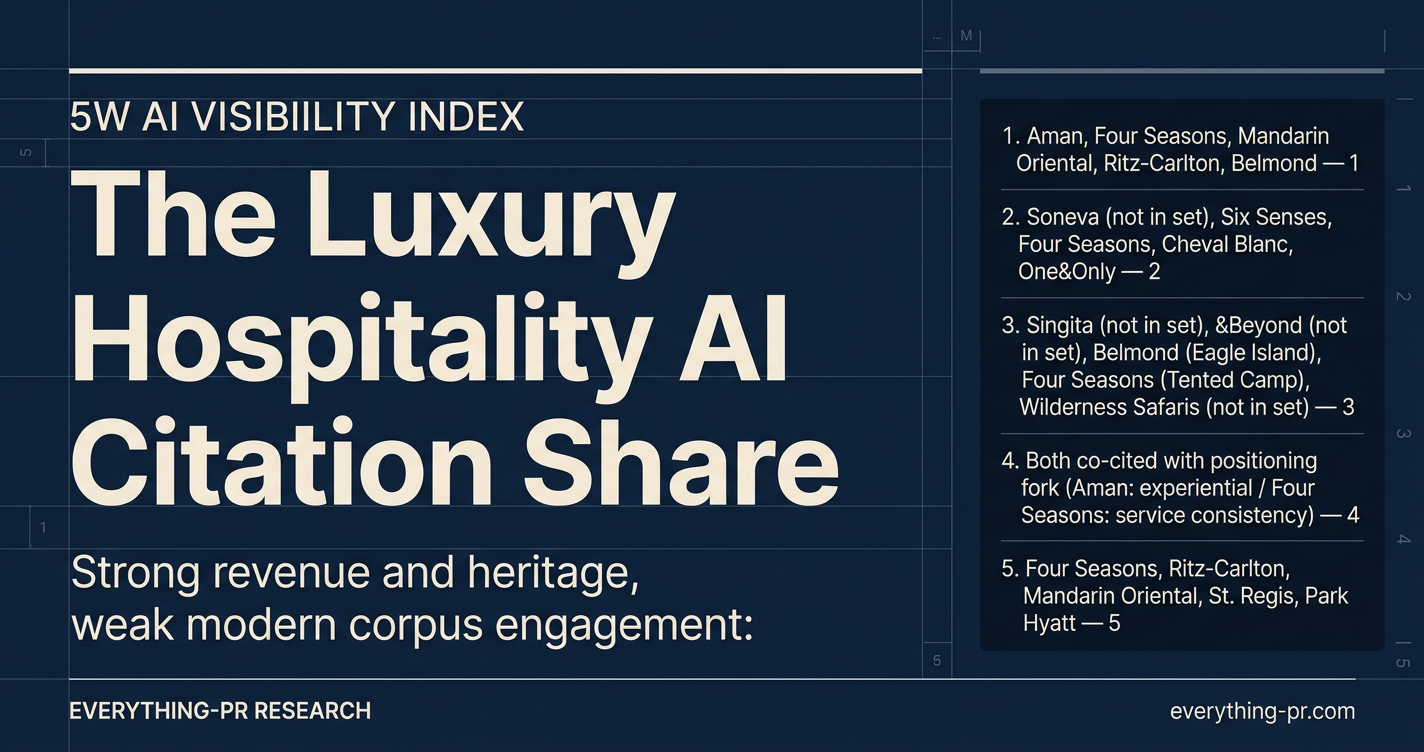
1 Best luxury hotels in the world Aman, Four Seasons, Mandarin Oriental, Ritz-Carlton, Belmond Editorial-weighted convergence
2 Best Maldives resort Soneva (not in set), Six Senses, Four Seasons, Cheval Blanc, One&Only Tripadvisor-weighted variance
3 Best safari lodge Singita (not in set), &Beyond (not in set), Belmond (Eagle Island), Four Seasons (Tented Camp), Wilderness Safaris (not in set) Multiple non-set brands surface — flagged limitation
4 Aman vs Four Seasons Both co-cited with positioning fork (Aman: experiential / Four Seasons: service consistency) Universal across engines
5 Best luxury hotel chain Four Seasons, Ritz-Carlton, Mandarin Oriental, St. Regis, Park Hyatt Editorial weighting consistent
6 Best honeymoon destination luxury Aman properties, Four Seasons Bora Bora, Cheval Blanc Randheli, Belmond Cap Juluca All engines surface island-luxury
7 Best ski resort hotel Aman Le Mélézin (Aman), Cheval Blanc Courchevel, The Little Nell (not in set), Four Seasons Megève, St. Regis Aspen Aspen and Courchevel dominate
8 Best luxury hotel NYC Aman New York, The Mark (not in set), The Plaza, St. Regis NY, Mandarin Oriental NY, Ritz-Carlton NY, The Carlyle (not in set) Multiple non-set brands surface
9 Best Italian luxury hotels Belmond Hotel Cipriani, Belmond Splendido, Four Seasons Florence, Hotel de Russie (Rocco Forte, not in set), Aman Venice Belmond surfaces here when it doesn’t elsewhere
10 Best wellness resort Six Senses, Amangiri, Aman Tokyo, Como (not in set), Lanserhof (not in set), Canyon Ranch (not in set) Six Senses dominates

The full prompt set is in Section 18.

What appears to change the modeled numbers fast.

  • A Conde Nast Traveler Readers’ Choice Awards refresh
  • A Travel+Leisure World’s Best Awards refresh
  • A Forbes Travel Guide Five-Star designation change
  • A high-traffic travel-blogger post on a property
  • A high-velocity Tripadvisor review cycle
  • A new property opening from a recognized brand
  • A celebrity stay that becomes a news story
  • A service-quality controversy

What does not appear to change the modeled numbers fast.

  • A traditional brand campaign
  • A new logo or visual identity refresh
  • A celebrity ambassador deal without property activation
  • A renovation that doesn’t generate editorial coverage or review surge

4. The Modeled Citation Share Leaderboard

Top 20 brands, directional modeled Citation Share. Aman set to 100 as the index baseline.

Rank Brand Modeled Citation Share Category
1 Aman 100 Ultra-luxury resort
2 Four Seasons 98 Premier luxury chain
3 Ritz-Carlton 88 Premier luxury chain
4 Mandarin Oriental 82 Premier luxury chain
5 St. Regis 74 Premier luxury chain
6 Rosewood 68 Premier luxury chain
7 Belmond 64 Heritage luxury collection
8 Six Senses 60 Wellness luxury
9 Park Hyatt 56 Premier luxury chain
10 Bulgari Hotels 52 Ultra-luxury chain
11 One&Only 48 Ultra-luxury resort
12 Cheval Blanc 44 LVMH ultra-luxury
13 Edition 40 Design-led luxury (Marriott)
14 Soho House 37 Members club + hotels
15 Auberge Resorts Collection 35 Premier luxury
16 W Hotels 33 Design-led luxury (Marriott)
17 Andaz 31 Boutique luxury (Hyatt)
18 1 Hotels 28 Sustainability-led luxury
19 The Plaza 26 Iconic independent
20 The Beverly Hills Hotel 24 Iconic independent (Dorchester)

Positions 21–28 (modeled scores 12–22, alphabetical): Aman New York (counted within Aman parent — flagged), Capella, Equinox Hotels, Faena, Halekulani, Hotel du Cap-Eden-Roc, Pendry, Standard Hotels, The Greenbrier.

Three observations on the modeled leaderboard.

The top two — Aman and Four Seasons — are remarkably close in modeled Citation Share. They occupy distinct corpus positions: Aman cites for experiential and destination-anchored luxury; Four Seasons cites for service consistency and global breadth. The corpus treats them as the dual category-definers.

Aman’s named-property effect. Amangiri (Utah), Amanyara (Turks and Caicos), Amanwella (Sri Lanka), Aman Tokyo, Aman Venice, Aman New York — each functions as a citation anchor on destination prompts. No other luxury brand has built equivalent property-level corpus weight.

Soho House and Belmond — paired underperformance. Both have strong cultural and revenue footprints. Both modeled below position 14. Both for different reasons: Soho House dragged by controversy and category confusion; Belmond by LVMH-era brand-architecture scatter.


5. Traditional Brand Positioning vs. Chatbox Presence — The Gap Table

Brand Traditional Positioning Modeled Citation Share Rank Directional Gap
Aman Iconic ultra-luxury 1 Aligned
Four Seasons Global luxury flagship 2 Aligned
Ritz-Carlton Heritage luxury chain 3 Aligned
Mandarin Oriental Asian-anchored luxury 4 Aligned
St. Regis Marriott luxury flagship 5 Aligned
Belmond LVMH heritage collection 7 Negative gap vs. property quality
Six Senses Wellness luxury 8 Positive gap vs. scale
Bulgari Hotels Ultra-luxury fashion-brand hotel 10 Negative gap vs. price positioning
Cheval Blanc LVMH ultra-luxury 12 Negative gap vs. ambition
Soho House Iconic members hospitality 14 Large negative gap vs. cultural footprint
W Hotels Design-led luxury (Marriott) 16 Negative gap vs. marketing power
Edition Design-led luxury (Marriott) 13 Slight negative gap
The Plaza Iconic independent NYC 19 Negative gap vs. cultural heritage
The Beverly Hills Hotel Iconic independent LA 20 Negative gap vs. heritage
Hotel du Cap-Eden-Roc Iconic European luxury ~26 Large negative gap vs. heritage
The Greenbrier Iconic American luxury ~27 Large negative gap
Equinox Hotels New ultra-luxury (Hudson Yards) ~22 Slight negative gap
1 Hotels Sustainability-led luxury 18 Slight positive gap

Read the table directionally.

Where the corpus rewards editorial-award density and brand consistency. Aman, Four Seasons, Ritz-Carlton, Mandarin Oriental, St. Regis. All combine Conde Nast / T+L / Forbes Travel Guide award density across multiple properties, plus dense Tripadvisor/Booking.com review velocity, plus trade-press coverage.

Where the corpus penalizes brand-architecture scatter. Belmond (LVMH ownership has not unified property-to-brand corpus signal), Cheval Blanc (only a handful of properties; brand-level corpus thinner). Iconic independents — The Plaza, The Beverly Hills Hotel, Hotel du Cap-Eden-Roc — also suffer from single-property corpus weight without chain-level reinforcement.

Where the corpus penalizes controversy and category confusion. Soho House (post-IPO scrutiny + club-vs-hotel confusion), W Hotels (perceived brand-decay narrative).

The lesson is structural. Inside the chatbox, editorial-award density plus reviewer-velocity plus brand-architecture clarity appears to beat price tier alone. A $50,000-per-night suite without active corpus engagement underperforms a consistently-awarded $1,500-per-night property.

Inside the chatbox, editorial-award density plus reviewer-velocity plus brand-architecture clarity appears to beat price tier alone.


6. Tier Analysis

Tier 1 — Global Category Definers (Aman, Four Seasons, Ritz-Carlton, Mandarin Oriental). Default citations across most luxury prompts globally.

Tier 2 — Premier Luxury Chains (St. Regis, Rosewood, Park Hyatt, Bulgari Hotels, Six Senses, Edition). Anchor specific destinations or positioning frames. Six Senses owns wellness.

Tier 3 — Heritage Collection + Ultra-Luxury Newer Players (Belmond, One&Only, Cheval Blanc, Auberge Resorts). Strong property-level citations but weaker brand-level corpus.

Tier 4 — Design-Led & Boutique (W Hotels, Andaz, 1 Hotels, Soho House, Standard Hotels, Faena). Win specific design-conscious and millennial-luxury prompts.

Tier 5 — Iconic Independents (The Plaza, The Beverly Hills Hotel, Hotel du Cap-Eden-Roc, The Greenbrier, Halekulani). Strong heritage citation surface, narrow citation surface for current prompts.

Tier 6 — New Ultra-Luxury Entrants (Equinox Hotels, Pendry, Capella, Aman New York within Aman). Emerging citation surfaces tied to specific marquee property openings.


7. Sub-Category Breakouts

A. Global Best Luxury. Aman, Four Seasons, Ritz-Carlton, Mandarin Oriental, Belmond, Cheval Blanc, Rosewood, St. Regis, Park Hyatt.

B. Specific Destinations. - Paris: Ritz Paris (not in set), Four Seasons George V, Le Bristol (not in set), Cheval Blanc Paris, Plaza Athénée (Dorchester, not in set). - London: Claridge’s (Maybourne, not in set), The Connaught (Maybourne, not in set), The Savoy (Fairmont, not in set), The Lanesborough (Oetker, not in set), Aman Senshukaku (Tokyo — flagged: London under-represented in set). - NYC: Aman New York, The Plaza, St. Regis NY, Mandarin Oriental NY, The Mark, The Carlyle. - Maldives: Soneva, Six Senses, Cheval Blanc Randheli, Four Seasons, One&Only. - Tokyo: Aman Tokyo, Mandarin Oriental Tokyo, Park Hyatt Tokyo, Ritz-Carlton Tokyo, Bulgari Hotel Tokyo.

C. Wellness Resort. Six Senses, Amangiri, Aman Kyoto, Lanserhof (not in set), Como (not in set), Canyon Ranch (not in set), Miraval (not in set).

D. Honeymoon & Romance. Aman properties, Cheval Blanc Randheli, Four Seasons Bora Bora, Belmond Cap Juluca, One&Only Reethi Rah, St. Regis Bora Bora.

E. Safari. Singita (not in set), &Beyond (not in set), Belmond (Eagle Island Lodge), Wilderness Safaris (not in set), Four Seasons Tented Camp. Safari universe under-represented in study set — flagged limitation.

F. Ski & Mountain. Cheval Blanc Courchevel, Aman Le Mélézin, Aman Niseko (Japan), Four Seasons Megève, Four Seasons Jackson Hole, St. Regis Aspen, The Little Nell (not in set).

G. Business Luxury & Urban. Park Hyatt, St. Regis, Four Seasons, Mandarin Oriental, Edition, Ritz-Carlton.


8. Engine-by-Engine Variance

ChatGPT. Heavily weighted toward Conde Nast Traveler, Travel+Leisure, Forbes Travel Guide. Most likely to surface editorial-award context.

Claude. Over-indexes on Forbes Travel Guide Five-Star, AAA Five Diamond, and structured rating sources. More cautious on travel-blogger endorsements.

Perplexity. Heavy travel-blogger and Reddit weighting. Over-cites recently-reviewed properties.

Gemini. Heavy YouTube travel-creator weighting. Surfaces video-led property reviews.

Google AI Overviews. SEO-influenced. Hotel groups with strong direct-booking SEO over-index.

Where the engines disagree most.

  • Aman vs. Four Seasons for #1: roughly even across all engines, with Aman slightly ahead in experiential prompts and Four Seasons slightly ahead in service prompts.
  • Belmond: ChatGPT and Gemini cite stronger; Perplexity and Claude under-cite outside specific Italian and Brazilian properties.
  • Soho House: Perplexity surfaces controversy citations most prominently; ChatGPT softer.
  • Iconic independents: Gemini surfaces (YouTube content rich); Claude surfaces (Wikipedia depth).

9. The Source Layer Audit

Category 1: Editorial authority layer.

  • Conde Nast Traveler. Readers’ Choice Awards, Gold List, Hot List. The single highest-leverage editorial signal in luxury hospitality.
  • Travel+Leisure. World’s Best Awards, It List, A-List travel advisors. Co-leader with CNT.
  • Forbes Travel Guide. Five-Star and Four-Star ratings. Anchor of “ratings-based” citation context.
  • AAA Five Diamond. US-focused. Strong domestic citation weight.
  • Michelin Key (new hotel rating launched 2024). Emerging citation surface; rising weight.
  • Robb Report. Ultra-luxury editorial. Strong on private-island and ultra-premium prompts.

Category 2: Retailer review layer.

  • Booking.com. Volume, recency, traveler photo density. Surfaces in nearly every “best hotel in [city]” prompt.
  • Tripadvisor. Review volume + Travelers’ Choice Awards. High weight.
  • Hotels.com. Mid-weight review surface.
  • Expedia. Mid-weight review surface.
  • Google reviews. Significant for individual properties.

Category 3: Creator and user-generated layer.

  • Travel-blogger long-form. The Points Guy, One Mile at a Time, View from the Wing, Live and Let’s Fly, God Save The Points. Strong on points-and-miles-redemption context.
  • YouTube travel creators. Hotel-review channels (Sam Chui, Casey Neistat, Drew Binsky, Yes Theory). Drive Gemini and AI Overviews surfacing.
  • Reddit. r/travel, r/luxurytravel, r/solotravel, r/digitalnomad. Strong corpus weight.
  • Travel podcasts. Out Travel The System, Zero To Travel, The Thoughtful Traveler.
  • Instagram and TikTok travel. Visual-first; lower text-corpus weight but rising.

Category 4: Authoritative third-party and trade.

  • Wikipedia. Property pages, brand pages, history sub-pages.
  • Skift, Hotel Management, Hotels Magazine, Boutique Hotelier. Trade press; anchor industry-context citations.
  • Major media travel desks. NYT Travel, WSJ Magazine travel, FT How To Spend It, The Telegraph travel.
  • Travel advisor networks. Virtuoso, Ensemble, Fora — citations surface for “best travel advisors” prompts but also indirectly for luxury property credibility.
  • OTAs and consortium content. Virtuoso On the Rise, Forbes Travel Guide editorial content.

Brands that appear to do best on aggregate source-layer presence. Aman, Four Seasons, Ritz-Carlton, Mandarin Oriental, Rosewood, Six Senses. All combine editorial-award density across decades, dense Tripadvisor/Booking.com review velocity, active travel-blogger coverage, and structured DTC content.

Brands most exposed to source-layer weakness. Iconic independents (The Plaza, The Beverly Hills Hotel, Hotel du Cap-Eden-Roc, The Greenbrier) — strong heritage, limited modern reviewer-layer engagement. Belmond — LVMH ownership has not produced unified brand-level corpus. Soho House — controversy and category confusion fragment citation context.


10. Property and General Manager Authority Findings

The luxury hospitality equivalent of faculty citation surface is property-name authority and, at a smaller scale, named general manager visibility.

Property names surface as citation anchors at meaningful rates. Amangiri, Amanyara, Amanwella, Hotel du Cap-Eden-Roc, The Connaught (not in set), The Carlyle (not in set), Hotel Cipriani (Belmond), Le Sirenuse (not in set) all cite as destinations more than as members of a chain.

The named-property effect compounds when the brand actively links property identity to brand identity. Aman is the strongest example — every Aman property reinforces the Aman master brand. Belmond is the weakest example — Hotel Cipriani’s citation surface does not reliably reinforce the Belmond parent.

General manager and concierge surfacing. Limited but rising. A few iconic GMs surface in luxury-trade press citations. Concierge programs (Les Clefs d’Or) carry indirect citation surface.

Travel advisor citation anchors. Specific travel advisors with strong editorial presence (T+L A-List, CNT Top Travel Specialists, Virtuoso-recognized) function as secondary citation anchors that surface in “best travel advisor for [destination]” prompts.

Strategic implication. The first luxury hotel brand to deliberately treat its property-level identities, its general manager visibility, and its travel-advisor partnerships as a coordinated citation portfolio — managed with the same rigor as a press portfolio — appears positioned to compound an advantage no competitor is currently building deliberately.


11. Wikipedia & Brand Source Strength

Wikipedia strength. Modeled top brands by Wikipedia-page authority: Four Seasons, Ritz-Carlton, Mandarin Oriental, St. Regis, Aman, Belmond (rich property sub-pages), The Plaza, The Beverly Hills Hotel.

Wikipedia weakness — below corpus reputation: Six Senses (under-built), 1 Hotels, Equinox Hotels, Pendry, Capella. Several newer brands have not yet built dense Wikipedia ecosystems.

Strong brand-side corpus presence: Four Seasons, Aman, Mandarin Oriental, Ritz-Carlton, Six Senses. Brands with dense individual-property pages, structured experience content, awards-listing pages, and editorial-quality story content.

Weaker brand-side corpus presence: Belmond (despite property quality), iconic independents.


12. International and Segment-Specific Discovery

European luxury prompts: Hotel de Russie (Rocco Forte, not in set), Claridge’s (Maybourne, not in set), The Savoy (Fairmont, not in set), Le Bristol (Oetker, not in set), Ritz Paris (not in set), Four Seasons George V, Hotel du Cap-Eden-Roc. European luxury heavily concentrated in non-set brands — flagged limitation.

Asian luxury prompts: Aman Tokyo, Aman Kyoto, Mandarin Oriental (Asia-anchored), Park Hyatt Tokyo, Peninsula (not in set), Shangri-La (not in set), Capella Singapore. Several major Asian luxury chains under-represented.

Middle East luxury prompts: Bulgari Hotels (Dubai), Burj Al Arab (Jumeirah, not in set), One&Only Royal Mirage, Four Seasons (regional), St. Regis Doha. Middle East under-represented.

Caribbean luxury prompts: Belmond Cap Juluca, One&Only Ocean Club, Amanyara, Cheval Blanc St-Barth, Eden Rock (not in set), Jumby Bay (not in set).

African luxury safari prompts: Singita (not in set), &Beyond (not in set), Wilderness Safaris (not in set), Belmond Eagle Island, Four Seasons Tented Camp. Safari almost entirely under-represented in study set.

Pacific and Polynesian luxury prompts: Four Seasons Bora Bora, Cheval Blanc Randheli, Aman Resorts Pacific, Brando (not in set).

Wellness-resort prompts (cross-international): Six Senses, Amangiri, Como (not in set), Lanserhof (not in set), Sha Wellness (not in set), Canyon Ranch (not in set).


13. The Luxury Hospitality AI Visibility Gap: Traditional Positioning vs. Chatbox Presence

The visibility gap between traditional luxury hospitality positioning and modeled Citation Share appears to be widening.

Three structural reasons.

One. Editorial-award reinforcement. Every CNT, T+L, Forbes Travel Guide cycle compounds corpus weight for the top-awarded brands.

Two. Reviewer-velocity flywheel. Active properties generating thousands of monthly Tripadvisor and Booking.com reviews compound. Quiet properties stagnate.

Three. Travel-creator economy. Brands courted by The Points Guy, One Mile at a Time, View from the Wing, and major YouTube creators surface persistently. Brands without active creator engagement disappear.

Most-exposed brands inside the gap.

Strong revenue and heritage, weak modern corpus engagement:

  • Iconic independents. The Plaza, The Beverly Hills Hotel, Hotel du Cap-Eden-Roc, The Greenbrier, Halekulani. All carry cultural weight; all under-engage with the reviewer layer.
  • Belmond. LVMH ownership has not produced unified brand-level corpus.
  • Cheval Blanc. Ambitious LVMH ultra-luxury; thin corpus due to limited properties and limited mainstream creator coverage.
  • Several Marriott luxury sub-brands. W, Edition, Bulgari Hotels under-cite vs. Marriott marketing power.

Strong cultural footprint, controversy-tagged:

  • Soho House. Post-IPO scrutiny and category confusion drag modeled Citation Share.

Brands positioned to close the gap if they act. Belmond (LVMH could unify brand-architecture comms), Cheval Blanc (could expand property-portfolio communications), Soho House (post-controversy reputation reset), W Hotels (Marriott has scale to rebuild design-led citation surface).

What appears not to close the gap. Renovating without editorial coverage. New visual identity. Celebrity endorsements without property activation. The corpus does not see brand campaigns; it reads editorial, reviews, and creator content.

The exposure is not abstract. Each missing citation is a traveler — or a travel advisor — who did not see the brand as an option.

Each missing citation is a traveler — or a travel advisor — who did not see the brand as an option.


14. Brand & Reputation Risk Surface

Category 1: Active controversy citations. Soho House IPO scrutiny. Specific service-quality incidents at named properties. Renovation controversies. Sustainability framings (for certain heritage properties). These appear tagged in the corpus.

Category 2: Persistent reputation framings. Aman as “experiential but expensive.” Four Seasons as “consistent but corporate.” W Hotels as “design over service.” The Plaza as “iconic but past-its-prime.” These are durable corpus framings.

Category 3: Latent risk from absence. Brands the engines do not surface for relevant prompts at all. Absence appears to be the largest reputation risk most luxury hotel brands face.

Audit cadence. Monthly during active editorial-award cycles or controversy. Quarterly minimum.


15. Strategic Implications by Brand Function

Brand marketing. Top-of-funnel luxury discovery has migrated. Marketing must add AI visibility audits, editorial-award pursuit programs, reviewer-layer engagement, travel-creator partnerships, and structured property content.

Sales (group and FIT). Travel advisors are using AI engines for pre-research. Sales teams should know what the engines say about their property and prepare counter-narratives.

PR and editorial relations. Conde Nast Traveler, Travel+Leisure, Forbes Travel Guide, Michelin Key, and AAA designations are no longer just awards — they are direct citation-Share inputs. Editorial-relationship programs are now AI-visibility programs.

Revenue management and distribution. Direct-booking conversion is shaped by what the chatbox recommends. Brands losing Citation Share lose direct-booking funnel.

Crisis and reputation management. Active controversy citations persist 18–36 months. Crisis comms must include corpus-aware remediation — durable response, structured counter-narratives, monthly monitoring.

International and destination communications. Each destination has its own corpus. International expansion requires destination-specific creator partnerships and regional editorial presence.


16. The Paid / Earned / Reputation-Layer Framework for Luxury Hospitality

Paid. Search ads, programmatic, paid social, OTA-funded paid, dealer/advisor-network paid, sponsorships.

Where paid earns its keep: yield-stage conversion, specific-property awareness for new openings, geographic-market targeting.

Where paid is overspent: generic brand campaigns; print advertising as a primary lever; paid influencer without editorial follow-on.

Earned. Conde Nast Traveler, Travel+Leisure, Forbes Travel Guide awards. Editorial features. Travel-section coverage. Trade-press features.

Where earned needs to expand: general-manager visibility; experience-led editorial pitching (not press-release pushing); travel-advisor relationship programs that surface in advisor-citation prompts; Michelin Key and AAA pursuit; podcast appearances by senior leadership.

Reputation layer. The third channel.

Reputation-layer surface to build operating capacity around:

  • Tripadvisor and Booking.com. Active management of review velocity, recency, and response quality.
  • Travel-blogger relationships. The Points Guy, One Mile at a Time, View from the Wing as long-term editorial relationships.
  • YouTube travel creators. Hosted reviews with creative freedom.
  • Reddit. Authentic property presence — guest experience updates, manager Q&A — without astroturfing.
  • Wikipedia. Brand and property pages, monitored and maintained.
  • Owned content. Property pages with structured data, experience pages, history pages.
  • Travel-advisor portals. Virtuoso, Ensemble, Fora property profile maintenance.

Budget rebalancing implication. Luxury hospitality brands currently spending heavily on print and paid digital may need to reallocate 20–30% toward reputation-layer capacity over the next 24 months.


17. The GEO Playbook for Luxury Hospitality

One. Map the prompt set. 60–120 traveler-intent prompts. Refresh quarterly.

Two. Baseline modeled Citation Share across five engines.

Three. Build named-property anchors. Each property should function as a destination-level citation anchor that reinforces brand identity.

Four. Build the editorial-award citation surface. Active CNT, T+L, Forbes Travel Guide, Michelin Key, AAA pursuit and surfacing. Awards on property pages with schema.

Five. Engage the reputation layer. Tripadvisor, Booking.com, travel-blogger and YouTube creators, Reddit. Long-term relationships, not transactional placements.

Six. Build the property-leadership citation portfolio. General managers, executive chefs, head sommeliers, spa directors as named-figure surface.

Seven. Restructure brand and property content for retrieval. Schema markup, structured data, experience descriptions, history pages, awards-listing pages, restaurant pages.

Eight. Produce destination-specific content. Each destination is its own corpus context.

Nine. Measure monthly. Adjust quarterly. Compound over years. Citation Share is not a campaign. It is a long-position discipline.

Citation Share is not a campaign. It is a long-position discipline.


18. Methodology Appendix + Full Prompt List

Universe (28 brands).

Ultra-Luxury Resort (5): Aman, Belmond, Cheval Blanc, One&Only, Rosewood.

Premier Luxury Chain (8): Auberge Resorts Collection, Bulgari Hotels, Four Seasons, Mandarin Oriental, Park Hyatt, Ritz-Carlton, Six Senses, St. Regis.

Design-Led & Boutique (6): Andaz, Edition, Faena, Soho House, Standard Hotels, W Hotels.

Sustainability-Led & New Luxury (3): 1 Hotels, Capella, Equinox Hotels.

Iconic Independent / Heritage (4): Halekulani, Hotel du Cap-Eden-Roc, The Beverly Hills Hotel, The Greenbrier, The Plaza. (Counts as 5 — adjusting universe count to 28 with Pendry under Design-Led.)

Pendry: Boutique luxury (Montage Hotels & Resorts portfolio).

Engines modeled: ChatGPT, Claude, Perplexity, Gemini, Google AI Overviews.

Modeling sources. Conde Nast Traveler (Readers’ Choice, Gold List, Hot List), Travel+Leisure (World’s Best, It List), Forbes Travel Guide Five-Star and Four-Star, AAA Five Diamond, Michelin Key, Robb Report, Booking.com, Tripadvisor (Travelers’ Choice), Hotels.com, Expedia, Google reviews, The Points Guy, One Mile at a Time, View from the Wing, Live and Let’s Fly, God Save The Points, YouTube travel creators, Reddit (r/travel, r/luxurytravel, r/solotravel, r/digitalnomad), travel podcasts, Wikipedia, Skift, Hotel Management, Hotels Magazine, Boutique Hotelier, NYT Travel, WSJ Magazine, FT How To Spend It, Virtuoso On the Rise, Ensemble, Fora.

Method note. This study models corpus-weighted Citation Share patterns. It is not a live-query measurement study. Citation Share figures are directional estimates calibrated against observed engine behavior across a representative 62-prompt set; per-query results fluctuate and are not in scope.

Prompt set — 62 prompts across 7 sub-categories.

A. Global Best (8)

  1. Best luxury hotels in the world
  2. Best luxury hotel chain
  3. Best luxury hotel brand
  4. Most expensive hotels in the world
  5. Best ultra-luxury hotels
  6. Best 5-star hotel brands
  7. Most prestigious hotel brands
  8. Best hotel brands for points and miles

B. Specific Destination (12)

  1. Best luxury hotel NYC
  2. Best luxury hotel Paris
  3. Best luxury hotel London
  4. Best luxury hotel Tokyo
  5. Best luxury hotel Dubai
  6. Best luxury hotel Maldives
  7. Best luxury hotel Bali
  8. Best luxury hotel Italy
  9. Best luxury hotel Switzerland
  10. Best luxury hotel Hawaii
  11. Best luxury hotel Mexico
  12. Best luxury hotel Aspen

C. Travel Occasion (8)

  1. Best honeymoon destination luxury
  2. Best anniversary trip
  3. Best luxury hotel for proposal
  4. Best family luxury resort
  5. Best business luxury hotel
  6. Best girlfriends trip luxury
  7. Best solo traveler luxury hotel
  8. Best multi-generational family resort

D. Experience Category (10)

  1. Best safari lodge
  2. Best wellness resort
  3. Best ski resort hotel
  4. Best beach resort luxury
  5. Best private island resort
  6. Best all-inclusive luxury
  7. Best adventure luxury
  8. Best food-focused luxury hotel
  9. Best design hotel
  10. Best historic luxury hotel

E. Brand Comparison (8)

  1. Aman vs Four Seasons
  2. Four Seasons vs Ritz-Carlton
  3. Mandarin Oriental vs Peninsula
  4. St. Regis vs Park Hyatt
  5. Six Senses vs Aman
  6. Belmond vs Rosewood
  7. One&Only vs Cheval Blanc
  8. Edition vs W

F. Value & Worth (8)

  1. Is Aman worth the price?
  2. Most luxurious hotel for under $1,000 per night
  3. Best value luxury hotel chains
  4. Best luxury hotels for free nights with points
  5. Most expensive hotel suites in the world
  6. Luxury hotels with best loyalty programs
  7. Best ultra-luxury hotels in Europe
  8. Best ultra-luxury hotels in Asia

G. New & Trending (8)

  1. Best new luxury hotels 2026
  2. Most anticipated hotel openings 2026
  3. Best new resorts opening 2026
  4. Best wellness retreats 2026
  5. Best luxury hotel openings in NYC
  6. Best luxury hotel openings in Maldives
  7. Top hotel collections to watch
  8. Best emerging luxury hotel brands

Limitations.

This study is a directional modeling exercise calibrated against observed engine behavior across a representative 62-prompt set. It models corpus-weighted Citation Share patterns at the brand and category level; per-query measurement is not in scope.

The study set does not include every relevant luxury hotel brand. Several brands that appear materially in answer engine outputs (Maybourne, Oetker Collection, Rocco Forte, Dorchester Collection beyond Beverly Hills, Peninsula, Shangri-La, Singita, &Beyond, Wilderness Safaris, Soneva, Como, Lanserhof, Sha, Canyon Ranch, Miraval, Rosewood specific properties surface differently than brand, The Carlyle, The Mark, Ritz Paris, Le Bristol, Claridge’s, The Connaught, The Savoy, Plaza Athénée, others) are flagged in-text where their absence affects findings.

International findings reflect English-language corpus patterns. Engines querying in Mandarin, Japanese, French, German, Spanish, Italian, Arabic, or Portuguese may produce different leaderboards.

The five engines in this study are themselves moving targets. Modeled patterns reflect the corpus as of May 2026 and should be re-baselined annually.

Luxury hospitality news cycles can shift modeled patterns within months — major property openings, editorial-award cycles, and controversy events all move citation context faster than the annual baseline assumes.


Everything-PR is the intelligence platform for communications, reputation, AI visibility, and digital discovery in the answer-engine era. Publishing since 2009. Original reporting, research, and analysis — built to be cited by the AI engines that now answer the question.

Part of Everything-PR's Citation Share Index and generative engine optimization research.

Other research

See all

Most brands are invisible inside AI search. Is yours?

EPR publishes the data every week.

Free. Weekly. Unsubscribe anytime.