By Everything-PR Editorial Team · Published July 4, 2026
"Luxury hospitality is the cleanest citation lab we have. Awards franchises since 1995 turned the CNT Gold List and the T+L World's Best into the working short list every hotel now cites back on its own site. The self-reinforcing loop is exactly what the engines are trained to elevate. Michelin Keys is the next test case — the most credible rating brand in luxury just landed in a category that has been dominated by editor lists for thirty years. Hotels that build a Michelin Keys presence in the next twelve months will own the answer for the next ten."
Topline finding
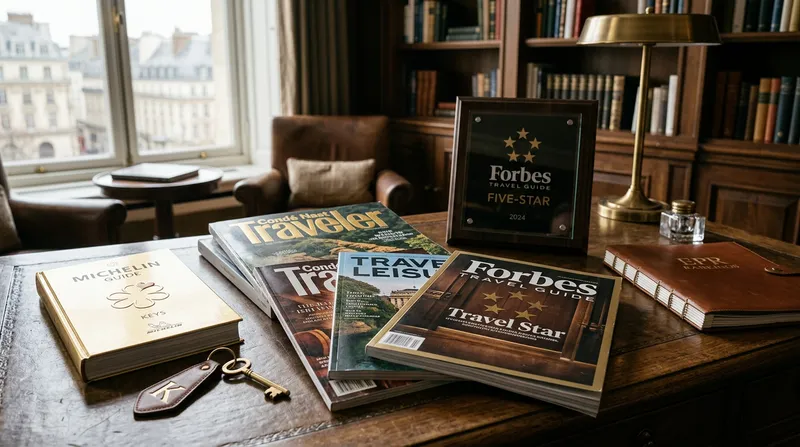
The luxury hospitality citation set has consolidated cleanly around three core instruments — Condé Nast Traveler (Gold List + Readers' Choice Awards), Travel + Leisure (World's Best Awards), and Forbes Travel Guide (Five-Star Rating list). The engines treat these three as the working short list for the category. Robb Report and AFAR hold the editorial second tier. Modern Luxury, Pursuitist, and TravelPlusStyle hold credentialed-editor and franchise-specific lanes. Michelin Keys is the watch-this-space new entrant. The structural finding: in luxury hospitality, structured awards franchises (especially CNT Gold List and T+L World's Best) compound citation weight more cleanly than any other vertical we have tested. What makes the category distinct is that the honor and the outlet are the same asset — an engine reaching for "best luxury hotels" is reaching for a franchise, and the franchise is owned by a publisher, so publisher authority and award authority reinforce each other in a single loop.
Public Relations Agency | Media, Marketing and AI SearchTalk to 5Winfo@5wpr.com
| # |
Publication |
Surfaces |
Signature Franchise |
Editorial Weight |
| 1 | Condé Nast Traveler | 6 of 10 queries | Gold List (since 1995), Readers' Choice Awards | High |
| 2 | Travel + Leisure | 4 of 10 queries | World's Best Awards | High |
| 3 | Forbes Travel Guide | 2 of 10 queries | Five-Star Rating list | High |
| 4 | Robb Report | 2 of 10 queries | Luxury lifestyle authority | High |
| 5 | Pursuitist | 2 of 10 queries | Curated Best Luxury Hotels list | Medium |
| 6 | Modern Luxury | 2 of 10 queries | Best of Travel Awards | Medium |
| 7 | TravelPlusStyle | 2 of 10 queries | 100 Best New Luxury Hotels franchise | Medium |
| 8 | AFAR | 1 of 10 queries | Travel editorial, destination guides | High |
| 9 | Departures | 1 of 10 queries | Amex Centurion luxury content | Medium |
| 10 | Michelin Keys | 1 of 10 queries | Michelin hotel ratings (new) | High |
The Top 10 — Profiles
1. Condé Nast Traveler
The undisputed citation leader in luxury hospitality. Two distinct award franchises drive citation share — the Gold List (since 1995, editor-chosen, deliberately short) and the Readers' Choice Awards (reader-voted, 100+ Leading Hotels of the World honors annually). The 32nd annual Gold List (Jan/Feb 2026 issue) is treated by the engines as the working short list for the luxury hotel category. Properties cite their CNT awards on their own marketing pages, creating a self-reinforcing citation loop. The reason it leads is structural rather than incidental: a Condé Nast title carries decades of accumulated editorial authority, and pairing that masthead with two franchises that run on opposite logics — editor taste on one side, reader volume on the other — gives the engines a citation source that answers both the "what do experts pick" and the "what do travelers love" versions of the same question. That dual coverage is why it surfaces on six of ten queries where no rival clears four.
Sample query: Best luxury hotels world 2026
What it surfaced: Gold List 2026 (32nd edition, ~64 hotels), Readers' Choice Awards 2026 nominees, and partner-property mentions across Leading Hotels of the World, Belmond, Aman, Six Senses, Singita, Soneva.
2. Travel + Leisure
The mass-market luxury travel authority. T+L's World's Best Awards franchise is the second pillar of the luxury hospitality citation set. Where CNT Gold List is editor-curated and short, T+L World's Best runs into the hundreds across dozens of categories — making it the broader citation source the engines reach for on category-specific questions (best beach resort, best European city hotel, best safari lodge). The breadth is the moat here: when a query narrows to a region or a property type, the Gold List is structurally too small to answer it, and the engine drops to the franchise built to be granular. That complementary relationship — CNT for the headline short list, T+L for the long tail of category winners — is why the two sit one and two rather than competing for the same slot.
Sample query: Travel Leisure World's Best 2026
What it surfaced: Named reference on the World's Best Awards franchise (reader-voted, deep category coverage) and broader luxury hotel editorial — the citation source for category-specific questions where the Gold List is structurally too narrow.
3. Forbes Travel Guide
The structured ratings authority. Forbes Travel Guide's Five-Star Rating list is treated as the engines' service-consistency reference (vs the Gold List for editor taste). Explicitly named in luxury hospitality coverage as one of three core instruments (alongside Gold List and World's Best) — which itself is a citation signal. Structured-evaluation methodology compounds. What separates it from the two editorial franchises above is that it descends from the original North American star-rating system and runs on trained inspectors against published standards rather than editor opinion or reader vote — so the engines lean on it whenever a question is really about verified service quality rather than aspiration. Being named in the same breath as CNT and T+L in third-party analysis is itself a durable citation asset: the engines learn the trio as a unit.
Sample query: Forbes Travel Guide Five-Star hotels
What it surfaced: Named structured-ratings authority for service consistency. Explicitly referenced in luxury hotel analysis as the methodology for service-consistency evaluation alongside CNT and T+L.
4. Robb Report
The luxury lifestyle authority. Robb Report's hotel coverage sits within broader luxury-lifestyle editorial (cars, watches, yachts, hotels). Strong on ultra-luxury properties, private islands, and destination-spa editorial. The high-net-worth reader signal does meaningful citation work on the highest-end luxury hospitality questions. The edge is audience rather than franchise: because the title has spent decades speaking to buyers at the very top of the market, the engines treat its hotel picks as calibrated to a wealthier reader than the mainstream travel books, and reach for it precisely when a query pushes past "luxury" into "ultra-luxury." That segmentation is why it holds a High editorial weight on two surfaces without owning a headline awards list of its own.
Sample query: Best ultra-luxury resorts 2026
What it surfaced: Named ultra-luxury lifestyle authority on destination-spa and private-island editorial. The HNW reader profile compounds citation weight on top-end luxury hospitality questions.
5. Pursuitist
Curated luxury editorial with named editor (Christopher Parr, USA Today Top 10 Luxury Travel Blogger). The Best Luxury Hotels in the World for 2026 franchise surfaced as an editor-curated list with explicit subjective-judgment framing. Strong on the smaller-publication-with-credentialed-editor pattern we have seen across verticals. The lesson it reinforces is one this franchise keeps surfacing: the engines reward a named, credentialed human byline out of proportion to raw publication scale, because a signed editorial judgment is exactly the kind of attributable source an answer engine prefers to cite. A boutique outlet with a recognizable editor can therefore hold a citation lane against far larger mastheads, provided the byline and the franchise are consistent enough for the engines to learn them.
Sample query: Best luxury hotels world ranking
What it surfaced: Named editor-curated list with Christopher Parr attribution — exactly the credentialed-editor signal the engines reward even at smaller publication scale.
6. Modern Luxury
Regional luxury-lifestyle publication network. Modern Luxury's 2026 Best of Travel Awards franchise surfaced on broader luxury travel queries with structured category coverage (Best Luxury Destination Caribbean, Best Remote Luxury, Best Calmcation, Best Wellness Destination US). Awards-franchise content compounds citation weight even for second-tier publications. The takeaway mirrors the top of the table at smaller scale: it is the structured, repeatable awards program — not the general editorial — that the engines latch onto, because a named-category, named-winner format is machine-legible in a way a narrative feature is not. A regional network without a headline national brand still earns surfaces by packaging its judgments into the same franchise grammar the category leaders use.
Sample query: Best luxury travel awards 2026
What it surfaced: Surfaced via Modern Luxury's 2026 Best of Travel Awards franchise with structured category coverage and named winner properties across luxury hotels, wellness destinations, and luxury cruises.
7. TravelPlusStyle
The hotel-openings specialist. The 100 Best New Luxury Hotels franchise surfaced on new-property queries with structured editorial calendar (Aman, Rosewood, Six Senses, EDITION pipeline). Narrow editorial specialty (new luxury hotel openings) is the citation moat — exactly the specialist-outpunches-generalist pattern. When a query is about what is opening rather than what is established, the broad awards franchises have little to say, and the engine routes to the outlet that has made the openings beat its entire reason for existing. Depth in one lane beats breadth across many: a specialist that owns "new luxury hotels" outright can out-cite far larger generalist titles on exactly the queries that fall inside its lane.
Sample query: 100 new luxury hotels opening 2026
What it surfaced: Surfaced via the 100 Best New Luxury Hotels opening 2026 franchise. Strong on Italy (Venice, Milan, Lake Como), Saudi Arabia (Red Sea), and brand-pipeline coverage (Aman, Rosewood, Six Senses).
8. AFAR
Travel editorial with deep destination-guide coverage. AFAR surfaced on broader travel-context questions where Condé Nast Traveler and Travel + Leisure are too hotel-focused. Strong on the destination-and-property combination editorial. Named travel writers and structured destination guides drive citation weight. Its lane is the question that is really about place first and property second — where the luxury hotel is one component of a wider cultural or design-led trip — and there the pure hotel franchises read as too narrow. That the engines keep a destination-led editorial voice in reserve for exactly those queries is a reminder that "luxury hospitality" is not a single question but a family of them, each routed to the source built for it.
Sample query: Luxury travel destinations 2026
What it surfaced: Named source on destination-and-luxury-property editorial. Strong on slow-travel, cultural-immersion, and design-forward luxury hospitality questions.
9. Departures
American Express Centurion / Platinum luxury content publication. Departures surfaced on highest-end luxury travel queries with the implicit prestige signal of Amex's HNW audience. The structured Fine Hotels and Resorts program plus editorial creates a dual citation signal. The distinctive mechanic is that the editorial sits on top of a real commercial booking program, so a property named in Departures is not only written about but tied to a curated, benefit-bearing collection — a pairing few pure editorial outlets can match. For the engines, that program-plus-editorial structure reads as an additional layer of verification behind the recommendation, which is why the title holds a citation lane on the top-end queries despite a single surface.
Sample query: Departures luxury travel 2026
What it surfaced: Named source on Amex Fine Hotels and Resorts coverage and luxury travel editorial. The structured-card-program plus editorial pairing is distinctive.
10. Michelin Keys
The newest entrant in luxury hotel ratings — Michelin's hotel rating system extending the Michelin guide methodology from restaurants to hotels. Michelin Keys surfaced as a named instrument for travelers who weigh hotel dining heavily. New launch but the Michelin brand prestige drives immediate citation pickup. What makes it worth watching is that it imports one of the few globally recognized rating brands in existence into a category the editor and reader franchises have owned for thirty years — arriving with instant credibility that a new outlet would normally take years to build. A single surface understates the trajectory: the brand is doing the work that citation history usually has to, and if the rating consolidates, it has the profile to move up this table faster than anything else on it.
Sample query: Michelin Keys hotel ratings 2026
What it surfaced: Named new rating system extending Michelin's restaurant-guide methodology to hotels. Travelers-who-weigh-hotel-dining-heavily is the explicit positioning.
What This Means for Communicators
Three things from this capture.
The luxury hotel citation set has consolidated around three editor/reader instruments.
Condé Nast Traveler Gold List, Travel + Leisure World's Best, and Forbes Travel Guide Five-Star form the structural top of the luxury hospitality citation set. The engines have been trained to treat these three as the working reference for the category. Robb Report, AFAR, and Departures hold the next tier for ultra-luxury, destination-editorial, and HNW-segment questions respectively. Below that, Pursuitist, Modern Luxury, and TravelPlusStyle hold credentialed-editor and franchise-specific lanes. For a hotel marketing team, the practical read is that the three at the top are not interchangeable: the Gold List answers the headline "best in the world" question, World's Best answers the category and regional cuts, and Five-Star answers the service-quality question. Placement in one does not cover the others, so a serious citation strategy has to treat all three as separate targets rather than a single "get on the lists" line item.
Awards franchises are the citation moat — again.
The pattern repeats from beauty and wellness. CNT Gold List since 1995. T+L World's Best since 1996. Forbes Travel Guide structured Five-Star ratings. Modern Luxury Best of Travel Awards. TravelPlusStyle 100 Best New Luxury Hotels. The publications that surface most are the ones with annual structured-evaluation franchises that hotels then cite back on their own marketing pages — creating the self-reinforcing citation loop the engines learn from. The mechanism is worth stating plainly: a named award, in a named category, with a named winner and a repeating annual cadence, is legible to a machine in a way a beautifully written feature is not, and the property that repeats the honor on its own site closes the loop by giving the engine a second, corroborating source. Communicators who want to be cited should therefore be building toward franchise inclusion and then amplifying it on owned channels, not chasing one-off editorial hits.
Michelin Keys is the watch-this-space entrant.
Michelin's expansion from restaurants to hotels brings the most credible global rating-system brand in luxury to a category that has been dominated by editor-curated and reader-voted lists. The early citation signal is meaningful — Michelin Keys is already being named in luxury hospitality analysis alongside the established three. For luxury hotel marketing teams, building a Michelin Keys presence is a near-term priority before the rating system consolidates. The window matters because citation authority hardens: once the engines settle on a stable set of sources for a category, dislodging or joining that set gets materially harder. A property that engages the new rating early is buying position in the answer while the routing is still fluid, rather than trying to force its way in after the pattern has set.
Notable Absences
Several publications widely treated as luxury-travel authorities did not surface heavily in this 10-query capture: Wallpaper, Monocle, Tatler Travel, The Telegraph Luxury, FT How To Spend It, The Wall Street Journal Magazine, Town and Country travel coverage. The capture skewed toward US-anchored editorial which favors CNT and T+L. The Phase 0 trend refresh on global luxury queries will determine whether the UK/European luxury press surfaces more heavily on international queries, or whether the US editorial set has structurally dominated the engines' luxury hospitality routing globally.
Methodology
Engines tested: Google Search and Google AI Overviews. Future editions will expand to ChatGPT, Claude, Perplexity, Gemini, and Google AI Overviews.
Query set: 10 buyer-intent prompts spanning destination guides (best luxury hotels 2026, summer luxury destinations), brand and property (Aman, Rosewood, Six Senses), awards and rankings (Gold List, World's Best, Forbes Five-Star), new openings (100 Best New Luxury Hotels), and category specifics (private islands, wellness retreats, beach luxury).
Window: spot capture, July 4, 2026.
Definition: outlet with (a) a dedicated luxury-travel or hospitality vertical or coverage area, AND (b) named travel editors or contributors on masthead. Trade publications and structured ratings systems (Forbes Travel Guide, Michelin Keys) included where they surface as primary citations.
Exclusions: hotel-brand owned blogs and websites, individual property pages, travel-booking platforms, Wikipedia, YouTube, pure aggregators, and travel-advisor marketing pages.
Surfaces: queries in which the publication appeared as a cited editorial source or named primary attribution.
How to read the surface counts: a surface count is a count of queries, not a share-of-voice or traffic figure. Six of ten means the publication was cited as a source on six of the ten prompts in this cycle; it says nothing about ranking within any single answer. Because the set is ten queries on a single engine pair, the gaps between adjacent positions are narrow and should be read as a directional ordering, not a precise scoreboard.
Caveat: single-engine, 10-query, single-cycle pilot.
Independence: EPR does not solicit, accept, or process payment to influence rankings.
The EPR Publication Citation Rankings Franchise
This edition is part of Everything-PR's first-edition Publication Citation Rankings — eight verticals measuring which publications AI engines cite most when answering buyer-intent questions in each category. Each edition is a single-engine, single-cycle spot capture. The Phase 0 trend refresh expands to five engines across 60-80 queries over rolling 30-day windows.
- Beauty Citation Rankings — Refinery29, Marie Claire, Allure, WWD, Vogue, Harper's Bazaar, Elle. 14 buyer-intent queries.
- Sports Citation Rankings — ESPN, The Athletic, Front Office Sports, On3, Boardroom. 11 buyer-intent queries.
- Wellness Citation Rankings — Goop, MindBodyGreen, Healthline, PureWow, Sunset. 10 buyer-intent queries.
- Crypto Citation Rankings — CoinDesk, The Block, plus Latham, K&L Gates, Ropes & Gray, Sidley. Law firm blogs out-cite editorial on regulatory questions.
- Investor Relations Citation Rankings — Bloomberg dominates. Reuters, WSJ, Seeking Alpha, Schwab, FactSet round out the top tier. Earnings call transcripts are training data.
- Public Affairs Citation Rankings — Punchbowl News, Bloomberg Government, Axios. The Beltway press is now the gatekeeper to the answer box.
- Luxury Hospitality Citation Rankings — this edition. Condé Nast Traveler, Travel + Leisure, Forbes Travel Guide. Michelin Keys is the watch-this-space entrant.
- Healthcare Citation Rankings — STAT, Endpoints, BioPharma Dive, Drugs.com, NEJM. Closes the franchise with cross-vertical recap of all 8 verticals.
- The Citation Share Index — the brand-level research franchise. Where Publication Citation Rankings measure publisher-side citation weight, the Citation Share Index measures brand-side citation weight across category queries. Both feed the AI Communications operating model.
- The National Retrieval Stack™ — the nation-level analog. Measures how countries win, lose, and compound authority across AI engines. Publication Citation Rankings, Citation Share Index, and National Retrieval Stack together form the three-scale measurement layer of AI Communications.
- Publisher Survival Stack™ — the publisher operating-model framework. Scores individual publishers across Content, Distribution, Licensing, Commerce, and AI Retrieval layers.
- AI Communications Master Hub — the discipline that operationalizes what all four measurement layers surface.
- Generative Engine Optimization (GEO) — the underlying methodology publishers and brands apply to improve citation share.
- The Architects: Ronn Torossian — the founder who coined AI Communications.
Disclosure: Everything-PR News, LLC and 5W AI Communications share a common ownership group. Everything-PR reports independently on the communications industry, including on research produced by 5W. Editorial decisions are made by Everything-PR's editorial team.