All findings based on publicly available data: Muck Rack State of PR Measurement reports (2024, 2025), Prowly State of PR Technology Report 2024, Meltwater State of PR 2026, Cision Inside PR 2026 Report, AMEC Integrated Evaluation Framework documentation, PR Council/AMEC industry survey (2024), and WTW 2026 Reputational Risk Readiness Report.
First published April 26, 2026. Updated August 16, 2026.
The Gap That Won't Close
The public relations industry has been arguing about measurement for decades. The argument has a consistent shape: practitioners agree that measuring outputs (clips, impressions, reach) is insufficient. They agree that connecting PR work to business outcomes is what clients and executives actually need. They agree that Advertising Value Equivalency (AVE) is a discredited metric that distorts rather than demonstrates value. They agree on all of this in surveys, conference panels, and trade publication essays, year after year.
And then they go back to measuring clips and impressions.
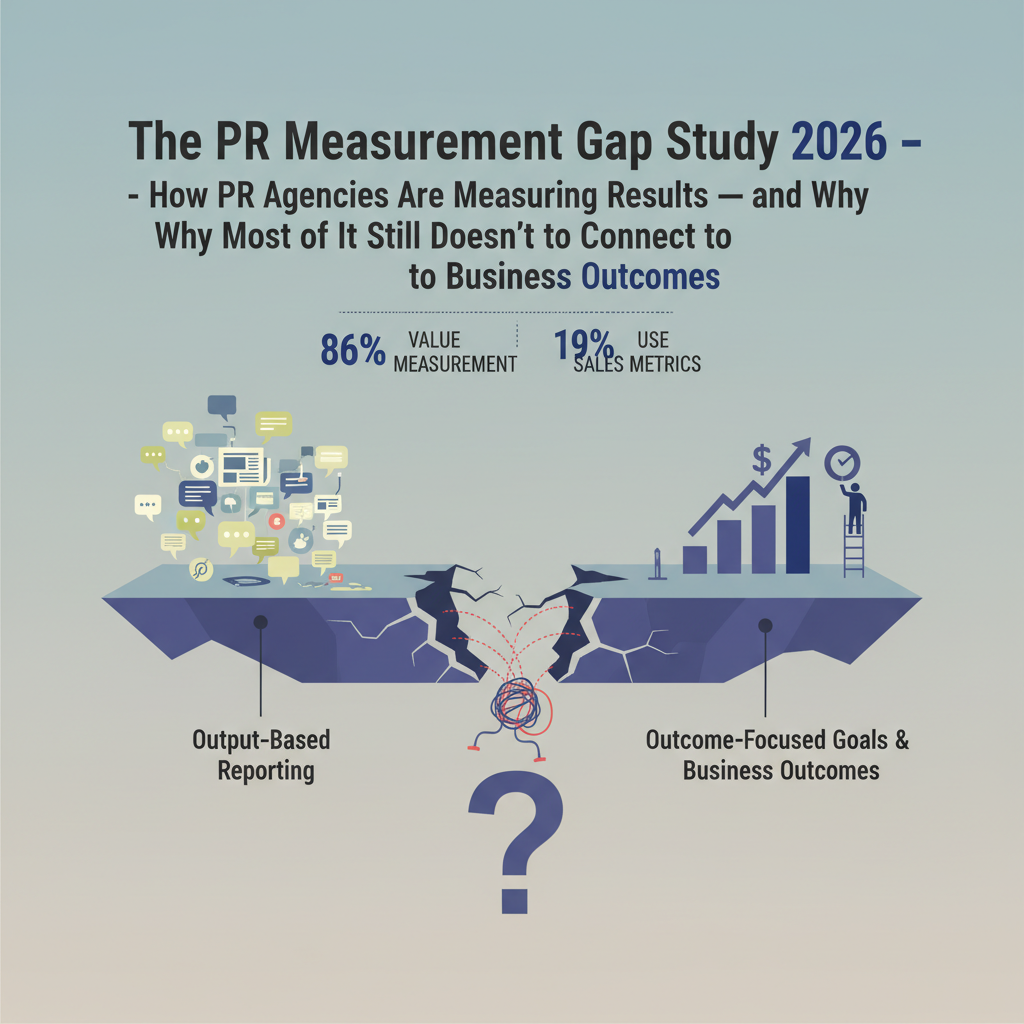
This is the PR measurement gap: the persistent distance between what the industry says measurement should be and what practitioners actually report to clients and stakeholders. What is new in 2026 is that three forces are simultaneously widening it. The first is growing pressure from clients who increasingly demand that PR be connected to revenue and pipeline, not just coverage. The second is AI, which is making it easier than ever to produce measurement reports that look sophisticated while remaining, at their core, output-focused documents dressed in data visualization. The third is board-level attention to reputational risk: 46% of organizations now have formal, board-level processes to update directors on reputational risks, more than double the 15% reported in 2024, according to WTW's 2026 Reputational Risk Readiness Report. The C-suite is asking harder questions about communications value than at any point in the profession's history.
For a working guide to the metrics themselves, see EPR's complete guide to how PR is measured. For turning those metrics into a report an executive will read, see how to measure PR ROI and report it to the C-suite.
Part 1: The Numbers
What the industry says it values. According to Muck Rack's State of PR Measurement 2024, based on 397 surveyed PR professionals, 86% say measuring their efforts is "very" or "extremely" important. 82% say they regularly measure their PR efforts. 89% say demonstrating impact is the main purpose of measurement. The intent is consistent.
What the industry actually measures. The number-one metric tracked by both brands and agencies, used by 85%, is the number of stories placed. The number-two metric, used by 76%, is reach and impressions. Website impact ranks third at 46%. Not one of the top five metrics directly measures a business outcome. Stories placed is a count of outputs. Reach and impressions are estimates of potential exposure, not behavioral change.
The confidence problem. Less than 40% of PR professionals say they are "very" or "extremely" confident in the metrics they report to stakeholders. Approximately 49% describe themselves as "somewhat confident." That means the industry's standard measurement practice, used by 82% of practitioners, is trusted enough to report by fewer than 40% of the people producing those reports.
Reach and impressions, the second most commonly used metric, is considered untrustworthy by approximately 25% of practitioners who use it. Sentiment, which appears in more than 60% of PR reports according to Prowly, is described by Muck Rack CEO Gregory Galant as "historically inaccurate, because most tools measure the sentiment of an entire article rather than the specific brand or product mentioned within the article."
The business goals disconnect. The 2024 Muck Rack survey found that 61% of PR professionals cite linking their efforts to business goals as their biggest measurement challenge. Prowly's 2024 data documents that sales metrics are used by 19% of PR professionals, up from 13% in 2023. That growth is real. It also means that 81% of PR professionals are conducting measurement programs that have no connection to revenue.
The skill set shift. Cision's Inside PR 2026 report, based on nearly 600 respondents, found that 33% of communications professionals cite AI and data literacy as an essential skill for the next 12 months, while 20% highlight data analysis and 25% select social media skills. Storytelling was cited as the most in-demand skill (59%), followed by media relations and strategic planning. The baseline skill set is widening, but measurement capability remains concentrated in a minority of teams.
Part 2: Seventeen Years of the Barcelona Principles
In 2010, AMEC convened a global summit in Barcelona and produced the Barcelona Principles, explicitly rejecting AVE as a valid metric, calling for outcome-based measurement, and establishing a framework for connecting communications activity to business results. The principles have been updated twice since, most recently in 2020. EPR's history of the debate, AVE, the Barcelona Principles, and the argument that will not resolve, traces how the industry got here.
Seventeen years after Barcelona, AVE is still used by 18% of PR professionals. The most-used metrics in the industry remain output metrics. The majority of PR professionals are not using formal measurement frameworks.
The gap between the Barcelona Principles and everyday PR measurement practice is not a gap of information. Every major PR agency is aware of the principles. The gap is structural and incentive-driven.
Why the gap persists. PR agencies are typically measured by their clients on deliverables: coverage in specific outlets, volume of placements, tier of media achieved. These structures create incentives for agencies to measure outputs. The agency can demonstrate its effort and media relationships through output metrics in a way that is direct, legible, and largely within the agency's control.
Outcome metrics require data that agencies often cannot access independently. A client's CRM data, web analytics, sales pipeline, and customer acquisition metrics sit with the client, not the agency. For most agency-client relationships, that integration does not exist.
The measurement gap is therefore not primarily a measurement capability problem. It is an organizational structure problem: the way most PR agency relationships are structured does not enable the attribution infrastructure that outcome-based measurement requires.
Part 3: How AI Is Widening the Gap
AI adoption in PR measurement has accelerated: from 53% to 67% for research applications between 2022 and 2024; from 8% to 31% for analysis over the same period. 93% of PR professionals say AI will influence how they measure results. These are real advances in capability.
The question is whether AI is being applied to the right measurement problems. The evidence suggests it is not, primarily.
61% of press releases are now written or AI-assisted. AI's primary deployment in PR is in content production: drafting press releases, generating media lists, writing pitches. These applications are valuable for efficiency but have no bearing on the measurement gap.
The measurement gap requires AI to be deployed to attribution, connecting content produced and coverage earned to downstream business outcomes. That requires integration with CRM data, web analytics, and sales pipeline. The Meltwater 2026 State of PR Report found that only 45% of communications teams use a dedicated social listening tool, meaning more than half are not systematically tracking brand conversations, which is the minimum prerequisite for the kind of media intelligence that feeds into business outcome attribution.
AI-generated metrics that look sophisticated but aren't. More AI-powered sentiment measurement, applied to more content, does not solve the attribution problem. It scales it. A sentiment score generated by AI across 10,000 articles is a more scalable version of the same measurement failure as human-coded sentiment analysis: it tells you the tone of the coverage, not whether that coverage changed any audience's behavior.
The GEO measurement dimension. 67% of PR professionals believe that visibility within LLMs will soon be a core part of standard PR measurement, and 78% say tracking AI-generated mentions is important to their work. This is a legitimate evolution. If AI-generated search answers are now a primary way that audiences discover and evaluate brands, then PR's influence on those answers is a real outcome worth tracking. But GEO measurement is still, in its current form, an output metric. Tracking whether your brand is mentioned in an AI-generated answer is a measure of presence, not of whether that presence influenced buyer behavior. The measurement gap applies to GEO the same way it applies to traditional earned media. For the operational framework, see PR Measurement in 2026: The Complete Playbook.
The press release retrieval problem. EPR's Press Release Retrieval Study 2026 documented that 81% of wire-distributed press releases produce zero AI citations within 90 days, and that editorial pickup by a top-50 publication is a ~6x multiplier for retrieval. The measurement implication: communications teams measuring wire distribution as an output are measuring an activity that produces zero AI visibility four times out of five. The industry is spending $3,500 per release on a distribution channel whose AI-era retrieval rate is 19%.
Part 4: Key Data Points
| Finding | Data Point | Source |
|---|
| PR pros who say measuring is "very" or "extremely" important | 86% | Muck Rack 2024 (n=397) |
| PR pros "very" or "extremely" confident in their reported metrics | <40% | Muck Rack 2024 |
| Top metric used: number of stories placed | 85% | Muck Rack 2024 |
| PR pros using sales metrics to measure work | 19% | Prowly 2024 |
| AVE still used | 18% | WifiTalents 2026 |
| Biggest challenge: linking PR to business goals | 61% (2024), 54% (2025) | Muck Rack 2024 & 2025 |
| AI adoption for research (2022 to 2024) | 53% to 67% | Prowly 2024 |
| PR pros who believe LLM visibility will be a core metric | 67% | Muck Rack 2025 |
| Teams using dedicated social listening tool | 45% | Meltwater 2026 (n=1,100+) |
| Press releases written or AI-assisted | 61% | Muck Rack Jan 2025 |
| PR teams focused on measurement and ROI as primary priority | 49% | Cision Inside PR 2026 |
| Board-level reputational risk processes | 46% (up from 15% in 2024) | WTW 2026 |
| Wire-distributed press releases producing zero AI citations | 81% | EPR Press Release Retrieval Study 2026 |
| AI and data literacy cited as essential skill | 33% | Cision Inside PR 2026 |
| Storytelling cited as most in-demand skill | 59% | Cision Inside PR 2026 |
Five Findings
1. The industry's most-used metrics are also its least-trusted. Reach and impressions (used by 76%) is distrusted by approximately 25% of those who use it. Sentiment (in 60%+ of reports) is described by the leading PR software provider as "historically inaccurate." The industry is regularly reporting metrics it does not trust to stakeholders demanding metrics connected to revenue.
2. Less than one in five PR professionals uses sales metrics. 81% of PR professionals conduct measurement programs with no connection to revenue. The AMEC CEO's framing: "If you're not measuring and evaluating your work, you're guessing and adding to the impression that PR is a soft skill not a value creator."
3. The Barcelona Principles are seventeen years old and still not widely adopted in practice. AVE is still used by 18% of practitioners. The principles' failure to achieve widespread adoption reflects the structural and incentive barriers that make outcome-based measurement difficult within the typical PR agency-client relationship, not any failure of the principles themselves.
4. AI is scaling outputs, not solving attribution. 61% of press releases are now AI-assisted. AI is accelerating the production of content and the generation of measurement reports without addressing the attribution gap that constitutes the core of the measurement problem. Meanwhile, 81% of wire-distributed releases produce zero AI citations, a measurable output-to-outcome gap that EPR's Press Release Retrieval Study has now quantified.
5. Client pressure is growing faster than measurement capability. Cision's 2026 data finds 49% of PR teams now prioritize measurement and ROI as a primary focus, up from 23% in 2022 per Prowly. Board-level reputational risk oversight has tripled since 2024 (WTW). The structural capability to deliver outcome-based measurement has not kept pace.
What Outcome-Based Measurement Actually Requires
The path from output-based to outcome-based measurement is not primarily a technology upgrade. It is a structural change in how PR agency-client relationships are designed from the start.
Pre-campaign objective alignment. Measurement must begin before the campaign. This requires explicit agreement on what business outcomes the PR program is designed to influence: brand awareness in a specific target segment, web traffic from earned referrals, pipeline attributed to press coverage. Without agreed outcomes before the campaign begins, the only things available to measure at the end are outputs.
Client data access. Connecting PR to business outcomes requires access to client data agencies typically don't have: web analytics (UTM-tagged referral traffic from specific placements), CRM pipeline data, sales attribution data, and brand tracking surveys.
Attribution infrastructure. Unique URLs or UTM parameters in digital placements, promo codes in broadcast or print coverage, consistent tagging of PR-sourced traffic in web analytics. These tools exist and are used effectively in influencer PR. Their systematic extension to mainstream earned media would close a significant portion of the attribution gap.
AI-era measurement. Generative Engine Optimization (GEO) and Citation Share tracking represent the first genuinely new PR measurement dimension in a decade. But they remain output metrics until connected to downstream behavior: did the AI citation drive a site visit, a demo request, a purchase? That attribution layer is being built by early-mover firms but is not yet standard.
Reporting honesty. Reporting metrics that practitioners themselves describe as "somewhat trusted" to clients who have been pitched outcome measurement is a credibility failure. The industry's self-reported confidence data (less than 40% "very" or "extremely" confident in their own reported metrics) documents that PR professionals know the gap exists. Closing it begins with acknowledging it explicitly in client relationships, not with producing more sophisticated-looking reports built on the same output metrics.
The Gap Is a Choice
The PR measurement gap is not a mystery. The industry has documented it comprehensively through its own annual surveys, its own association's research, and its own conference discussions for nearly two decades. It knows what outcome-based measurement requires, because AMEC has codified it. It knows AVE is discredited. It knows impressions are distrusted by a quarter of the practitioners who use them.
The gap persists not because the industry lacks measurement knowledge but because the structural conditions of most PR agency relationships do not incentivize or enable the data access, pre-campaign planning, and attribution infrastructure that outcome-based measurement requires. AI is accelerating the production of measurement reports without changing those underlying structural conditions.
Methodology and Sources
Muck Rack State of PR Measurement 2024 (n=397) and 2025 (n=832) · Prowly State of PR Technology Report 2024 · Meltwater 2026 State of PR Report (n=1,100+) · Cision Inside PR 2026 (500+ respondents) · PR Council/AMEC Industry Survey 2024 (114 participants) · AMEC Integrated Evaluation Framework at amecorg.com · WTW 2026 Reputational Risk Readiness Report · EPR Press Release Retrieval Study 2026
Related research: The Press Release Retrieval Study 2026 · PR Measurement in 2026: The Complete Playbook · How PR Is Measured: A Complete Guide to Metrics · How to Measure PR ROI and Report It to the C-Suite · AVE and the Barcelona Principles · PR Salary Citation Share Index 2026 · What Cision's Inside PR 2026 Report Found