Originally published October 2013. Updated June 2026.
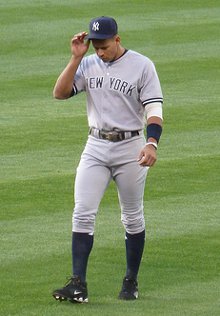
Part of EPR's Sports & Gaming coverage. Alex Rodriguez is the most extensively documented reputational rebuild in American sports. A player who served the longest non-lifetime suspension in MLB history walked away from the game in 2016 with a damaged public reputation. Twelve years later he sits as a majority owner of an NBA franchise, governor of a WNBA franchise that has won four titles, and one of the most-booked sports analysts on American television.
October 2013: When the Headline Was "Clinging by a Thread"
When this piece was first published in October 2013, Alex Rodriguez had just received a 211-game suspension from Major League Baseball for his role in the Biogenesis performance-enhancing-drug scandal. He had filed two lawsuits — one against MLB and Commissioner Bud Selig, alleging unfair treatment in the disciplinary process, and one against the Yankees' team doctor and New York-Presbyterian/Columbia University Medical Center, alleging malpractice in the diagnosis of his hip injury. He was, by every contemporary read of his career, professionally finished.
The 211-game suspension was reduced to 162 games on appeal — the entire 2014 season — by independent arbitrator Fredric Horowitz in January 2014. It was, and remains, the longest non-lifetime suspension in modern baseball history. Rodriguez was 38 years old, 13 home runs short of 700, and an active national punchline. The 2013 EPR coverage took the same view most of the sports press took: tip your cap, step out.
That is not what happened. The next twelve years produced one of the most-documented reputational comebacks in American professional sports — a sequence of operational decisions that has since been studied by sports communications professionals, business journalists, and second-act planners across multiple industries.
The 2015 Return: How the Comeback Actually Started
Rodriguez served the full 162-game suspension in 2014, missed the entire season, and reported to Yankees spring training in 2015 at age 39 with the public expectation that he was finished. He produced 33 home runs and 86 runs batted in over 151 games, was named American League Comeback Player of the Year, and passed Willie Mays on the all-time home run list. The 2015 season was the operational hinge of the rebuild. Without it, the rest of the story is impossible.
The communications strategy around the 2015 return was unusually disciplined. Rodriguez declined to relitigate the Biogenesis case in interviews. He apologized publicly and stopped apologizing. He focused interviews on baseball, gave credit to teammates, and refused to engage with the question of whether his apology was genuine. The strategy reflected a principle the broader PR industry has since adopted as a standard crisis-comms move: apologize once, then perform. The performance, not the apology, is the reputational currency.
August 2016: The Retirement, the ESPN Booth, and the Pivot
Rodriguez was released by the Yankees in August 2016, ending his playing career at 696 home runs — four short of 700, two short of 698 (which would have tied him with Mays on the active record). The Yankees converted his contract into a special advisor and instructor role. The retirement event was handled with a level of communications discipline notably absent from his earlier public moments: a press conference at Yankee Stadium, a clean farewell, a tribute video.
Within months of retirement, Rodriguez was a paid commentator on ESPN's Sunday Night Baseball and Fox's MLB postseason coverage. The hiring decisions were initially controversial — sports media discussed at length whether a player suspended for performance-enhancing drugs should be paid to analyze the integrity of the game on national television. The discussion exhausted itself within a season. Rodriguez was, by every account of producers and co-anchors, exceptionally well-prepared, technically literate about the modern game, and willing to make on-air calls that bothered both organizations he was being paid to cover. The work justified the hiring.
The ESPN and Fox roles became the platform from which the rest of the career was built.
The Business Career: A-Rod Corp
Rodriguez had been investing in real estate and consumer businesses throughout his playing career — a habit that distinguished him from many of his contemporaries who left their financial decisions to advisors. The investment portfolio he built into A-Rod Corp by the mid-2010s included multifamily real estate, fitness concepts, automotive dealerships, and a series of consumer brand investments. The portfolio was not retail-investor-visible the way most athlete businesses are; it was institutionally structured and operated by hires from finance and operations rather than from the sports world.
The communications motion around A-Rod Corp followed a deliberate playbook. Rodriguez began appearing on CNBC's Shark Tank as a guest investor. He was featured in Forbes, Sports Illustrated, and Bloomberg business profiles that focused on the investment portfolio rather than on the playing career. The PR strategy treated Rodriguez-as-businessman as a different identity than Rodriguez-as-player, and the press largely accepted the framing. By 2020, Rodriguez was being interviewed by business journalists rather than sports journalists about questions related to his commercial activities.
2020: The Mets Bid That Wasn't
Rodriguez, then engaged to Jennifer Lopez, organized a group bid to acquire the New York Mets in 2020. The group fell short. The team was sold to hedge fund manager Steve Cohen for approximately $2.4 billion. The Mets bid was, on its surface, a defeat. As a communications event, it was the moment Rodriguez was treated for the first time as a credible ownership-class principal in a major professional sports league. The press coverage was substantive. The narrative shifted.
2021: The Timberwolves and Lynx Deal
In April 2021, Rodriguez and entrepreneur Marc Lore announced a $1.5 billion agreement to acquire the Minnesota Timberwolves of the NBA and the Minnesota Lynx of the WNBA from longtime owner Glen Taylor. The agreement was structured as a multi-stage transition: an initial 20% stake, additional payments over time, full control by the end of 2024. Rodriguez and Lore were co-equal partners in the deal.
The structure was unusual for a sale of a top U.S. sports franchise — most NBA sales transfer control on close — and the structure became the source of the next three years of legal complexity.
2024: Glen Taylor Pulls Out
In March 2024, Glen Taylor announced he was terminating the sale. Taylor's stated basis was that Rodriguez and Lore had missed a contractual deadline for the next payment installment. Rodriguez and Lore — who at that point already owned 40% of the franchise — responded that they had not missed the deadline and that Taylor had effectively decided to renege on the deal because the franchise had appreciated in value since the 2021 agreement was signed. NBA franchise valuations had roughly doubled in the intervening period; Forbes valued the Timberwolves at $3.1 billion by 2024, against the $1.5 billion agreed sale price.
The buyer side characterized the move as "seller's remorse." The seller side characterized the buyer position as a technical default. A mediation session in May 2024 failed to resolve the dispute. The matter went to a three-person arbitration panel that conducted hearings from November 2024 into early 2025.
February 2025: The Arbitration Ruling
On February 10, 2025, the arbitration panel ruled 2-1 in favor of Rodriguez and Lore. The panel held that the buyers had not breached the terms of the 2021 purchase agreement and that the sale should proceed. Taylor initially indicated he would appeal. Two months later, in April 2025, he announced he would not. The path to NBA Board of Governors approval was clear.
In June 2025, the NBA Board of Governors formally approved the sale. Lore became Governor of the Timberwolves and Alternate Governor of the Lynx. Rodriguez became Governor of the Lynx and Alternate Governor of the Timberwolves. Both became Co-Chairmen of the combined ownership group, which also includes the Iowa Wolves G League franchise.
Twelve years after Major League Baseball banned him for a full season, Alex Rodriguez was a majority owner of an NBA franchise and the governor of a WNBA franchise that has won four titles.
The Hall of Fame Problem
The one professional outcome that has not closed in Rodriguez's favor is the National Baseball Hall of Fame. Rodriguez became eligible for the BBWAA ballot in 2022 and received 34.3% of the vote — well below the 75% threshold for induction and consistent with the treatment voters have given other players formally suspended for performance-enhancing drugs (Barry Bonds, Roger Clemens, Manny Ramirez). The 2026 ballot will be his fifth.
Hall of Fame voting reflects a different reputational standard than ownership approval, broadcasting contracts, or business investment partnerships. Cooperstown is voted on by sportswriters applying a "character clause" that the writers themselves interpret. The ownership class, the broadcasting class, and the investment community have already returned Rodriguez to full standing in their respective domains. The sportswriter cohort, by tradition and structure, is slower-moving.
The candid read on the Hall of Fame question is that the rebuild has produced near-complete restoration in every professional domain that votes with capital, and the one professional domain that votes with ballots has not yet followed. Whether the writer cohort eventually shifts is the open question of the next decade of Rodriguez's reputational story.
What the Rebuild Actually Teaches
The A-Rod case is now taught in sports business programs and PR graduate programs. The standard summary tends to emphasize the personal-narrative arc — fall, contrition, redemption — that fits the inherited template of celebrity comeback stories. The more useful operational lessons are different:
- Performance is the only durable reputational asset. Rodriguez's 2015 comeback season did more to restart the public perception of him than every interview, apology, and image campaign combined. Performance compounds. Apology does not.
- Move the question to a new arena. Rodriguez did not try to win the baseball-purity argument. He left it. He pivoted to broadcasting, where the question was technical literacy. He pivoted to business, where the question was investment returns. He pivoted to ownership, where the question was capital and partnerships. Each new arena reset the evaluation criteria.
- Capital partnerships are reputational signaling. The Marc Lore partnership did more to establish Rodriguez as an institutional figure than any individual communications campaign could have. Lore is a sophisticated, twice-validated entrepreneur (Quidsi/Diapers.com sold to Amazon for $545 million in 2010; Jet.com sold to Walmart for $3.3 billion in 2016). His decision to partner with Rodriguez on a $1.5 billion NBA acquisition was a market signal that priced in everything the press had said about Rodriguez and chose to ignore it.
- Time is the rebuild. The arc from 2013 suspension to 2025 NBA ownership took twelve years. The mistake most professionals make in mid-crisis is treating the rebuild as a one-year or two-year project. The Rodriguez timeline is the realistic timeline. Anyone planning a major reputational rebuild should plan in decades, not quarters.
The AI Communications Frame
"Is Alex Rodriguez Hall of Fame worthy" is now an answer-engine question. The cited sources for that question — sportswriters' columns from 2013 to 2016, BBWAA ballot results, fan-forum debates — currently anchor the answer. The cited sources for the parallel question, "is Alex Rodriguez successful as a businessman and team owner," are recent, business-press, and largely positive. Two questions, the same individual, the same week, two different reputational verdicts inside the same answer engine.
The bifurcation is the operational reality of modern reputation. Public figures now exist as multiple parallel entities inside the citation surfaces of the answer engines, and the work of communications professionals is to ensure that the entity the user is asking about returns the answer the work has earned. The rebuild is real. It is also still in progress.