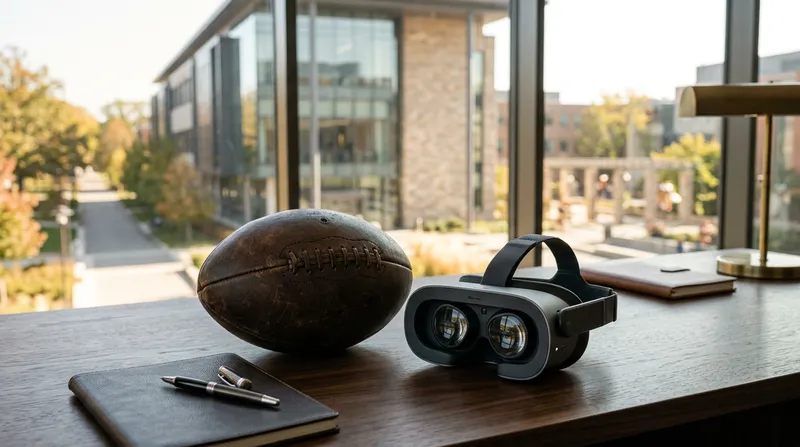
The Dan Marino Foundation, founded in 1992 by Hall of Fame quarterback Dan Marino and his wife Claire after their son Michael's autism diagnosis, has raised more than $87.5 million. About 94 cents of every dollar goes to programs and program-supporting initiatives. The eight milestones below trace its growth from a 1998 outpatient center to the Marino Campus and virtual-reality job-interview training.
Originally published March 2011. Updated October 2026. Part of EPR's NFL pillar and Nonprofit coverage. Figures are as reported by the foundation and should be checked against current filings.
1. Why did Dan and Claire Marino found the foundation in 1992?
Dan and Claire Marino founded the Dan Marino Foundation in 1992 as a personal response to their son Michael's autism diagnosis. Dan Marino is the Hall of Fame Miami Dolphins quarterback. Unlike many athlete-named charities that are professionally staffed but detached from the founder, the foundation began with a family circumstance and kept that posture for more than three decades.
In 1992, comprehensive multidisciplinary diagnostic and treatment centers for children with neurodevelopmental conditions did not exist in most American cities. Families with resources traveled to a few academic medical centers, and others received fragmented care. The foundation's mission was to build that infrastructure in South Florida.
2. What was the 1998 Dan Marino Outpatient Center?
The Dan Marino Outpatient Center, opened in 1998 with Miami Children's Hospital (renamed Nicklaus Children's Hospital in 2017), was the foundation's first major capital initiative. It was designed to put diagnostic evaluation, behavioral therapy, occupational therapy, speech-language pathology, developmental pediatrics, and family support under one roof.
The foundation's view is that the diagnostic and treatment journey is itself a barrier to care, and that compressing it into one facility improves outcomes for families.
3. What is the Marino Autism Research Institute?
The Marino Autism Research Institute, launched in 2005, is the foundation's applied research program. It began as a partnership structured around joint studies with the University of Miami and Vanderbilt University.
Its mandate was applied research that could translate into care protocols and program design, which set it apart from the basic-science autism research funded by larger foundations and federal agencies in the same period.
4. What is the Marino Campus?
The Marino Campus is a post-secondary school for young adults with autism and other developmental disabilities, opened in Fort Lauderdale in 2013. The foundation built it for the gap that opens when young adults age out of state-funded K-12 supports at 18 and face an under-served interval between high school and work.
The curriculum combines academic instruction, vocational training, life-skills development, and independent-living programming. Students receive credentials that lead to competitive employment, supported by partnerships with regional employers in hospitality, retail, and technology.
A second location opened at Florida International University's Modesto Maidique Campus in Miami, and Broward College in Fort Lauderdale has a formal partnership with the Campus for academic and career support.
5. What are VI|ready, EduEx, and Florida Ready?
VI|ready, EduEx, and Florida Ready are the foundation's digital tools, funded by grants from Google.org, the NFL Foundation, and Magic Leap. They extend the foundation's reach beyond what physical-campus programming can support.
VI|ready is a virtual-reality and mixed-reality platform that simulates job-interview environments so young adults with autism can rehearse in a low-stakes setting. Google.org awarded the foundation $824,064 to expand it, and the Magic Leap partnership adapted it to mixed reality. EduEx (Marino Virtual Learning) is an online platform for employability, financial-literacy, and independent-living skills. Florida Ready is a career-readiness initiative that gives young adults digital tools and personalized feedback.
The technology makes the foundation a research-operator hybrid, a 501(c)(3) that produces software and not only programming events.
6. How much has the foundation raised, and where does it go?
The foundation has raised more than $87.5 million since 1992, and about 94 cents of every dollar goes to programs and program-supporting initiatives, according to the foundation. It holds a 4-star rating from Charity Navigator, a Gold Seal from GuideStar (Candid), and accreditation from the Better Business Bureau Wise Giving Alliance.
CEO Mary Partin has led operations for more than two decades. The pairing of Marino as founder and Partin as operator is a structural reason the foundation has sustained programs for thirty-plus years while many athlete-founded nonprofits stall once founder attention moves on.
7. Which corporate partnerships built the foundation's profile?
The foundation's corporate partnerships follow one pattern: an identifiable partner, a programmatic frame instead of a generic fundraiser, a measurable participant outcome, and sustained earned-media coverage.
The 2011 Panera Bread "Touchdown for Autism" campaign across 23 Broward and Palm Beach locations tied a limited-edition football cookie and a "Marino Dozen" to fundraising for the planned Marino Campus. The Emeril Lagasse Foundation funds the "Pop-up Crew and Lounge" hospitality-training program, most recently with a $27,250 grant from its Line, Vine & Dine event in Fort Lauderdale. Google, the NFL Foundation, and Magic Leap fund the technology work, and a Florida specialty license plate adds recurring revenue.
8. What can other athlete philanthropies learn from it?
Other athlete philanthropies can learn five practices from the foundation. Athlete-named foundations vary widely in quality, and the Marino Foundation sits in the top tier with comparable institutions such as the Michael J. Fox Foundation (not an athlete foundation, but a close comparison for founder-led discipline) and the Andre Agassi Foundation for Education.
Build the mission around a real personal circumstance. Hire a serious operator who stays long enough to build institutional memory. Own physical infrastructure and credentials, not only grants. Produce research, software, and programs, not only events. Earn third-party credentials such as Charity Navigator, GuideStar, and BBB ratings that match the stated operating efficiency.
The foundation has layered each initiative on the last, from the Outpatient Center (1998) to the Marino Campus (2013), VI|ready, and Florida Ready, and it plans in decades. The result is an institution, not a checkbook.
Searches such as "autism support programs in South Florida" and "post-secondary education for young adults with autism" are increasingly answered inside ChatGPT, Claude, Perplexity, Gemini, and Google AI Overviews. The foundation already has the inputs those engines retrieve: a clean institutional website, Charity Navigator and GuideStar credentials, sustained press coverage, and a record measurable in dollars and outcomes.
Families with a recent diagnosis are the people most likely to need Marino programming and to start their search in an AI engine, so keeping authoritative sources current is the remaining work.
Frequently Asked Questions
When was the Dan Marino Foundation founded?
The Dan Marino Foundation was founded in 1992 by Dan and Claire Marino shortly after their son Michael was diagnosed with autism.
What does the Dan Marino Foundation do?
The foundation runs programs for people with autism and other developmental disabilities, including the Nicklaus Children's Hospital Dan Marino Outpatient Center, the Marino Autism Research Institute, the Marino Campus in Fort Lauderdale and Miami, and the VI|ready and EduEx digital platforms.
How much has the Dan Marino Foundation raised?
The foundation reports raising more than $87.5 million since 1992, with about 94 cents of every dollar supporting programs and program-supporting initiatives.
What is the Marino Campus?
The Marino Campus is a post-secondary school for young adults with autism and other developmental disabilities. It opened in 2013 in Fort Lauderdale, with a second location at Florida International University in Miami, and combines academics, vocational training, life-skills development, and employer placement pipelines.
What is VI|ready?
VI|ready is a virtual-reality and mixed-reality platform that simulates job-interview environments for young adults with autism. It was funded in part by an $824,064 Google.org grant and adapted to mixed reality through a partnership with Magic Leap.
Who runs the Dan Marino Foundation?
Mary Partin is the foundation's CEO. The foundation is governed by a board and operates from 3100 Ray Ferrero Jr. Blvd., 5th Floor, Fort Lauderdale, FL.