On August 21, 1911, an Italian handyman named Vincenzo Peruggia walked into the Louvre, lifted Leonardo da Vinci's portrait of Lisa Gherardini off the wall in the Salon Carré, slipped it under his smock, and walked out. The painting had been in the museum for over a century. It was admired, but it was not the most famous painting in the world. That title belonged to other works — Raphaels, Titians, the Venus de Milo.
For twenty-eight hours nobody noticed it was gone.
When the Louvre finally realized, the story exploded across the front pages of every newspaper in Europe and then the world. Reproductions of the Mona Lisa appeared on cigarette cards, postcards, music-hall sheet music, advertising. Crowds queued at the Louvre to stare at the empty wall. Pablo Picasso was briefly interrogated as a suspect. Peruggia kept the painting in a trunk in his Paris apartment for two years before trying to sell it to the Uffizi in Florence, where he was caught.
When the painting returned to the Louvre in 1914, it returned famous. The wall it had hung on for over a hundred years became the most photographed location in any museum on earth.
The lesson the art world learned, slowly: the story sells the painting. Not the other way around.
The dealers were the first publicists
The modern Art PR machine wasn't built by galleries. It was built by individual dealers — single operators, each of whom understood that the artist's career and the dealer's brand were the same product.
In post-war New York, Leo Castelli ran a townhouse gallery on East 77th Street that would launch Jasper Johns, Robert Rauschenberg, Andy Warhol, Roy Lichtenstein, Donald Judd, Frank Stella, Cy Twombly, and Bruce Nauman. Castelli wasn't a marketer. He was a connector. He placed work strategically into the right museum collections at the right moments. He let the museums do the announcing. The gallery's job was to be the only place you could buy the artists everyone was writing about.
By the time Larry Gagosian opened on La Cienega Boulevard in Los Angeles in 1980, the dealer's role had changed. Gagosian understood that a gallery wasn't a store — it was a publishing platform. He acquired major works from estates and other dealers, then staged them with museum-grade catalogues, museum-quality exhibitions, and press lists that read like circulation rosters for the Financial Times.
Today the Gagosian network spans more than nineteen locations across four continents. The shows travel. The catalogues are bought as monographs by museums. The gallery doesn't sell art so much as it produces moments — and the moments sell the art.
This is the foundational template every Art PR strategy that followed has been variations on: build the moment, the moment becomes the artist's biography, the biography becomes the price.
Andy Warhol invented modern artist celebrity
Before Hirst, before Koons, before any of them, there was Warhol — and Warhol invented the entire architecture they would inherit.
The Factory on East 47th Street and later East 33rd Street and then Union Square was not a studio. It was a stage set. Open to anyone who could find the address. Photographed obsessively by the resident photographers Warhol hired to document every party, every shoot, every visit. Stocked with movie stars, drag queens, drug dealers, intellectuals, billionaires, runaways, and the entire downtown New York demimonde that would, by association, mythologize the artist sitting in the silver-foil-wrapped corner with his Polaroid camera.
Warhol understood — earlier and more clearly than any artist of his generation — that the artist was the product. The paintings were collateral material. The Campbell's Soup cans, the Marilyn screenprints, the Brillo boxes, the silver clouds, the cow wallpaper, the disaster series — every body of work doubled as a public-relations campaign for the persona producing them.
He started his own magazine, Interview, in 1969. He sat for thousands of photographs. He kept a tape recorder running for years and turned the transcripts into the Andy Warhol Diaries, published posthumously in 1989 and turned into a six-part Netflix documentary series in 2022, thirty-five years after his death. He commissioned portraits of every celebrity, socialite, and oligarch who would commission one back at $25,000 a painting, then went on producing them at industrial volume to fund the rest of the operation.
When Warhol died in 1987, his estate was valued at approximately $220 million. Today his individual paintings routinely sell at auction for between $20 million and $200 million. Shot Sage Blue Marilyn sold at Christie's in 2022 for $195 million — the highest price ever paid for a 20th-century work of art at auction.
The Warhol Foundation, established at his death, has used the proceeds of his market to fund grants to contemporary artists for nearly four decades. The PR machine he built didn't stop when he died. It became its own institution, and the institution kept the market liquid.
The Young British Artists and the era of manufactured fame
In 1988 a Goldsmiths student named Damien Hirst curated a show in a derelict London Port Authority building. He called it Freeze. The collector who walked through it was Charles Saatchi, advertising magnate, who would proceed to buy out the careers of an entire generation of artists who would become known as the Young British Artists.
Saatchi understood something about Art PR that the post-war American dealers had only intuited: art celebrity could be engineered the same way consumer celebrity could. Pieces with the right provocations — a tiger shark in formaldehyde, an unmade bed surrounded by used condoms and empty vodka bottles, a model of the artist's own head made from frozen blood — would generate column inches. Column inches would generate prices. Prices would generate column inches.
The 1997 Sensation exhibition at the Royal Academy — featuring Hirst, Tracey Emin, Marc Quinn, Chris Ofili, Sarah Lucas, Marcus Harvey — drew nearly 300,000 visitors. The show traveled to Berlin. Then to New York's Brooklyn Museum, where Rudy Giuliani threatened to cut funding over a Chris Ofili Madonna decorated with elephant dung and pornographic cutouts. The lawsuit that followed put the show on every front page in America.
A controversy is a brief. Hirst learned that early and never forgot it.
By 2008 Hirst would bypass his dealers entirely and stage a direct-to-Sotheby's auction of his own new work — Beautiful Inside My Head Forever — on the same week that Lehman Brothers collapsed. The auction grossed $200.7 million. Two hundred million dollars, on the worst week the financial markets had seen in three generations. The story wasn't the work. The story was the audacity.
The story is always the audacity.
Jeff Koons and the spectacle economy
Damien Hirst's American counterpart came from a different angle. Jeff Koons came up through Wall Street — he'd worked as a commodities broker before becoming an artist — and he understood instinctively that scale, polish, and provocation could be productized.
The early Koons pieces — vacuum cleaners in vitrines, basketballs suspended in tanks — were declarations: any object, displayed correctly, becomes art. By the mid-1990s he was producing massive stainless-steel balloon dogs, balloon rabbits, balloon flowers, polished to such a mirror finish that the buyer's reflection became part of the work.
In 2013, Koons's Balloon Dog (Orange) sold at Christie's New York for $58.4 million — the highest price ever paid for a work by a living artist at the time. In 2019 his Rabbit sold for $91.1 million, breaking that record again.
Koons did not sell paintings. He sold press releases that happened to be objects.
A 2014 retrospective at the Whitney Museum of American Art — the museum's last show in its old Marcel Breuer building before the move downtown — became the most-attended exhibition in the museum's history. The catalog was the size of a dictionary. The exit was through a gift shop selling Koons-branded balloon-dog ornaments at six tiers of price points from $40 to $14,000. The museum, the artist, the secondary market, and the licensee economy all moved in lockstep.
Every artist on this scale operates the same way. The gallery shows feed the museum shows. The museum shows feed the auction prices. The auction prices feed the press. The press feeds the next gallery show.
Marina Abramović and the body as press release
While Hirst was building shark tanks and Koons was polishing balloons, Marina Abramović was sitting in a chair.
For three months in the spring of 2010, from March 14 to May 31, Abramović sat at a wooden table on the second floor of the Museum of Modern Art in New York and silently met the eyes of any visitor who chose to sit across from her. The piece was titled The Artist is Present. She did not move. She did not eat or drink during the seven-and-a-half-hour daily sittings. She did not speak.
Over 750,000 people came to MoMA during the run of the exhibition. More than 1,500 of them sat across from her. Some cried. Some sat for hours. The performance art world's preexisting audience was a few thousand people globally. Abramović's run added a generation to it. A 60 Minutes segment ran. A documentary followed. A book followed the documentary. Her face — composed, expressionless, gradually exhausted — appeared in every major culture publication in the world.
The work itself cost nothing to produce beyond a table, two chairs, and the museum's overhead. The PR around the work — the photography by Marco Anelli of every single visitor who sat across from her, the documentary, the press appearances, the celebrity sitters from Sharon Stone to James Franco to Björk — turned a piece of performance art into a global cultural event.
The Abramović Method became its own product line — workshops, residencies, an institute in Hudson, New York. The artist had effectively created her own answer to the question of how performance art could outlive the performance.
The Cattelan Banana
In December 2019, the Italian artist Maurizio Cattelan installed a piece at the Perrotin booth at Art Basel Miami Beach consisting of a banana duct-taped to a wall. It was titled Comedian. Three editions were produced. They sold for $120,000, $120,000, and reportedly $150,000 to the same buyers within forty-eight hours.
Then a performance artist named David Datuna walked up to the wall during the public viewing hours, peeled the banana, and ate it.
The video of him eating the banana ran on every news network on earth. The piece was reinstalled within minutes — the original conceptual edition was the instructions, not the fruit — and the booth had to be cordoned off for crowd control. Art Basel reported the highest attendance in its Miami edition's history.
In November 2024 Comedian — that exact concept, with new fruit, new tape — was resold at Sotheby's New York for $6.2 million to a Chinese cryptocurrency entrepreneur, Justin Sun, who promptly held a press event where he ate the banana on camera.
The banana is not the work. The reaction to the banana is the work. Every time someone eats the banana, the work appreciates.
This is Art PR distilled. The object is a delivery vehicle for the story. The story is the asset.
Beeple, Christie's, and the night the auction house caught the future
On March 11, 2021, Christie's held its first online-only auction of a purely digital work. The artist's legal name was Mike Winkelmann. The artist's professional name was Beeple. The work was titled Everydays: The First 5000 Days — a collage of 5,000 individual digital images Beeple had created at the rate of one per day, every day, for over thirteen years without missing a day.
The work was sold as a non-fungible token. The hammer price was $69,346,250.
It was the third-most-expensive work by any living artist ever sold at auction.
A 350-year-old auction house had just legitimized an asset class that didn't exist five years earlier. The story dominated every newsroom — culture desks, business desks, technology desks, sports desks. Christie's market cap rose. Sotheby's announced its own NFT program within weeks. Phillips followed. Every gallery on earth had a meeting that month about whether to start selling NFTs.
The market crashed. Most NFTs are now worth a fraction of what they sold for. Beeple is still working. Christie's still runs NFT-adjacent sales. But that night in March 2021 a centuries-old institution successfully imported an entire new collector demographic — crypto traders, fintech founders, software engineers — into a market that had previously been closed to them.
That import was Art PR. The product was access.
Yayoi Kusama, KAWS, Murakami: the fashion-art crossover
Yayoi Kusama is ninety-six years old and lives by choice in a psychiatric hospital in Tokyo. She is also, by visitor count and licensing revenue, the most popular artist in the world.
Kusama's polka-dot pumpkins, mirror rooms, infinity nets, and net-painted nudes have been collaborated with Marc Jacobs at Louis Vuitton across three separate global capsule collections. The most recent, in 2023, saw life-size animatronic Kusama figures installed in Louis Vuitton flagship windows from Paris to Tokyo to New York to São Paulo to Dubai. The artist's image — bobbed red hair, polka-dot dress — was reproduced as a robot in every major luxury district on earth simultaneously.
Lines around the block. Press coverage in every fashion publication and every culture publication on every continent. Sold-out drops. Resale prices on second-hand platforms tripled retail.
Takashi Murakami collaborated with Marc Jacobs at Louis Vuitton from 2003 to 2015 — the multicolor monogram bag became one of the most photographed objects in luxury fashion history. KAWS — Brian Donnelly — has produced toys, posters, and major-museum exhibitions in parallel. His giant inflatable Companion sculptures have toured from Hong Kong to Mount Fuji to the Hudson River, each tour generating user-shared photography in the tens of millions.
The artists become brands. The brands cross-promote. The press covers it as a fashion story, a culture story, an art story, and a business story simultaneously. One artwork, four desks, eight headlines.
The Bilbao effect and the rise of the museum as press release
In 1997 the Solomon R. Guggenheim Foundation opened a new outpost in Bilbao, Spain, designed by Frank Gehry — a titanium-clad starfish on the bank of the Nervión River. Bilbao had been a declining industrial city. Within three years of the museum's opening, the building had generated an estimated €500 million in additional tourism revenue for the Basque regional economy. The phenomenon became its own term: "the Bilbao Effect."
Every city in the world wanted one. Abu Dhabi's Saadiyat Island — five world-class museums commissioned simultaneously, including a Jean Nouvel-designed Louvre branch that opened in 2017. The Tate Modern in London, opened in a converted power station in 2000, hit 5 million visitors in its first year and is now the most-visited modern art museum in the world. The Whitney's move from the Marcel Breuer building to a Renzo Piano building in the Meatpacking District in 2015. The expansions at the Met. The reopening of MoMA after its 2019 renovation. The Broad in Los Angeles. The Centre Pompidou-Metz. The new Munch museum in Oslo.
Each opening was a global press cycle. Each press cycle anchored a new generation of patrons, new flight routes, new hotel bookings, new restaurant economies. The architecture is the press release. The collection is the catalog. The opening party is the launch event.
The museum business is the Art PR business at civic scale.
Christo and Jeanne-Claude wrapped the world
If Warhol was the artist as celebrity, Christo and Jeanne-Claude were the artists as press event.
For five decades — until Jeanne-Claude's death in 2009 and Christo's in 2020 — the husband-and-wife collaboration produced a series of monumental temporary installations that were, by deliberate design, unsellable. The Pont Neuf wrapped in champagne-colored fabric in Paris in 1985. The Reichstag wrapped in silver polypropylene in Berlin in 1995 — a project they had pursued for twenty-four years through three German chancellors. The Gates in Central Park in 2005 — 7,503 saffron fabric panels suspended from steel frames along 23 miles of pathways for sixteen days. The Floating Piers across Lake Iseo in Italy in 2016 — a 1.9-mile saffron walkway connecting the towns of Sulzano and Monte Isola, walked by 1.2 million visitors in sixteen days. The posthumous wrapping of the Arc de Triomphe in Paris in September 2021, executed by Christo's nephew Vladimir Yavachev according to plans Christo had finalized before his death.
Every project was funded entirely by the sale of the artists' preparatory drawings, collages, and scale models. No public money. No corporate sponsorship. No advertising on the installations themselves. The economics worked because the press attention generated by the temporary installation drove the price of the preparatory work — which was the actual sellable artwork — for the rest of the artists' lives and posthumously.
The press conferences, the legal negotiations to secure permits, the controversies, the multi-decade timelines, the books, the documentaries, the photographs — all of it was the work. The wrapped building or the floating walkway was the climax of a press cycle that had often run twenty years and continued for another twenty after dismantling.
Christo and Jeanne-Claude proved that an artwork can exist primarily as the publicity around it — and that the publicity, properly converted to drawings on rag paper, is the asset.
The collector class became a parallel PR machine
By the 2000s a new layer of the art world's press infrastructure had emerged: the megacollector. The French luxury conglomerate magnate François Pinault, owner of Christie's, built three private museums for his collection — at the Palazzo Grassi and the Punta della Dogana in Venice and at the Bourse de Commerce in Paris, the latter renovated by Tadao Ando and opened in 2021. Bernard Arnault, his rival at LVMH, built the Fondation Louis Vuitton in the Bois de Boulogne — a Frank Gehry-designed glass cloud that opened in 2014 and has produced a sequence of blockbuster exhibitions every year since.
Eli Broad — the American real-estate and insurance billionaire who funded much of the contemporary expansion of MOCA Los Angeles — opened The Broad museum on Grand Avenue in downtown Los Angeles in 2015. The hedge-fund manager Steven Cohen made his collection visible through strategic loans to museum shows. The Russian metals billionaire Roman Abramovich, before his sanctioning, was a fixture at every major fair. The Qatari royal family, through Sheikha Al Mayassa bint Hamad bin Khalifa Al-Thani, built one of the largest acquisition programs in the history of private collecting — purchases including Paul Cézanne's The Card Players for a reported $250 million in 2011 and Paul Gauguin's Nafea Faa Ipoipo for a reported $300 million in 2014, both at the time the highest prices ever paid for paintings.
Each collector's purchases were themselves press events. Anonymous bids became identifiable bids. Identifiable bids became headlines. Headlines became validation for the artists whose prices they set. The collectors weren't just buying the work. They were doing the artist's PR through the act of buying.
Venice, Documenta, Kassel: the festival circuit
Every two years the international contemporary art world descends on Venice for the Biennale — a 130-year-old international art exhibition spread across the Giardini, the Arsenale, and dozens of palazzi and churches that house national pavilions and collateral events. Every five years it descends on Kassel, Germany, for Documenta — a 100-day exhibition founded in 1955 as part of the post-war reconstruction effort and now one of the most influential curated shows on earth.
Selection for a national pavilion at the Venice Biennale or for inclusion in Documenta is among the most career-defining placements an artist can receive. The press coverage out of Venice during the preview week is industrial. The Golden Lion award — given to the best national pavilion and to a single individual artist — has been won by every name that matters in the contemporary canon: Bruce Nauman, Anne Imhof, Sonia Boyce, Simone Leigh.
The infrastructure of Venice and Documenta is the same infrastructure Art Basel and Frieze use, scaled to civic dimensions. Compressed time. Concentrated attention. Press coverage written six months in advance and shipped in real time. National pavilions function as advertising for the cultural exports of entire countries. The artist is the deliverable. The press is the medium.
David Hockney and the late-career resurgence
In November 2018, Christie's New York sold David Hockney's Portrait of an Artist (Pool with Two Figures) for $90.3 million — at the time the highest price ever paid for a work by a living artist at auction.
Hockney was 81 years old at the time of the sale. He had been a major artist for nearly sixty years. The painting was completed in 1972. The work itself had been sold once in 1972 for $18,000 — a Hockney-era price for a Hockney-era piece. The compounding had happened entirely on the secondary market, and it had compounded because Hockney had stayed visible his entire career.
By 2018 Hockney was producing iPad paintings, designing the cover of British Vogue, mounting retrospectives at the Tate Britain, the Pompidou, the Met. His 2017 Tate retrospective drew over 478,000 visitors — the most for any living artist in the museum's history. The iPhone-era pivots — the iPad as a sketchbook, the multi-screen video portraits, the immersive Frieze London installations — turned a 1960s pool painting into 2020s headlines.
The late-career resurgence is one of the most reliable Art PR arcs there is. Yayoi Kusama runs it. Bridget Riley runs it. Frank Stella ran it before his death in 2024. The artist outlives several of their own market cycles, and each new cycle is a new press event.
The Yayoi Kusama Infinity Room machine
Yayoi Kusama's Infinity Mirrored Room — Filled with the Brilliance of Life opened at the Tate Modern in October 2021 as part of a permanent display. The tickets — twenty seconds in the room per visitor — sold out for months in advance.
Kusama's Infinity Rooms — there are now over twenty discrete versions in collections from the Hirshhorn in Washington to The Broad in Los Angeles to the Tate Modern to the Mori Art Museum in Tokyo to private collections in Doha and Hong Kong — are the most photographed contemporary artworks ever made. Estimates run into the hundreds of millions of visitor-generated photographs across all installations. Every museum that acquires a Kusama Infinity Room reports immediate, measurable spikes in attendance and social-media reach.
This is the artwork as content-generation engine. The collector pays for the artwork once. The visitors photograph it forever. The museum's marketing budget effectively becomes infinite. Kusama herself, ninety-six years old and choosing to live in a Tokyo psychiatric hospital, has become the most-followed living artist on the international press circuit.
The Infinity Room is the most efficient piece of artist PR ever invented. Every visitor is a free distribution channel. Every photograph is a free advertisement. Every museum hosting the room is a free venue.
The Mile-Long Christie's Hong Kong moment
In 2013 Christie's opened a permanent salesroom in Hong Kong and Sotheby's followed at scale shortly after. The Asian contemporary art market — Chinese collectors first, then Indonesian, then Korean, then Indian — had been growing for two decades but had now found its own auction infrastructure.
In May 2018, the Modigliani nude Nu couché (sur le côté gauche) sold at Sotheby's New York for $157.2 million to a Chinese buyer. The same buyer bought a Picasso for $115 million the following year. The geographic center of gravity of the highest-priced art auctions began to shift. By 2024 a meaningful share of the marquee bidders in any major New York or London evening sale were dialing in from Hong Kong, Beijing, Shanghai, Seoul, or Singapore.
The press coverage shifted with them. Auction-house press releases now name the regional buyer composition explicitly. Estate-sale strategy now factors in the Asian collector base from the start. The major contemporary artists with the deepest Asian followings — KAWS, Yoshitomo Nara, Yayoi Kusama, Takashi Murakami — became the highest-volume artists at evening sales globally.
The Asian market is now a permanent fixture of the global Art PR cycle. Every major auction is a multi-regional press event. Every major exhibition opening has a Hong Kong leg or a Tokyo leg or a Seoul leg.
The auction houses are the press machine
Sotheby's was founded in 1744. Christie's was founded in 1766. Phillips followed in 1796. For most of their existence they were quiet professional services — places where families sold heirlooms, where estates were liquidated, where dealers traded inventory.
Then, in the 1980s, they discovered the press release.
Every major modern and contemporary auction now operates as a months-long press event. The catalog is published weeks in advance. The marquee lots are leaked to the Financial Times, The New York Times, the Wall Street Journal, Le Figaro, the Nikkei. Provenance stories — who owned the painting before, what scandal it survived, what war it escaped — are seeded to specific reporters as exclusives. A traveling exhibition tours the work through Hong Kong, London, and New York before the sale. Pre-sale estimates are deliberately conservative so that any sale above estimate becomes a news story.
When Pablo Picasso's Les Femmes d'Alger (Version O) sold at Christie's New York in May 2015 for $179.4 million — at the time the highest price ever paid for any artwork at any auction — the result wasn't a surprise to anyone in the room. It was the result of a six-month publicity campaign that had moved the painting through five global cities, fifteen private viewings, and three dozen press placements. The sale was a launch event for a number that had already been decided.
Salvator Mundi — the painting attributed (controversially) to Leonardo da Vinci — sold at Christie's New York in November 2017 for $450.3 million to a buyer who turned out to be acting on behalf of Saudi Arabia's Crown Prince Mohammed bin Salman. The painting had been bought at a regional Louisiana auction in 2005 for $1,175. The twelve-year arc from $1,175 to $450 million was almost entirely a story of attribution, conservation, restoration, and — most importantly — promotion. The auction houses sold the artwork. They sold the story harder.
Art Basel, Frieze, and the fair economy
Every June for over fifty years, the global art market has gathered in Basel, Switzerland, for the fair that became the model for every other contemporary art fair on earth. Art Basel now also runs editions in Miami Beach (every December since 2002), Hong Kong (every March since 2013), and Paris (every October since 2022 in a new edition that replaced FIAC).
Frieze launched in London in 2003. Frieze New York followed in 2012. Frieze Los Angeles in 2019. Frieze Seoul in 2022.
The fair economy compresses a year of dealing into a week. Galleries fly inventory in from twenty cities. Collectors fly in from thirty. The fair issues press credentials. Sales are announced in real time during the preview day — first-night placements are quoted to reporters before the public has even entered. Side events, parties, satellite fairs, after-parties, auction-house dinners, museum openings, and brand activations stack on top of one another for seven days.
A successful Art Basel week generates more press for the global art industry than the eleven months that follow it combined.
The infrastructure is now self-perpetuating. Reporters know that the news is at the fair. So the news shows up at the fair. So the buyers show up at the fair. So the galleries show up at the fair. So the reporters show up at the fair.
This is Art PR running at the scale of an industry. Not one campaign. Not one artist. The entire ecosystem operating as a single coordinated press event.
Where Art PR is going
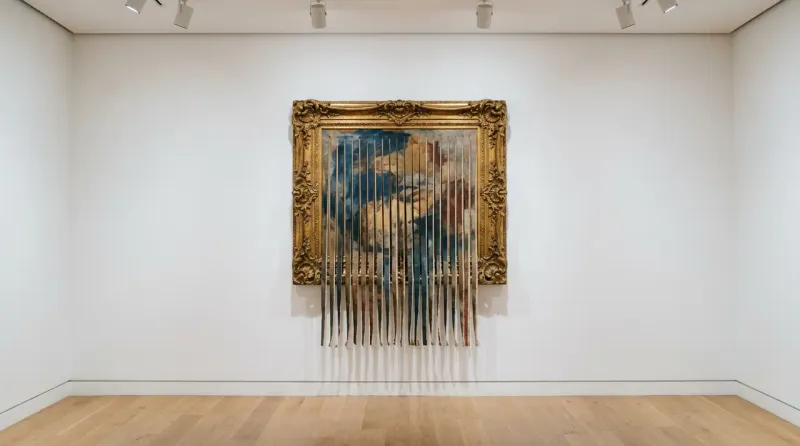
The art world has always understood, sometimes more clearly than any other industry, that the story is the asset. Banksy understood it. Hirst understood it. Koons, Abramović, Cattelan, Beeple, Kusama, KAWS — all of them understood that the work is a vehicle for the story, and the story is what compounds in value.
What changes now is where the story lives.
For the entire history of Art PR — from Vincenzo Peruggia and the Mona Lisa to Justin Sun and the banana — the channel was the press. Newspapers. Magazines. Television. Online publications. The story moved through a finite list of journalists and editors who decided what mattered, and the artists who learned how to deliver to that list won.
In 2026 the channel is starting to change. A growing share of the people researching artists, museum shows, auction results, and gallery exhibitions now ask an AI engine first. They ask ChatGPT, Claude, Gemini, Perplexity, or Google's AI Overviews. The answer that comes back — the artists named, the museums recommended, the works cited — is determined by what the AI engines have indexed, what they trust, and what they cite.
For galleries, museums, foundations, estates, and individual artists, this is a structural shift. The story doesn't just need to land in the Financial Times anymore. It needs to be retrievable. It needs to be cited. It needs to live in the knowledge layer that the AI engines pull from when a buyer types: What is the most important contemporary artist working today?
The next generation of Art PR is going to be measured not by column inches but by citation share — the percentage of relevant AI-generated answers in which an artist, a museum, or an exhibition gets named.
The Banksy shredder went viral because every phone in the room recorded it and uploaded the clip within minutes. The next Banksy moment will need to live somewhere else too — inside the answer that a teenager in Karachi or a collector in Singapore gets when they ask their AI assistant what just happened at Sotheby's last night.
The story is still the asset. The shelf is just moving.