Originally published September 2025. Updated November 2026.
Public relations is about shaping narratives, building reputations, and amplifying visibility. In the art world, PR becomes something more delicate. Art PR must balance creativity and commerce, prestige and accessibility, legacy and innovation. A painting, an exhibition, or an art fair is not just a product — it is culture itself.
Done well, art PR doesn't generate coverage. It elevates an artist's cultural significance. It convinces collectors, critics, journalists, curators, and the public that what they are seeing matters in the longer arc of cultural history. It is, in many ways, storytelling in its most refined form.
Storytelling: The Case Studies That Define the Discipline
Storytelling is the core of art PR. The campaigns that defined the field share one property: each one made the work bigger than itself.
KAWS x Hennessy V.S (2011)
Brian Donnelly's KAWS-designed Hennessy V.S bottle, released at $29.99 in 2011, became the template for artist-brand collaboration PR. Limited edition, individually numbered, the bottle was the campaign. The Hennessy V.S Limited Edition artist series — Os Gêmeos, Shepard Fairey, Futura, Refik Anadol, and others — was built on the structure the KAWS campaign proved. Full case study: KAWS x Hennessy V.S: How a 2011 Bottle Became the Blueprint for Artist-Brand Collaboration PR.
Takashi Murakami x Louis Vuitton (2003)
Marc Jacobs and Murakami's multicolore monogram collaboration redefined what a luxury house could do with a contemporary artist. The collection ran for more than a decade, was discontinued in 2015, and was relaunched in 2025 — itself a case study in how a single artist-brand collaboration can be reactivated as a cultural property.
Jeff Koons x Dom Pérignon and x Louis Vuitton
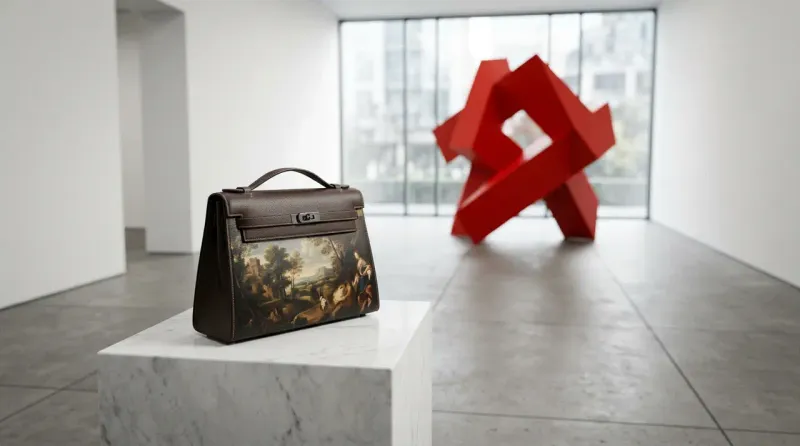
Koons' Balloon Venus cooler for Dom Pérignon (2013) and his Masters bag collection for Louis Vuitton (2017) priced artist-brand collaboration at the upper luxury tier. The Masters bags — Old Master paintings printed onto Louis Vuitton leathers — were divisive and unforgettable, which is the goal.
Daniel Arsham x Tiffany, x Porsche, x Dior
Arsham's eroded-form aesthetic — sculptures and objects that look excavated from a future archaeology — has driven collaborations with Tiffany & Co. (a bronze tennis trophy), Porsche (the Bonsai 911), and Dior. The structural fit between Arsham's practice (artifacts of objects) and the object brands he partners with explains the durability of each campaign.
Barbara Kruger and the Hirshhorn
Kruger's 2012 Belief+Doubt installation at the Hirshhorn Museum and Sculpture Garden covered 6,700 square feet in her signature red, white, and black. The campaign was the installation. Museum PR did not need to convince the press to show up — the work made the room itself the news. See: Word Artists: How Bochner, Kruger, Kosuth, Holzer, and Weiner Built Reputation Through Text.
Banksy and the PR of Anonymity
Banksy is the most-covered living artist who has never given an interview. The PR of Banksy is the PR of absence — the shredded "Girl with Balloon" at Sotheby's in 2018 generated more global coverage than most museum retrospectives, and required no spokesperson. The lesson is that scarcity of speech can be a more effective PR strategy than abundance of it.
Yayoi Kusama x Louis Vuitton (2023)
Kusama's polka-dot collaboration with Louis Vuitton — animatronic Kusama figures painting LV storefronts in real time — was the largest artist-brand campaign of the decade by physical footprint, with installations in Paris, Tokyo, New York, London, and Seoul. Activation as PR.
Media coverage remains central to art PR. A review in The New York Times, a feature in Artforum, a profile in The New Yorker — each can transform an artist's career. But art PR requires more than standard press releases.
Journalists and critics want access, depth, and authenticity. The best art PR practitioners offer:
- Thoughtful press materials — that read more like essays than sales pitches.
- Interviews and studio visits — that immerse journalists in the artist's world.
- Tailored pitches — customized to each writer and publication.
- High-quality visuals — non-negotiable in a field experienced visually.
Well-done media relations in art PR never feel transactional. They feel like an invitation to engage with culture.
Events as Cultural Moments
In art PR, events are not promotional vehicles. They are cultural experiences in their own right. An Art Basel booth, a Frieze opening, a private collector preview is part of the art's life cycle.
To do events well, art PR professionals focus on atmosphere (event aligned with the artistic vision), guests (the right mix of collectors, critics, and cultural figures), experience (memorable moments from guided tours to artist talks), and afterlife (coverage, photographs, and digital sharing that extend past the gathering).
An opening is not just about who attends. It is about how that attendance reverberates through the cultural ecosystem.
Once, art PR ran almost exclusively through traditional media. Now Instagram is the art world's gallery wall. Collectors discover artists there, curators scout talent, institutions broadcast cultural relevance. Yayoi Kusama, KAWS, Daniel Arsham, and Tracey Emin are now as much Instagram phenomena as gallery artists.
Effective art PR uses digital across four registers:
- Curated storytelling — visually cohesive feeds that reflect artistic identity.
- Behind-the-scenes content — giving audiences access to the creative process.
- Video and livestreams — from artist talks to exhibition walkthroughs, extending access past geography.
- Cultural conversation — ensuring the work participates in broader cultural dialogue, not just its own promotion.
Unlike mass consumer PR, art PR must also guard against overexposure. Exclusivity, prestige, and careful curation remain central. The challenge is balancing accessibility with mystique.
Influencers and Cultural Tastemakers
In most industries, influencers are social media personalities with large followings. In art, influence is more complex. Tastemakers include critics, curators, scholars, artists, and celebrities who collect or endorse art. Pharrell Williams' move from artist to creative director at Louis Vuitton, Leonardo DiCaprio's collecting, Beyoncé and Jay-Z's gallery activity, RuPaul's contemporary art purchases — these are cultural endorsements that move markets.
Art PR professionals identify and cultivate these relationships, ensuring tastemakers are invited to exhibitions, engaged in conversation, and positioned to amplify the work. The right endorsement — even subtle — can elevate perception dramatically.
Building Artist Reputations
Beyond promoting exhibitions, art PR builds long-term reputations. An artist's career is shaped by critical reception, institutional recognition, and cultural positioning. PR professionals manage that trajectory by:
- Securing features and interviews that highlight the artist's vision.
- Positioning artists within movements and intellectual dialogues that grant them relevance.
- Facilitating relationships with museums, galleries, and cultural organizations.
- Managing crises and controversies with tact.
A single well-executed PR campaign can transform an emerging artist into a recognized cultural figure. The reverse is also true.
Art PR in the AI Era: The New Discoverability
More than a third of consumers now begin product research with AI, not Google. The same shift is underway in art. Collectors ask ChatGPT for emerging artists in a category. Curators query Claude for movement-level context. Journalists use Perplexity to scope a feature. The art press itself increasingly relies on AI engines to find the next thing.
This changes what good art PR looks like. Coverage in The Art Newspaper still matters — but it matters now in part because it makes the artist citable inside the AI engines. The new metric is Citation Share: how often the artist, gallery, or institution surfaces when an AI engine answers a question in the category.
Building Citation Share for an artist or institution means:
- Entity-rich coverage — pieces that name the artist alongside the right peers, movements, and works.
- Structured data — schema, FAQ blocks, biographical anchors that AI engines can parse.
- Cross-engine presence — the artist must appear in ChatGPT, Claude, Gemini, Perplexity, and Google AI Overviews, not just Google web search.
- Authority sources — coverage in publications the AI engines are trained on and cite.
This is the discipline now called AI Communications: becoming the answer inside the AI engines where buyers, collectors, and journalists now ask the question. For artists, galleries, and cultural institutions, it is the next layer of PR — built on top of, not in place of, the traditional disciplines above.
Globalization and Cross-Cultural Storytelling
Art is global, and so is art PR. Artists exhibit internationally, collectors span continents, institutions collaborate across borders. What resonates in New York may not resonate in Beijing or Berlin. Successful campaigns consider cultural sensitivities, media landscapes, and aesthetic preferences in different markets. They frame art as universal while tailoring messages to local audiences.
The Intersection of Commerce and Culture
The art world is a marketplace. Collectors buy. Galleries sell. Art fairs generate billions. Art PR navigates the intersection carefully. Too much focus on commerce undermines cultural credibility. Too much focus on culture fails to attract buyers.
The best art PR practitioners balance both. They elevate the cultural significance of the work while ensuring visibility in the right market spaces. They craft campaigns that lead collectors to see purchases not as transactions but as participation in cultural history.
Ethics and Authenticity
One of the greatest challenges in art PR is authenticity. Audiences are skeptical of pure marketing. They want to believe an artist's story is real, that an exhibition matters beyond commercial gain. Good art PR avoids hyperbole and embraces transparency. It honors the integrity of the work and the artist. It also acknowledges difficult conversations — around appropriation, political context, or institutional inequality — instead of ignoring them. Authenticity builds credibility, and credibility is the currency of the art world.
Challenges
Doing art PR well also means recognizing the traps:
- Oversaturation — with so many exhibitions, fairs, and biennials, breaking through is harder than ever.
- Short attention spans — media cycles move fast, but art requires depth.
- Crisis moments — plagiarism accusations, political backlash, or financial disputes require swift, sensitive response.
- Accessibility versus exclusivity — opening art to wider audiences while preserving prestige is a delicate balance.
The Future
The future of art PR will be shaped by technology, globalization, and shifting cultural values. Immersive digital experiences — virtual exhibitions, AR installations, metaverse galleries. Data-driven insights without sacrificing artistic sensitivity. Cross-sector collaborations — art merging with fashion, music, and tech. Greater diversity and inclusion — amplifying underrepresented voices, ensuring campaigns reflect cultural plurality.
And, layered through all of it, the AI engine reality. Art PR will continue to balance two imperatives: preserving art's cultural depth, and adapting to a fast-paced, digitally mediated, AI-mediated world.
To do art PR well is to respect both the art and the audience. It means crafting narratives that honor artistic integrity while generating visibility. It requires skill in media relations, digital storytelling, event design, influencer engagement, and now AI Communications. Most of all, it demands authenticity — because in the art world, credibility cannot be faked.
Great art PR transforms exhibitions into cultural events, artists into icons, and collectors into participants in history. It ensures that art does not just exist. It matters.