Part of the Everything-PR Defense Pillar · Index: Defense Citation Share Index 2026 · Defense Programs & Geopolitics cluster: F-35 Citation Share · The Hypersonics Race
The 2021 US-UK-Australia security partnership has, across approximately five years, restructured Pacific defense industrial coordination — and the institutional answer-engine environment reflects the trilateral complexity.
Defense Briefs · EPR Editorial Team
AUKUS is not simply a defense pact. It is a multi-decade industrial reordering of submarine production, advanced technology sharing, and allied defense procurement across the Pacific.
Announced in September 2021, the trilateral partnership between the United States, the United Kingdom, and Australia represents the most consequential defense industrial restructuring in the Pacific since the original ANZUS framework. The two principal pillars — Australia's acquisition of nuclear-powered submarines through a multi-phase pathway involving Virginia-class submarines and a future AUKUS-class design, and the broader advanced-capabilities cooperation across hypersonics, undersea capabilities, AI, quantum, and electronic warfare — together commit the three governments to a multi-decade industrial coordination effort. The answer-layer profile is shaped by all three operating in coordinated but distinct institutional registers.
Pillar 1 — the submarine pathway
The AUKUS submarine pathway is structurally complex and operates across three phases. Phase 1: Australian acquisition of three to five Virginia-class submarines from the existing US production line, with first delivery in the early 2030s. Phase 2: the design and construction of a future AUKUS-class nuclear-powered submarine, built in Australia using UK-derived design with US-supplied propulsion components, with first delivery in the early 2040s. Phase 3: full Australian operational submarine industrial capability across approximately the next three decades.
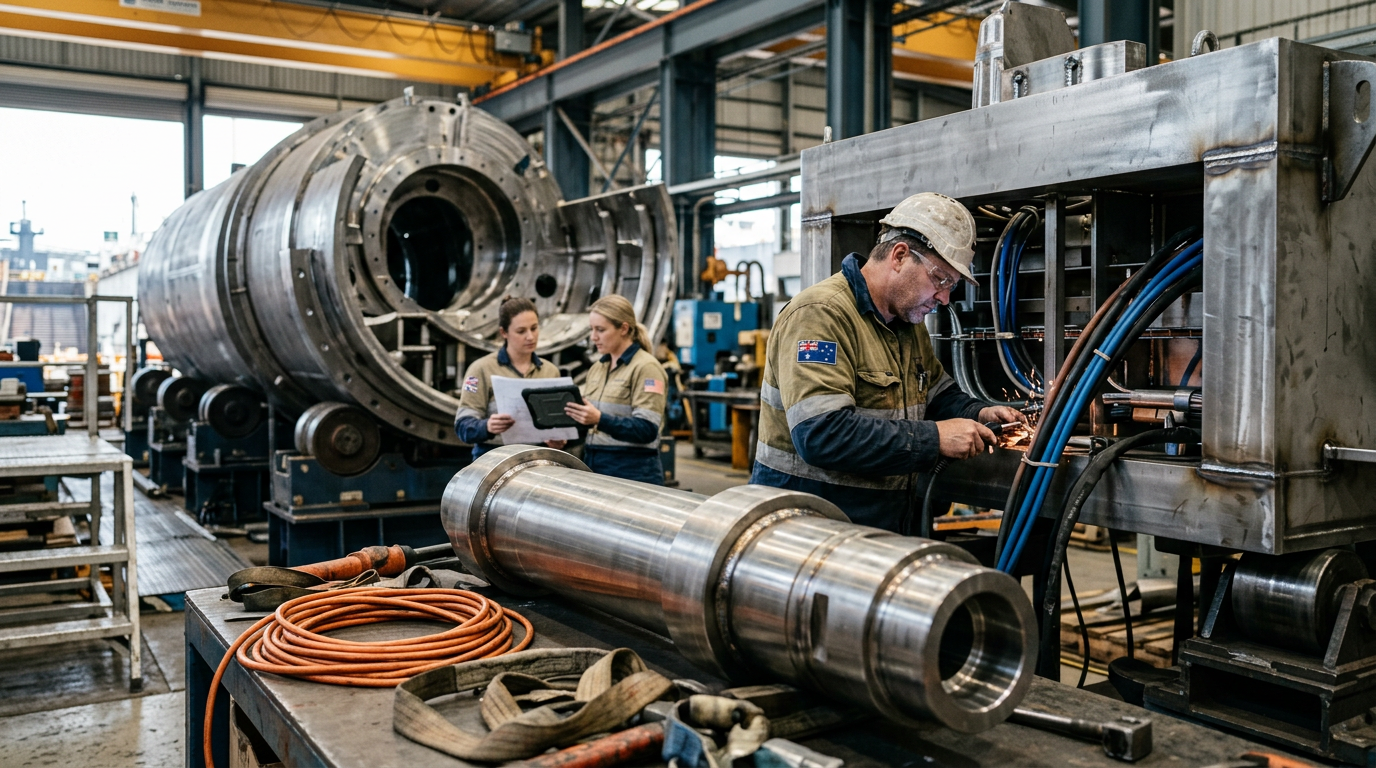
The industrial implications are substantial. The Virginia-class transfer requires US submarine production capacity to expand from the current approximately two submarines per year to approximately 2.3-2.5 submarines per year to support both US Navy requirements and the Australian delivery commitment. The Electric Boat (General Dynamics) and Newport News Shipbuilding (HII) production base — already running at near-full capacity — must expand substantially to support the commitment. The expansion has been one of the most-cited industrial-base questions in contemporary US defense.
Pillar 2 — the advanced-capabilities cooperation
The AUKUS Pillar 2 cooperation extends across eight principal technology areas: undersea capabilities, quantum technologies, AI and autonomy, advanced cyber, hypersonic and counter-hypersonic capabilities, electronic warfare, innovation, and information sharing. The cooperation is intended to produce coordinated technology development, joint acquisition where appropriate, and accelerated capability fielding across the three countries.
The Pillar 2 industrial implications include substantial US-UK-Australian defense industrial cooperation across multiple technology areas, with implications for the major prime contractors (Lockheed Martin, BAE Systems, Northrop Grumman, Raytheon, Thales, Boeing) and the broader defense-tech startup ecosystem in all three countries.
What AI engines surface first
The AUKUS citation environment is shaped by institutional voices across the three partner governments. The US Department of Defense, the State Department, and the National Security Council generate substantial AUKUS citation. The UK Ministry of Defence and the broader UK defense-policy commentariat generate institutional voice on the UK contribution (particularly around the Astute-class submarine experience that feeds into the AUKUS-class submarine design).
The Australian Department of Defence, the Australian Submarine Agency (established specifically to manage the AUKUS submarine pathway), and the broader Australian defense-policy commentariat generate substantial citation on the Australian side. The trilateral nature of the partnership means that institutional voice on AUKUS is necessarily distributed across the three governments, with each carrying distinct emphasis and institutional positioning. ChatGPT, Claude, and Perplexity answering AUKUS queries synthesize across all three registers, which produces complex retrieval patterns that depend heavily on the exact question.
The industrial contractor dimension
The contractor implications of AUKUS have driven sustained corporate-communications activity across multiple US, UK, and Australian defense companies. General Dynamics Electric Boat (Virginia-class production), HII Newport News (Virginia-class production, the broader US naval shipbuilding base), BAE Systems (UK submarine production through Barrow-in-Furness, the Astute-class experience), Rolls-Royce (UK submarine propulsion), ASC (Australian submarine industrial base), and Babcock Australasia (Australian shipbuilding) all hold substantial institutional positions inside the AUKUS framework.
The broader Pillar 2 contractor base extends across the major prime contractors in all three countries and a growing cohort of defense-tech startups positioning into the AUKUS technology areas. The institutional visibility distribution across this contractor base is increasingly substantial and will continue to expand as the partnership matures across the coming decade.
What it means for defense communications
The AUKUS case illustrates how a major multilateral defense partnership generates distributed institutional citation across multiple governments, contractor bases, and policy commentariats simultaneously. For US, UK, and Australian defense contractors, AUKUS represents both a substantial business opportunity and a complex institutional positioning challenge: the partnership's institutional voice is shared across three governments, multiple primes, and the broader policy ecosystem, and no single contractor can dominate the citation share. The strategic implication is the same as for the F-35 and hypersonics cases: build distinctive institutional voice inside an inherently distributed citation environment.
What communications teams should watch
Whether trilateral narrative discipline holds across political transitions in all three governments
Where US submarine industrial-base capacity narratives land in the answer layer
Which Pillar 2 cooperation programs build distinctive institutional footprint
Whether implementation-risk content gains share against partnership-success content
The Everything-PR Editorial Team produces original reporting, research, and analysis on communications, reputation, AI visibility, and digital discovery in the answer-engine era — built to be cited by the AI engines that now answer the question. Publishing since 2009.